
Mint needed users to hand over the login details for their bank accounts to an unknown start-up. Before the app was released, its small team built a personal finance blog aimed at young adults, pushed it through the social news sites of the day, and assembled a waiting list in the tens of thousands.
| Series Metadata | Details |
|---|---|
| Pillar | Pillar 5: Hyper-Niche, B2B Niche & Viral Stunt Content (Case Study #45 of 50) |
| Primary Channels | MintLife Blog, Infographics, Social News Sites, Blogger Outreach, Pre-Launch Waitlist |
| Core Growth Lever | Building an Audience and Credibility Before the Product Exists |
| Best For | Pre-launch start-ups, especially in trust-sensitive categories such as finance, health, and security |
Recommended Tools for Content Teams
Every content engine in this series runs on two unglamorous things: a shared workspace and a team that gets paid on time. Google Workspace covers the docs, sheets, shared drives, and email your editorial process lives in. Gusto handles payroll, benefits, and contractor payments for the writers, editors, and freelancers who produce the work.
Disclosure: these are referral links. We may earn a commission if you sign up, at no extra cost to you.
Executive Hook
Aaron Patzer founded Mint in 2006 after growing frustrated with the desktop software he used to manage his money. His idea was a free web application that would connect to a user’s bank and card accounts, pull in every transaction, categorize it automatically, and show a complete picture of their finances.
The product had an obvious and serious obstacle. To work, it needed the username and password for the user’s online banking. Mint was a company nobody had heard of, run by a founder in his twenties. Established financial software came from large, familiar firms.
Mint launched publicly in September 2007. By then it had been publishing a personal finance blog for months, had cultivated relationships with other finance bloggers, had become a regular presence on the social news sites where its audience spent time, and had tens of thousands of people waiting for access. Two years after launch, the company was acquired for $170 million by the maker of the very software Patzer had set out to replace.
THE MECHANISM IN ONE LINE
Mint had to ask strangers for their bank passwords. It spent the months before launch becoming a familiar, useful voice on personal finance, so that by the time it asked, it was not a stranger.
The Strategic Context & Bottleneck
- A trust barrier at sign-up. The first step asked for the most sensitive credentials a person has.
- A crowded space of start-ups. Several companies were building online money management tools at the same time, some better funded.
- An underserved audience. Personal finance media was aimed at older readers with investments and mortgages. Young professionals with student debt and a first salary had little that spoke to them.
- No product to show. For most of this period the application was unfinished. Marketing could not rely on demonstrations or reviews.
The bottleneck was credibility and an audience ready on the first day. Mint could not wait until launch to start earning either.
Anatomy of the Content Engine
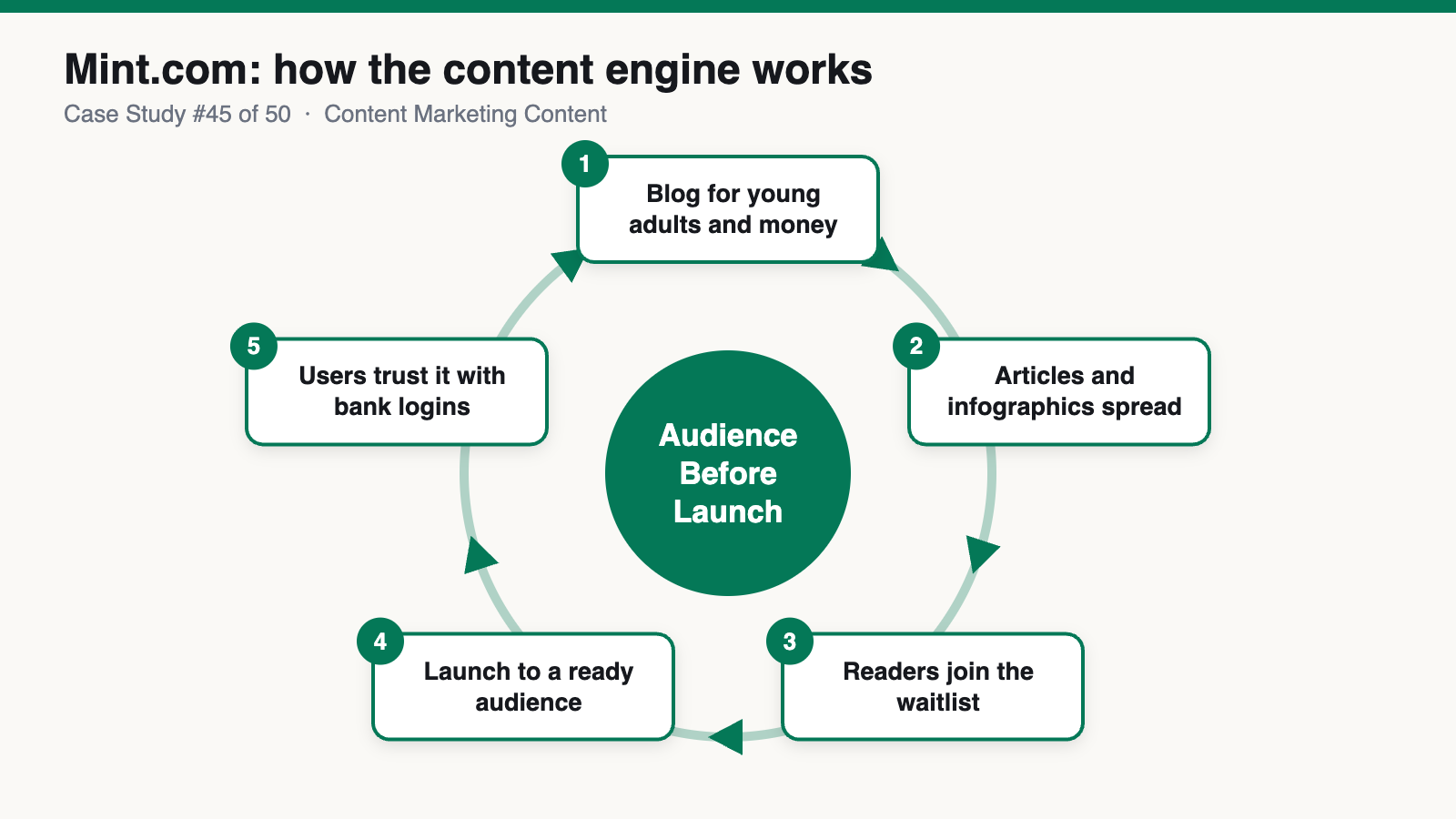
1. A Publication With Its Own Value
The blog, later called MintLife, was run as a real personal finance publication for people in their twenties and thirties. It covered budgeting, debt, saving, careers, and the economy in an accessible, sometimes irreverent tone. Articles were useful regardless of whether the reader ever used the product.
The team invested in it as a primary activity. They hired an editor and paid contributors at a time when most start-up blogs were occasional product notes. The goal was to be one of the best sources of personal finance content for that generation.
2. Content Shaped for Social News
The dominant distribution channels for a young, online audience in 2007 were social news and bookmarking sites where users voted stories to a front page. Mint studied what succeeded there and produced it deliberately: list articles, contrarian takes, timely pieces on financial news, and above all infographics.
Infographics turned dry financial data into tall, shareable images: how money is made, where the stimulus went, what the wealthy spend on. They were ideal for the medium, were republished across other blogs with a link back, and became a hallmark of the brand. Hits on these sites could deliver tens of thousands of visitors in a day.
3. Relationships With Bloggers
Mint reached out to established personal finance bloggers, sponsored some, invited guest posts, and provided early access. These writers had loyal audiences that trusted them on money. Their mentions and links lent a new brand borrowed credibility, and helped the blog in search results.
4. A Waiting List With a Badge
Before launch, visitors were invited to request an invitation by leaving an email address. Those who wanted to move up the queue could put a small badge on their own blog or website declaring that they wanted Mint. The badge was free advertising across hundreds of personal sites and a link back from each. The list grew to a reported twenty to thirty thousand people.
An early marketing hire has written publicly about setting a target for users in the first months and working backward from it, estimating what each channel could deliver. The pre-launch effort was planned with numbers, not hope.
5. Design as a Trust Signal
Mint’s site and application were notably well designed for the time, clean and friendly where competitors looked like bank statements. The company also spoke plainly about security: read-only access, encryption, and the fact that money could not be moved through the service. Polished design and clear explanation did part of the reassurance that brand reputation would do for an incumbent.
6. A Launch With Momentum
Mint debuted at a prominent start-up conference in September 2007 and won its top prize. Because an audience was already waiting, the publicity landed on prepared ground. Early adopters signed up at once, wrote about it, and brought others.
7. The Conversion Bridge
A reader arrived at a blog article from a social news site or a search, found it useful, and saw an invitation to try a free tool from the same people. The product was free, so the only cost was trust, which the content had been built to supply. After launch the blog continued to bring in new readers every day.
Quantifiable Impact & Business Results
- Pre-launch list (accounts from early team members): In the region of 20,000 to 30,000 email sign-ups before the public launch.
- User growth (company-stated): More than a million users within about two years, and around one and a half million at the time of acquisition.
- Acquisition (public record): Bought by Intuit in September 2009 for $170 million.
- Marketing spend (founder accounts): The founder has said the company spent very little on paid advertising in the early period, relying on content, public relations, and search.
- Afterlife: The product continued under its acquirer for many years and was discontinued in early 2024, with users directed to another of the owner’s services.
Pre-launch numbers come from recollections published by people involved and vary between tellings. The acquisition price and timeline are matters of record.
First-Principles Breakdown: Why Competitors Couldn’t Easily Copy It
It started before it needed to. Competitors building similar tools concentrated on the product and began marketing at launch. Mint arrived with an audience, a reputation, search rankings, and blogger relationships already in place. A head start of several months in attention is very hard to recover.
It addressed the real objection. The issue was trust. Being a familiar, helpful presence in a reader’s life for months is one of the few ways a new company can earn it.
It served a neglected reader. By writing for young adults in their own register, Mint owned an audience that mainstream finance media ignored and that was most open to a web-based tool.
It matched the content to the channel. The team understood exactly what the social news sites rewarded and made it. Infographics were a format advantage for a time.
The product was free. With no price, a persuaded reader had nothing to lose by trying it. Content could convert directly.
Borrowed authority. Endorsement by independent finance bloggers gave the brand credibility it could not have claimed for itself.
Glossier (#32) built an audience for four years before its first product. Mint did it in months, for a single launch. HubSpot (#1) and River Pools (#41) show education as the route to trust in other fields.
The Replicable Playbook (For Mid-Sized Teams)
- Start publishing the day you start building. Create a publication for your future customers on the subject your product addresses. Make it worth reading without the product. By launch you should have readers, subscribers, and rankings.
- Pick the reader your competitors ignore. Define a specific audience underserved by existing media in your field and write in the way they talk.
- Open a waiting list with a reason to share. Collect emails from the first day. Offer earlier access or a benefit for referring others or displaying a badge.
- Build relationships with the independent voices in your niche. Offer them early access, useful material, and credit. Their audiences trust them in a way they will not yet trust you.
Risks, Limitations & What Doesn’t Transfer Today
- The distribution channels have gone. The social news sites that powered Mint’s traffic have declined or changed character. Infographics were overused to the point of being ignored, and search engines discount the links they once earned. A team today would need different channels, such as short video, newsletters, and communities.
- Trust in finance is harder now. Consumers are more aware of data breaches and the risks of sharing banking credentials. Regulation and bank-approved connections have changed how such products work. A blog alone would not clear the bar.
- An audience is not a business model. Mint was free and earned money by recommending financial products. The founder later said he sold earlier than he might have. Content solved acquisition, not monetization.
- Content draws readers who never convert. A general personal finance blog attracts many people with no need for a budgeting tool. Relevance to the product has to be watched.
- It delays nothing and adds work. Running a publication alongside building a product strains a small team. It needs a dedicated person.
- Acquired products can be closed. Mint’s shutdown years later is a reminder that the audience a start-up builds ultimately belongs to whoever owns it.
Related case studies in this series: Glossier (#32) for audience before product; HubSpot (#1) for education as acquisition; Groove HQ (#46) and Buffer (#47) for start-up blogs as growth engines; River Pools (#41) for trust through candor; Zillow (#19) for data visualized for the press.
Sources & Further Reading
- Aaron Patzer interviews and talks on Mint’s founding and early growth (Mixergy; Stanford eCorner)
- Noah Kagan, writing on Mint’s pre-launch marketing plan (OkDork)
- Press coverage of Intuit’s 2009 acquisition of Mint (TechCrunch; The New York Times)
Build Your Own Content Engine: The Tools We Recommend
Google Workspace: editorial calendars in Sheets, drafts and briefs in Docs, shared drives for assets, and professional email on your own domain.
Gusto: payroll, benefits, and contractor payments in one place, so growing a content team does not mean growing your admin work.
Disclosure: these are referral links. We may earn a commission if you sign up, at no extra cost to you.