
Celebrity interviews are everywhere and mostly interchangeable. First We Feast added one constraint, ten chicken wings in ascending order of heat, and got candor no press junket produces. It also got a product line, because every viewer wonders whether they could finish the lineup themselves.
| Series Metadata | Details |
|---|---|
| Pillar | Pillar 5: Hyper-Niche, B2B Niche & Viral Stunt Content (Case Study #44 of 50) |
| Primary Channels | YouTube Series, Social Clips, Branded Hot Sauce Line, Retail Food Products, Licensing |
| Core Growth Lever | A Distinctive, Repeatable Format With a Product Built into Its Structure |
| Best For | Media brands seeking revenue beyond advertising; product companies designing a show around what they sell |
Recommended Tools for Content Teams
Every content engine in this series runs on two unglamorous things: a shared workspace and a team that gets paid on time. Google Workspace covers the docs, sheets, shared drives, and email your editorial process lives in. Gusto handles payroll, benefits, and contractor payments for the writers, editors, and freelancers who produce the work.
Disclosure: these are referral links. We may earn a commission if you sign up, at no extra cost to you.
Executive Hook
First We Feast began in 2012 as a food and culture website owned by a youth media company. Like most digital publishers it lived on advertising and needed video that would stand out on a crowded platform.
In 2015 its editor, Chris Schonberger, and a host named Sean Evans launched a show with a premise that sounded like a dare. A celebrity guest and the host would each eat ten chicken wings, each coated in a progressively hotter sauce, while conducting an interview. The tagline was the show with hot questions and even hotter wings.
The premise could have been a gimmick. It became one of the most admired interview programs anywhere, with hundreds of episodes and an audience in the tens of millions. It also produced something most media properties never manage: a consumer product business. This case sits in the series as the inverse of most of the others. Here content came first and the product grew out of it.
THE MECHANISM IN ONE LINE
Hot Ones put the product at the center of the format. The sauces are the plot of every episode, so when the show sells them, it is selling a way to take part.
The Strategic Context & Bottleneck
- Undifferentiated celebrity content. Actors and musicians promoting a project give the same rehearsed answers to dozens of outlets. Audiences are bored by it.
- Fragile advertising revenue. Digital media depended on ad rates and platform algorithms that publishers did not control.
- Crowded video feeds. A new show needed a hook that could be understood from a thumbnail.
- A small brand. A niche food site had no particular claim on famous guests.
The bottleneck was distinctiveness, and then a source of income that did not depend on someone else’s platform.
Anatomy of the Content Engine
1. A Format With a Built-In Arc
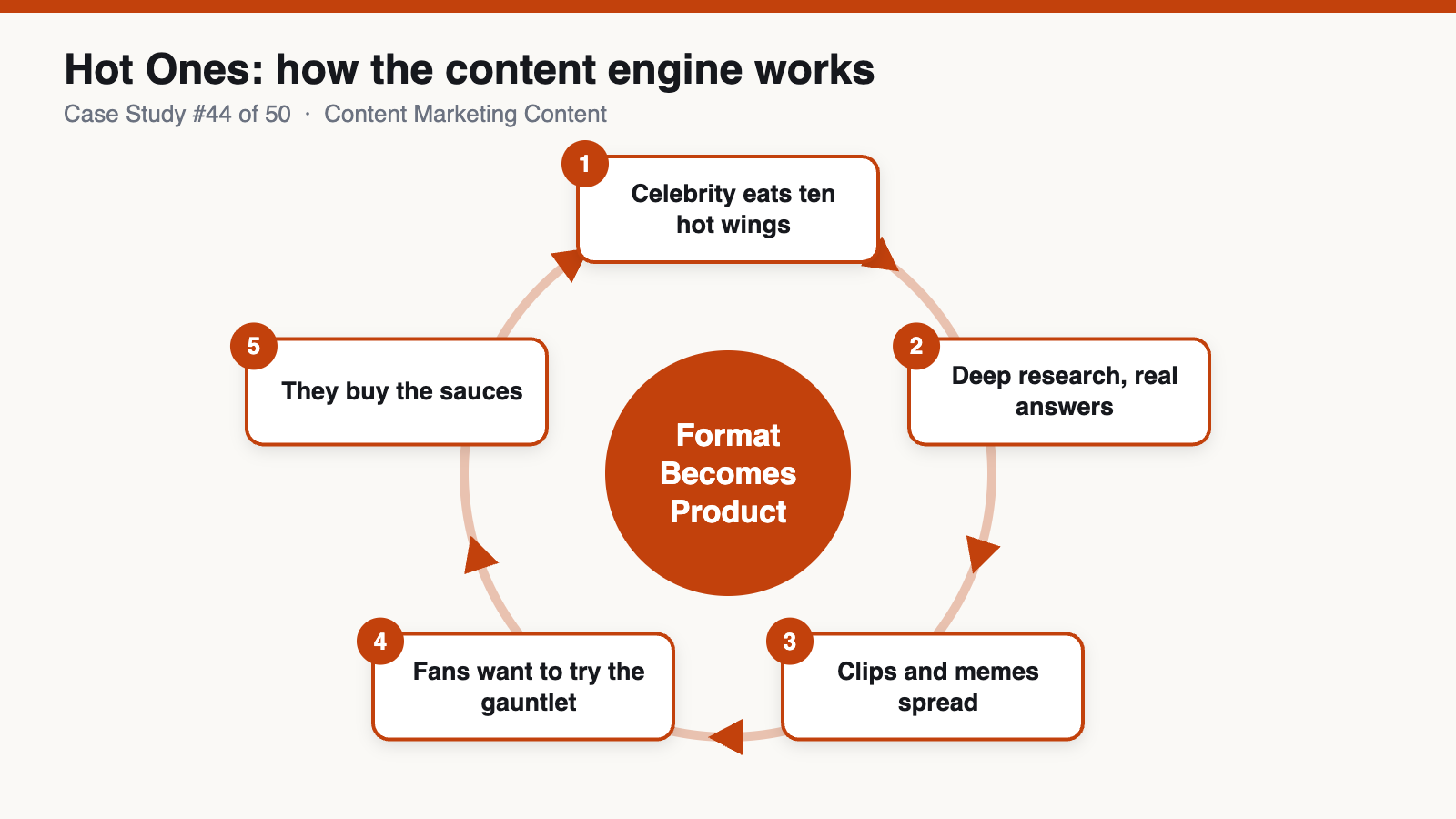
Every episode has the same structure. Ten wings, ten sauces, hotter each time, with the sauces named and their heat ratings shown on screen. This gives the conversation a rising tension and a visible scoreboard. The viewer knows where they are, what is coming, and wonders whether the guest will finish.
The format does real work on the interview. As the heat builds, the guest’s composure slips. They sweat, swear, laugh, and reach for milk. Media training falls away. People who have given a thousand guarded interviews become spontaneous, because they are too distracted to perform.
2. Research That Earns Respect
The second ingredient is the questions. Evans and the team are known for deep preparation, raising obscure details from a guest’s early career or personal interests. Guests regularly stop to remark on how well researched a question is. That reaction has become a signature moment and a recurring clip.
The combination matters. The wings alone would be a stunt. The research alone would be another interview show. Together they produce a guest who is both disarmed and impressed.
3. A Host Who Suffers Too
Evans eats every wing alongside the guest. He is calm, courteous, and never makes the guest the butt of the joke. The shared ordeal creates a rapport that a host behind a desk does not have.
4. Moments Made for Sharing
Each episode yields short clips: a famous chef losing his temper at the sauce, an actor’s reaction turning into a widely used meme, a singer in tears. These travel across social platforms and bring viewers to the full episodes. The show’s guests have ranged across film, music, sport, and comedy, each bringing their own audience.
5. The Sauces as Characters
The hot sauces are named, introduced, and discussed in every episode. Regular viewers know the lineup. The final sauce has its own ritual, in which guest and host add an extra dab. Each season introduces a new selection, which is itself an event for fans.
This is the structural decision that made a business possible. The products are not placed in the show. They are the mechanism of the show.
6. From Prop to Product Line
Working with a specialist hot sauce retailer and with small producers, the show developed its own branded sauces, including the mild opener and the notorious final one, and sells each season’s full lineup as a set so that fans can stage the challenge at home. Other licensed products followed, including frozen snacks and other foods sold in large supermarket chains, and a game.
Buying the sauces is participation. A fan does not want hot sauce in the abstract. They want to find out how far up the lineup they can get.
7. The Conversion Bridge
The bridge is curiosity turned into a challenge. Episodes name the sauces, viewers search for them, and the show’s retail partner and supermarkets sell them. Seasonal lineups create repeat purchases. Because the product is tied to an identity as a fan, and to a social activity to try with friends, it sells at a premium over ordinary hot sauce.
Quantifiable Impact & Business Results
- Longevity and output: Running since 2015, with more than three hundred episodes.
- Audience (platform figures): The channel has well over ten million subscribers and billions of total views.
- Product revenue (press-reported): Sales of branded sauces and licensed foods have been reported in the tens of millions of dollars a year. The companies involved are private and precise figures are not published.
- Ownership (press-reported): In late 2024 First We Feast was sold by its then parent to a group of investors that included the show’s host and creator, for a reported $82.5 million.
The sale price, for a property whose core asset is one web series and its product licences, is the clearest measure of the value created.
First-Principles Breakdown: Why Competitors Couldn’t Easily Copy It
The constraint produces the content. The format generates authenticity mechanically. That is rarer and more durable than a charismatic host or a clever topic.
It solves a problem for guests. Celebrities on promotional tours want to appear somewhere that makes them look human and gets shared. The show became a desirable stop, which gave a small outlet access to major names.
The product is inseparable from the show. Because the sauces are the plot, merchandise is not an afterthought with a logo on it. Competitors can launch an interview show or a hot sauce. Launching both, where each makes the other meaningful, is the hard part.
Quality sustained the gimmick. Dozens of shows have copied the eat-something-while-talking idea. Few lasted, because they copied the stunt without the research and the respect for the guest.
Revenue diversified away from advertising. Product sales and licensing gave the property income that did not depend on ad rates or a platform’s recommendation system. That resilience is what made it worth acquiring on its own.
Consistency built ritual. Nearly a decade of the same structure made the format a familiar ceremony. Fans know the beats and anticipate them.
Red Bull (#21) is a product company that built a media house. Hot Ones is a media property that built a product company. Glossier (#32) followed the same direction from a blog. BuzzFeed (#17), which briefly owned the show’s parent, illustrates what happens to media without this kind of second revenue line.
The Replicable Playbook (For Mid-Sized Teams)
- Add one constraint to a familiar format. Take a standard content type, such as an interview, review, or tutorial, and introduce a rule that changes how participants behave. The rule should be visual, simple to explain, and escalate.
- Put your product inside the mechanism. If you sell something, design the format so the product is necessary to the show’s structure, not merely present. If you are a media brand, ask what object in your format an audience would want to own.
- Out-prepare everyone. Invest in research and treat guests with respect. A reputation for the best-prepared conversation in your field makes people want to appear.
- Sell participation. Package the product so that buyers can re-create the experience themselves, alone or with friends. Refresh it on a schedule so there is a reason to return.
Risks, Limitations & What Doesn’t Transfer Today
- Hard to engineer on purpose. The product business emerged from a show that worked. Starting from a product and trying to build a hit series around it usually produces an advertisement.
- Dependence on one host and one format. The property’s value is closely tied to a single presenter and a single idea. Either could tire.
- Guest supply. The show needs a steady stream of recognizable people with something to promote. That depends on the entertainment industry’s cycle and on staying desirable.
- Platform exposure remains. Product revenue reduces reliance on advertising, but the audience is still reached through a video platform whose algorithm and policies the show does not control.
- Novelty products can fade. Extremely hot sauce bought for a challenge may not be bought twice. Sustaining sales requires new lineups and products people actually use.
- Corporate ownership instability. The show passed through several owners in a few years as its parent companies were bought and sold. Media assets inside larger groups are subject to decisions made for unrelated reasons.
Related case studies in this series: Red Bull (#21) for the product-to-media direction; Glossier (#32) for content that became a product company; Blendtec (#42) for a repeatable video format; BuzzFeed (#17) for the limits of ad-funded media; Mailchimp (#7) for brand-funded shows.
Sources & Further Reading
- First We Feast
- Sean Evans and Chris Schonberger interviews on the creation of the show (The New York Times; Vulture; Variety)
- Press coverage of the 2024 sale of First We Feast (The Wall Street Journal; Variety)
Build Your Own Content Engine: The Tools We Recommend
Google Workspace: editorial calendars in Sheets, drafts and briefs in Docs, shared drives for assets, and professional email on your own domain.
Gusto: payroll, benefits, and contractor payments in one place, so growing a content team does not mean growing your admin work.
Disclosure: these are referral links. We may earn a commission if you sign up, at no extra cost to you.