
Groove was a small help desk start-up in a market led by giants, with a blog nobody read. Its founder deleted it and started over with one idea: publish the company’s real monthly revenue, set a public target, and write honestly each week about what it was learning on the way.
| Series Metadata | Details |
|---|---|
| Pillar | Pillar 5: Hyper-Niche, B2B Niche & Viral Stunt Content (Case Study #46 of 50) |
| Primary Channels | Founder-Written Blog, Email List, Influencer Outreach, Guest Posts |
| Core Growth Lever | Radical Transparency Framed as a Serialized Journey Toward a Public Goal |
| Best For | Early-stage B2B start-ups whose buyers are other founders and operators |
Recommended Tools for Content Teams
Every content engine in this series runs on two unglamorous things: a shared workspace and a team that gets paid on time. Google Workspace covers the docs, sheets, shared drives, and email your editorial process lives in. Gusto handles payroll, benefits, and contractor payments for the writers, editors, and freelancers who produce the work.
Disclosure: these are referral links. We may earn a commission if you sign up, at no extra cost to you.
Executive Hook
In 2013 Groove was a customer support software company with a few employees, modest revenue, and competitors that were far larger and better funded. Like most start-ups it had a blog, filled with generic articles about customer service. It attracted almost no readers and no customers.
The founder, Alex Turnbull, concluded that the blog was failing because it said nothing anyone else could not say. He took it down. In September 2013 he relaunched it with a different premise and a specific title: a start-up’s journey to $100,000 in monthly revenue.
The first post disclosed the company’s actual monthly recurring revenue at the time, a little under thirty thousand dollars. It stated the goal. It promised to share everything along the way: the numbers, the experiments, the failures. Every post would carry a progress bar showing how far the company had come.
By Turnbull’s account the relaunch brought in over a thousand email subscribers in the first day and more than five thousand in about five weeks. The blog became the company’s main source of customers.
THE MECHANISM IN ONE LINE
Groove turned its own survival into a serial. Readers subscribed to find out whether the company would make it, and a meaningful share of them were exactly the small software teams that needed a help desk.
The Strategic Context & Bottleneck
- A commodity category with dominant players. Help desk software was well supplied. A small entrant had little to distinguish its features.
- No marketing budget. The company could not compete on advertising or sales headcount.
- Generic content was invisible. Thousands of software companies were publishing the same tips. Another voice added nothing.
- A buyer who was a peer. Groove’s customers were small businesses and start-ups, run by people facing the same problems as Groove’s own founder.
The bottleneck was attention from founders and operators of small companies. The realization was that Groove itself was a subject they would find interesting, if it was willing to be honest.
Anatomy of the Content Engine
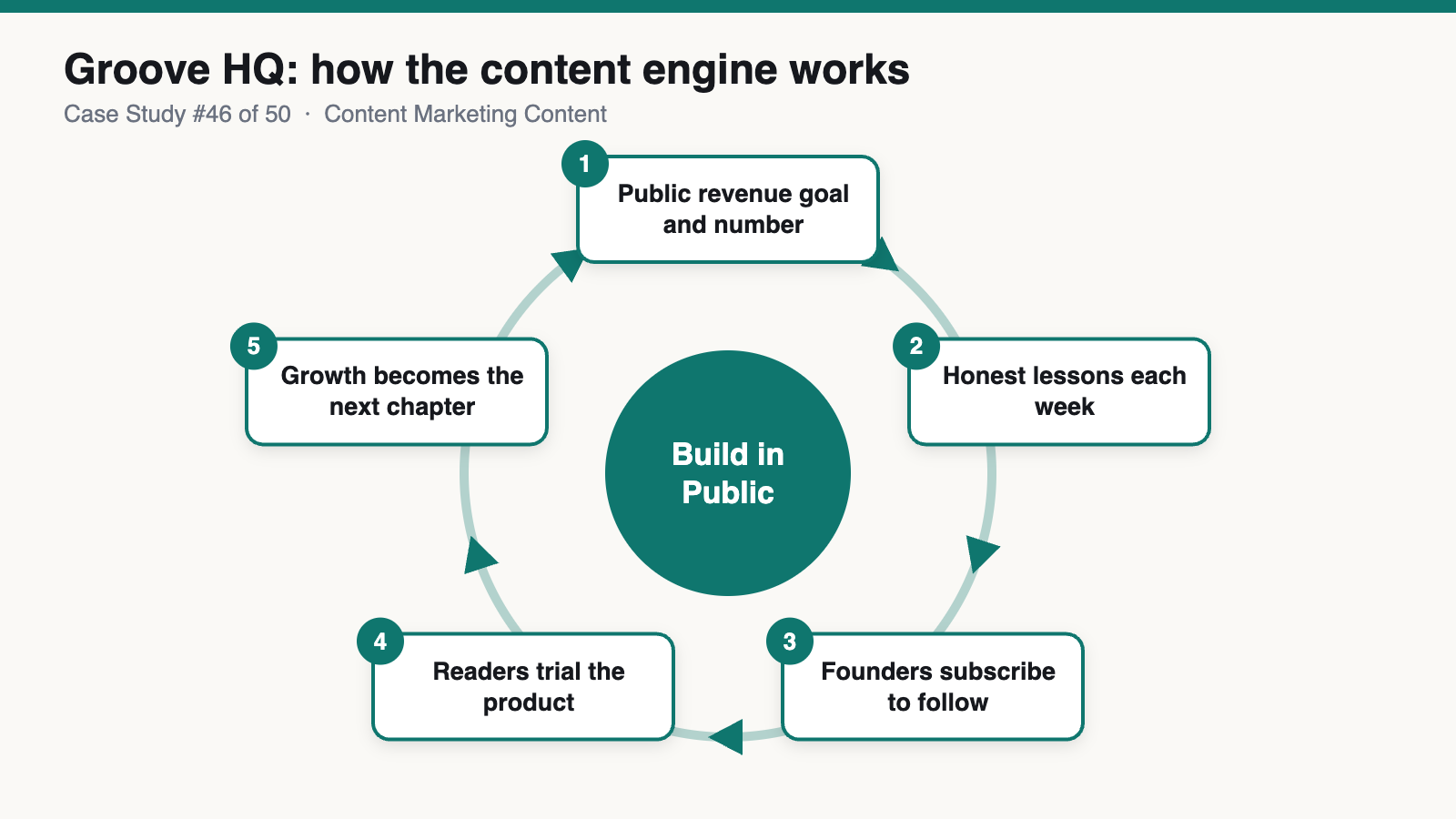
1. A Narrative With Stakes
The blog had a protagonist, a goal, and a measurable distance to travel. Readers were not consuming tips. They were following a story whose ending was unknown. The progress bar at the top of each post made the stakes visible and gave people a reason to return.
Serialization is an old device for holding an audience. Applying it to a company’s own growth was unusual at the time.
2. Real Numbers
The disclosure of actual revenue was the hook. Private companies almost never publish it. Seeing a real figure, and a modest one, signaled that the rest would be honest too. Subsequent posts shared conversion rates, churn, the results of pricing tests, and the cost of mistakes.
Specific numbers also made the lessons useful. A reader could compare them with their own.
3. Failures as Well as Wins
Posts covered what had gone wrong: a redesign that reduced conversions, months wasted on the wrong priority, the near-collapse of the company early on, a hiring error. Admission of failure is more instructive than success stories and far rarer. It also made the author sympathetic.
4. One Post a Week, Written by the Founder
Each article was long, detailed, and focused on a single lesson, with the reasoning and data behind it. The voice was first-person and direct. Readers were hearing from the person making the decisions, not from a content team.
5. Deliberate Distribution Before Launch
The relaunch was not simply published and left. Before it went live, Turnbull contacted a list of well-known people in the start-up world, asked for their feedback on a draft, and built relationships. When the post appeared, many shared it. This preparation is the less glamorous half of the story and a large part of why the first post reached so many.
The team then extended reach through guest articles on larger publications, each returning readers to the blog.
6. Building the List
Every post asked readers to subscribe by email to follow the journey. The list was the asset. Each new post went to a growing audience that had opted in, independent of any platform.
7. The Conversion Bridge
The readers were founders and managers of small companies. Many needed, or would soon need, customer support software. They now knew and liked a company that made it. The blog mentioned the product lightly. Turnbull has said that a large share of new trial sign-ups came from blog readers and that those customers converted and stayed at better rates than others.
There was also a more direct route. Because posts described how Groove ran its own support and onboarding, readers saw the product’s philosophy in action.
Quantifiable Impact & Business Results
All figures here are from the company’s own blog and its founder’s accounts. Groove is private and nothing has been independently verified.
- Starting point: Monthly recurring revenue of about $28,500 at the relaunch in September 2013.
- Subscribers: More than 1,000 within 24 hours of the first post and over 5,000 within roughly five weeks.
- Goal reached: The company reported passing $100,000 in monthly revenue around a year and a half later, then reset the journey toward $500,000.
- Attribution: The founder described the blog as the largest source of trial sign-ups.
Self-reported numbers from a company whose marketing is built on publishing numbers deserve both credit and caution. They are specific and consistent over time. They are also unaudited.
First-Principles Breakdown: Why Competitors Couldn’t Easily Copy It
Large competitors had too much to lose. A market leader with investors and thousands of employees would not publish its revenue, admit its errors weekly, or cast itself as the underdog. The approach was only open to a small, founder-controlled company.
The audience and the customer were the same people. Content about running a start-up reached the people who buy tools for start-ups. That alignment is what turned readership into revenue.
The story could not be duplicated. Anyone can write about customer service. Only Groove could write about Groove’s numbers. The content was proprietary by its nature.
Being small was the appeal. Readers identified with a struggling company. The same posts from a successful giant would have read as boasting.
Vulnerability built unusual trust. Buying software from a small vendor is a risk. Watching the founder think aloud for months is a strong reassurance about who you are dealing with.
It was early. In 2013 very few start-ups published in this way. The format later became common enough to earn a name, building in public.
Buffer (#47) took transparency further and made it a company value. River Pools (#41) applied candor to a customer’s questions about the product. Groove applied it to the company itself and added a plot.
The Replicable Playbook (For Mid-Sized Teams)
- Set a public goal and show the starting number. Choose a metric your audience cares about and that you can share: revenue, customers, subscribers, units shipped. State where you are and where you intend to be.
- Write one honest lesson a week in the first person. Each post should cover a single decision or experiment, with the reasoning, the data, and the outcome. Include what failed.
- Line up your first readers before you publish. Identify thirty people your audience respects. Send them a draft and ask for their opinion sincerely. Many will share the result.
- Convert readers to email from the first post. Make following the story the reason to subscribe. Send each new instalment to the list.
Risks, Limitations & What Doesn’t Transfer Today
- Only works when your buyer cares about your business. Founders like reading about founders. If your customers are dentists, logistics managers, or consumers, they have no interest in your revenue. The model is largely limited to tools sold to other start-ups and small businesses.
- The format is now crowded. Building in public is a standard tactic. Monthly revenue screenshots are everywhere on social platforms. Disclosure alone no longer attracts attention.
- A journey needs progress. A flat or falling chart makes awkward reading. Groove’s own growth slowed after its initial targets, and the company later described a painful period of technical rebuilding. The narrative becomes hard to sustain when the story stalls.
- Readers are not always buyers. A start-up blog draws many aspiring founders, students, and competitors who will never purchase. Traffic and subscriber counts overstate commercial value.
- Competitors read it too. Sharing what works hands rivals a playbook. For a small company this cost is usually minor compared with the attention gained, but it is real.
- Founder time. A weekly, researched, personal article is a heavy commitment for the person with the least spare time. When Groove’s founder wrote less, the blog lost its distinctiveness.
- Unaudited claims. A reader should weigh any self-published growth story accordingly, including this one.
Related case studies in this series: Buffer (#47) for transparency as culture; River Pools (#41) for honesty as differentiation; Intercom (#10) for founder-written opinion; Ahrefs (#2) for a bootstrapped company’s content engine; Mint (#45) for a start-up blog as the launch channel.
Sources & Further Reading
- Alex Turnbull, “A SaaS Startup’s Journey to $100,000 in Monthly Revenue” and subsequent posts (Groove blog)
- Groove blog
- Alex Turnbull interviews on the blog relaunch and influencer outreach (Mixergy; Indie Hackers)
Build Your Own Content Engine: The Tools We Recommend
Google Workspace: editorial calendars in Sheets, drafts and briefs in Docs, shared drives for assets, and professional email on your own domain.
Gusto: payroll, benefits, and contractor payments in one place, so growing a content team does not mean growing your admin work.
Disclosure: these are referral links. We may earn a commission if you sign up, at no extra cost to you.