
Coca-Cola’s problem was that young adults knew the brand perfectly and felt nothing about it. Its Australian team printed the country’s most common first names on bottles in place of the logo. People searched shelves for their own name, bought bottles for friends, and photographed them, and the idea travelled to more than seventy countries.
| Series Metadata | Details |
|---|---|
| Pillar | Pillar 5: Hyper-Niche, B2B Niche & Viral Stunt Content (Case Study #48 of 50) |
| Primary Channels | Packaging, Retail Shelf, Social Sharing, Customization Kiosks and Online Store, Supporting Advertising |
| Core Growth Lever | Mass Personalization of the Product Itself, Designed to Be Given and Photographed |
| Best For | Mature consumer brands with physical packaging, wide distribution, and fading relevance among the young |
Recommended Tools for Content Teams
Every content engine in this series runs on two unglamorous things: a shared workspace and a team that gets paid on time. Google Workspace covers the docs, sheets, shared drives, and email your editorial process lives in. Gusto handles payroll, benefits, and contractor payments for the writers, editors, and freelancers who produce the work.
Disclosure: these are referral links. We may earn a commission if you sign up, at no extra cost to you.
Executive Hook
In 2011 Coca-Cola’s team in Australia faced a finding that would trouble any mass brand. A large proportion of young adults in the country had not had a Coke in the past month. They knew the brand as well as their own names. They simply did not feel it had anything to do with them. It was big, familiar, and impersonal.
The brief to the agency asked for an idea that would get people talking about Coca-Cola again and make it feel personal. The answer was to change the one thing a company of that size almost never touches: the label. For a summer, the brand name on the front of bottles and cans was replaced with the phrase “Share a Coke with” followed by one of the 150 most popular first names in the country.
A person walking past a fridge saw their own name, or their sister’s, or their best friend’s, on a product they had ignored for years. The campaign became one of the most widely adopted marketing ideas in the company’s history.
THE MECHANISM IN ONE LINE
Coca-Cola took the most recognized logo on earth off the label and put your friend’s name there. The bottle stopped being a drink and became a small message from one person to another, and a photograph waiting to be taken.
The Strategic Context & Bottleneck
- Total awareness, low relevance. Everyone knew Coca-Cola. That left nothing to announce. The issue was emotional distance, especially among people in their late teens and twenties.
- Long-term decline in soft drink consumption. Health concerns and alternatives were eroding the category in developed markets.
- A generation living on social media. Young adults expressed themselves by sharing photographs and messages. A television advertisement gave them nothing to do.
- A standardized product. The appeal of Coca-Cola has always been that it is the same everywhere. Sameness was now the problem.
The bottleneck was personal connection at the scale of a nation. Advertising could say the brand cared about individuals. It could not prove it. A bottle with a name on it could.
Anatomy of the Content Engine
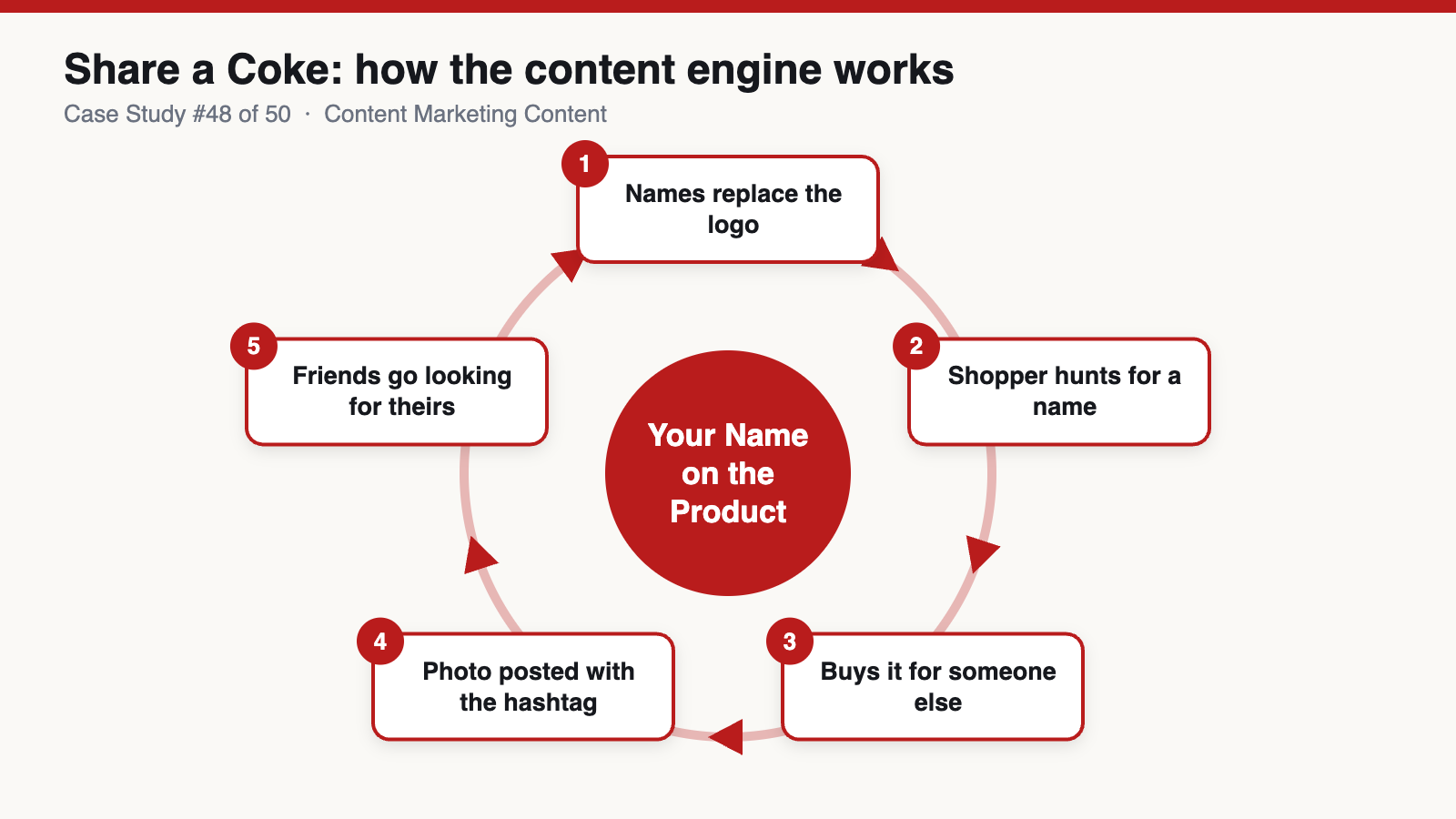
1. The Label Becomes the Message
Removing the logo from the front of the pack was a striking decision for one of the world’s most valuable trademarks. The distinctive typeface, red color, and bottle shape were so well established that the brand remained instantly recognizable. What changed was the subject. The package now addressed a person.
The wording mattered as much as the names. “Share a Coke with” is an instruction to give it to someone. The product was reframed from something you drink to something you offer.
2. The Hunt
Only a limited set of names was printed, distributed unpredictably across shops. Finding yours, or a friend’s, took luck or effort. People rummaged through fridges and visited several stores. The search was itself an experience and a story to tell. Scarcity and chance turned an everyday purchase into a small game.
3. Built for the Photograph
A bottle bearing a name is a ready-made image. People photographed their finds, tagged the person named, and posted them with the campaign hashtag. The format was obvious and required no creativity. Every post was an advertisement showing the product, made and distributed by a customer, addressed to a specific friend.
This is the crucial design point. Coca-Cola did not ask people to make content about the brand. It gave them an object that made content about their own relationships, with the brand in the frame.
4. Including the Excluded
A fixed list of names leaves many people out. The campaign anticipated this. Touring kiosks in shopping centers printed any name on a can while people waited, and queues formed. The public was invited to vote for more names to be added. Later versions offered online ordering of personalized bottles, and generic labels such as “Mum,” “Friend,” and “Legend.” The initial frustration of not finding one’s name became a reason to take part in the next phase.
5. Media in Support
Billboards, including a prominent digital sign in Sydney that displayed submitted names, television, and online tools such as virtual cans to send friends all reinforced the idea. But they were amplification. The core medium was the product on the shelf, which reached every shopper at no additional cost per impression.
6. Global Rollout and Renewal
The idea was adapted to more than seventy countries over the following years, each with its own list of local names. It reached the United States in 2014 with 250 names. Later editions used surnames, song lyrics, and holiday destinations to keep the format fresh, and the campaign has been revived for a new generation.
7. The Conversion Bridge
The bridge was the shortest possible. The content was the product, and it was already in the shop. Seeing a friend’s post led to looking for a name on the next visit. Finding it led to a purchase, often of more than one bottle, since the point was to give them away.
Quantifiable Impact & Business Results
Figures are those reported by Coca-Cola and its agency or in press coverage.
- Australia (company and agency-reported): Consumption among young adults rose by about 7% during the first campaign, and more than 250 million named bottles and cans were sold in a country of around 23 million people.
- Reach: Extended to more than 70 countries.
- United States, 2014 (press-reported from sales data): Sales volume of Coca-Cola rose by about 2% during the campaign period, reversing more than a decade of annual declines.
- Social participation (company-reported): Hundreds of thousands of photographs shared with the campaign hashtag in the first American summer.
These are campaign-period results reported largely by the brand and its partners. The American increase was modest and did not reverse the long-term trend in soft drink consumption. Attribution is cleaner than in most brand campaigns, because the campaign was the packaging, but other factors such as weather and pricing also affect seasonal sales.
First-Principles Breakdown: Why Competitors Couldn’t Easily Copy It
People respond to their own names. A person’s name is the most attention-catching word they know. The campaign exploited a reliable feature of human psychology.
It gave people a reason to buy for someone else. Framing the bottle as a gift meant a shopper might buy several, and that each purchase was a social act. The sharer got credit for a thoughtful gesture at the cost of a drink.
The brand was strong enough to remove its name. Very few trademarks could be dropped from the front of the pack and still be recognized. Coca-Cola’s distinctive assets made the move possible, and a lesser-known brand copying it would have disappeared.
Distribution was the media plan. Coca-Cola is on sale within reach of almost everyone. Putting the campaign on the product meant it automatically appeared in millions of shops and homes. A smaller company has no equivalent.
Manufacturing capability. Printing hundreds of label variants at national volume, and distributing them in a sensible mix, required digital printing technology and supply-chain coordination that the company had to develop. This is an operational barrier, not a creative one.
The content was about the customer. User-generated campaigns that ask people to celebrate a brand struggle. This one let people celebrate each other.
Spotify Wrapped (#11) personalizes with data. Share a Coke personalizes with a name. Both hand the customer something about themselves to post. GoPro (#23) shows another product that generates its own shareable output.
The Replicable Playbook (For Mid-Sized Teams)
- Look at your packaging, receipt, or delivery as media. Whatever physically reaches the customer is your cheapest, most certain channel. Ask what it could say that is about them, not you.
- Personalize in the simplest possible way. A first name, a city, a role, a date. You do not need customer data. A set of common variants that people will recognize as theirs is enough.
- Frame it as something to give. Wording that prompts the buyer to pass the item to someone else multiplies purchases and creates a reason to post.
- Plan for the people left out. Offer a way to request, customize, or order a personal version, and make that process an event in itself.
Risks, Limitations & What Doesn’t Transfer Today
- A temporary lift. The campaign raised sales during its run. It did not change the direction of the category. Novelty faded with each repetition, and later editions had less effect.
- Exclusion has a sting. A list of popular names reflects the majority and can leave out people with less common names, often from minority backgrounds. The brand faced that criticism and had to widen its lists and add customization.
- Open customization gets abused. Tools that let anyone print any word invite offensive or embarrassing submissions. Filters are needed and will also block legitimate names, producing bad publicity of a different kind.
- Operational complexity and cost. Variable printing, extra inventory variants, and retail coordination are significant undertakings. Smaller producers may find the economics prohibitive.
- Requires strong distinctive assets. If customers would not recognize your product without its name, do not remove the name.
- Health context. A campaign that successfully increases consumption of a sugary drink among young people attracts criticism from public health advocates.
- Widely imitated. Named and personalized packaging has since been used by many brands. The surprise is gone.
Related case studies in this series: Spotify Wrapped (#11) for personalization at scale; GoPro (#23) for customer-made content; Chewy (#50) for individual gestures; Dove (#29) for a long-running idea at a consumer goods giant; LEGO (#25) for an iconic product reframed.
Sources & Further Reading
- The Coca-Cola Company, accounts of the campaign’s origin in Australia (coca-colacompany.com)
- Mike Esterl, “‘Share a Coke’ Credited With a Pop in Sales,” The Wall Street Journal, September 25, 2014
- Ogilvy Australia campaign case study and award submissions (2012)
Build Your Own Content Engine: The Tools We Recommend
Google Workspace: editorial calendars in Sheets, drafts and briefs in Docs, shared drives for assets, and professional email on your own domain.
Gusto: payroll, benefits, and contractor payments in one place, so growing a content team does not mean growing your admin work.
Disclosure: these are referral links. We may earn a commission if you sign up, at no extra cost to you.