
Retailers compete to open earlier and discount deeper on Black Friday. In 2015 REI announced it would shut all its stores, process no online orders, and pay its employees to spend the day outdoors. It asked the public to do the same and gave them a hashtag and a guide to nearby trails.
| Series Metadata | Details |
|---|---|
| Pillar | Pillar 5: Hyper-Niche, B2B Niche & Viral Stunt Content (Case Study #49 of 50) |
| Primary Channels | Corporate Action, Hashtag Campaign, Trail-Finder Microsite, Partner Organizations, Earned Media |
| Core Growth Lever | A Costly Symbolic Act Consistent With the Brand’s Purpose, Supported by Useful Content |
| Best For | Mission-aligned retailers and membership organizations with the structure to absorb a short-term cost |
Recommended Tools for Content Teams
Every content engine in this series runs on two unglamorous things: a shared workspace and a team that gets paid on time. Google Workspace covers the docs, sheets, shared drives, and email your editorial process lives in. Gusto handles payroll, benefits, and contractor payments for the writers, editors, and freelancers who produce the work.
Disclosure: these are referral links. We may earn a commission if you sign up, at no extra cost to you.
Executive Hook
Black Friday, the day after the American Thanksgiving holiday, had by 2015 become a spectacle. Stores opened at midnight or on the holiday itself. News programs showed crowds pushing through doors. For a retailer it was among the most important sales days of the year.
In late October of that year REI, a seller of outdoor clothing and equipment, sent its members a message from the chief executive. All 143 of its stores would be closed on Black Friday. Online orders placed that day would not be processed until the next. Its roughly twelve thousand employees would be paid to take the day off. The company invited everyone to join them outside, under the name #OptOutside.
It was a marketing campaign that consisted, at its core, of not marketing. It won the highest honor at the advertising industry’s leading festival the following year. It has been repeated every year since, and REI has declared the closure permanent.
THE MECHANISM IN ONE LINE
REI’s campaign was a business decision before it was a message. Closing on the biggest shopping day of the year cost real sales, which is exactly why people believed it and joined in.
The Strategic Context & Bottleneck
- A day that contradicted the brand. REI exists to get people outdoors. Black Friday keeps them in shopping centers. Taking part in the frenzy sat badly with what the company says it stands for.
- A discount war it could not win. Larger retailers and online giants could always go lower on price. Competing on the day’s terms offered little advantage.
- A different kind of ownership. REI is a consumer cooperative, founded in 1938 and owned by its members. It has no outside shareholders demanding maximum quarterly sales.
- A values-driven customer. REI’s members are hikers, climbers, cyclists, and campers. Many were uneasy about holiday consumerism.
The bottleneck was standing out at the noisiest moment of the retail year in a way that deepened loyalty. Shouting louder was not an option. Staying silent, conspicuously, was.
Anatomy of the Content Engine
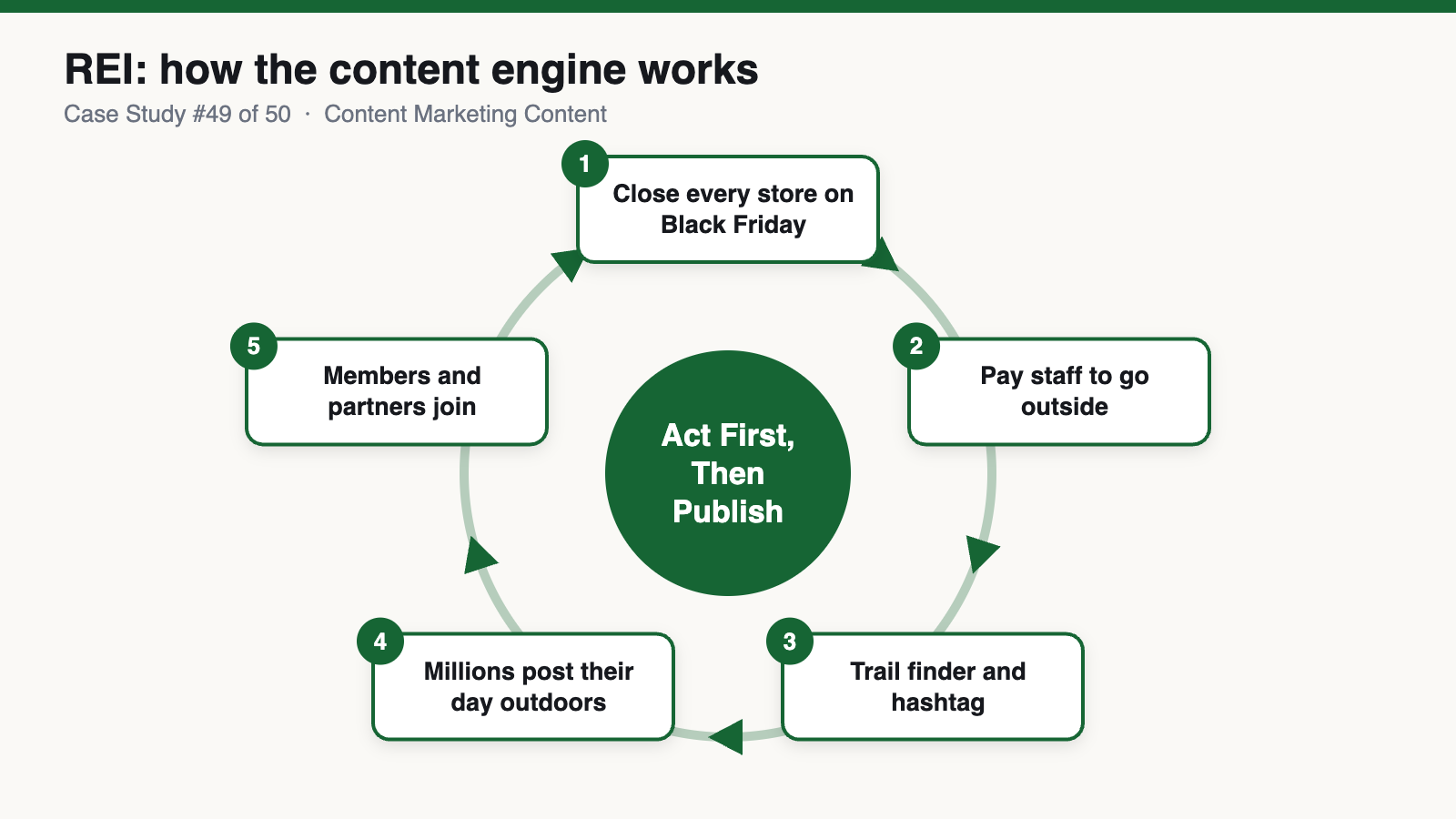
1. The Act Is the Content
The foundation was a real operational decision with a real cost. The stores were shut. The staff were paid. Sales were forgone. Nothing about it was symbolic in the sense of being merely claimed.
This distinguishes the campaign from almost all purpose-led marketing. The message did not have to be argued. It was demonstrated by what the company did, and the cost was obvious to everyone.
2. An Invitation, Not a Statement
REI did not simply announce a policy. It asked people to join. The name was a verb phrase and a hashtag. The request was specific and achievable: on this one day, go outside, and tell us where.
That turned a corporate decision into a shared act. People who would never have posted about a retailer’s opening hours posted photographs of themselves on a trail.
3. Useful Tools
A dedicated website helped people act on the invitation. It offered a search for hiking trails and outdoor spaces near any location, with details and recommendations, drawing on a trail-mapping service REI had recently acquired and on its own library of expert advice. Visitors could make a pledge to opt outside and generate a personalized image to share.
The content answered the natural next question. Having been told to go outside, a person needs to know where. Providing that made the campaign practical and gave the site lasting value.
4. Employees as the First Voices
Twelve thousand staff with a paid day off and a love of the outdoors were the campaign’s first participants. Their own posts were sincere and gave the story human detail. Treating employees well was part of the message and a source of content.
5. A Coalition
REI invited other organizations to take part. More than 170 did in the first year, including outdoor brands, nonprofit groups, and public agencies. Several state park systems waived entry fees for the day. This made the campaign larger than one retailer and gave local media in many states a story of their own.
6. Earned Media at Scale
A retailer closing on Black Friday was news. Business pages, morning television, and social media carried it widely. The announcement’s timing, about a month ahead, allowed weeks of discussion. The company’s advertising presence that season was modest. Coverage did the work.
7. Repetition and Evolution
REI repeated the closure each year, which changed it from a stunt into a tradition. Later editions added themes, such as an emphasis on environmental action and clean-ups, and the company ultimately committed to closing every Black Friday.
8. The Conversion Bridge
There is no sale on the day. The return comes through membership and loyalty over the rest of the year. A person moved by the campaign may join the cooperative for a one-time fee, and members spend more and return more often. The campaign also bought goodwill that makes REI the first choice when that person next needs a tent or a pair of boots.
Quantifiable Impact & Business Results
Figures are those reported by REI and its agency, and by the trade press.
- Participation (company-reported): About 1.4 million people pledged or took part in the first year, alongside more than 170 partner organizations.
- Media (agency-reported): Several billion media impressions and a very large increase in social media mentions during the campaign period.
- Recognition: The top prize in the most prestigious category at the 2016 Cannes advertising festival, among many other awards.
- Business results (company annual report): REI reported revenue growth of more than 9% for 2015, strong growth in digital sales, and its largest-ever annual increase in membership, more than a million new members.
The annual results reflect a whole year and many factors. They cannot be attributed to a single day’s campaign. What they do show is that giving up Black Friday did not damage the business that year. Impression counts are compiled by the agency and are not independently audited.
First-Principles Breakdown: Why Competitors Couldn’t Easily Copy It
The cooperative structure made it possible. With no public shareholders, REI’s leadership could forgo a major sales day for a long-term benefit. A listed retailer’s executives would have had to answer for the lost revenue on an earnings call.
The act fit the purpose exactly. An outdoor retailer telling people to go outside is coherent. The same gesture from an electronics chain would have made no sense. Fit between action and identity is what gave it meaning.
The cost made it credible. Customers have learned to distrust statements of values. A decision that visibly sacrifices revenue cannot be dismissed as words.
It ran against the entire industry on one day. Every competitor was doing the opposite at the same moment. The contrast guaranteed attention that no advertisement could have purchased.
First mover. Once REI had done it, any retailer following would be imitating. A few did close, and were described as following REI’s lead.
Participation gave people ownership. By supplying a hashtag and a trail finder, REI let the public make the campaign their own. Millions of personal photographs carried the idea further than the company’s own channels.
Patagonia (#22) made the related move in 2011 by advising customers not to buy its jacket on the same day of the year. Both rest on the same logic: an action that costs the company money is the most persuasive content it can produce.
The Replicable Playbook (For Mid-Sized Teams)
- Find the moment when your industry behaves worst. Identify a date, practice, or convention in your market that conflicts with what your customers value, and that you take part in mainly because everyone does.
- Do the opposite, and bear the cost. Make a real operational change on that occasion: close, give something away, decline to discount, donate the day’s revenue. It must cost you something visible.
- Invite people to join with a specific act. Give the action a name. Tell people exactly what to do and make it easy to share that they did.
- Publish what helps them do it. Build the guide, map, or tool that answers the practical question your invitation raises. Then repeat the whole thing next year.
Risks, Limitations & What Doesn’t Transfer Today
- Most companies cannot afford it or will not be allowed to. Forgoing a major sales day requires owners who accept the trade. Public companies and those with thin margins generally cannot.
- Online sales soften the sacrifice. Critics noted that REI’s website remained accessible and that orders were simply processed a day later, and that sales may have shifted to adjacent days. The cost was real but smaller than the headline suggested.
- Consistency is examined. A company that claims to put people and purpose first is judged on how it treats employees all year. REI has since faced criticism over layoffs and its response to staff efforts to unionize. Those disputes are measured against the image the campaign created.
- A gesture ages. What was startling in 2015 is expected a decade later. Attention declines each year, and the campaign needs renewal to stay meaningful.
- Inclusion. Encouragement to spend a day outdoors assumes time, transport, and access that not everyone has. REI later addressed this in its messaging and grants.
- Imitation without fit fails. Brands that have closed for a day or staged anti-consumption messages without a credible connection to their purpose have been met with indifference or scorn.
Related case studies in this series: Patagonia (#22) for costly action as content; Dove (#29) for opposing a category’s conventions; Buffer (#47) for values made visible; YETI (#26) for an outdoor brand’s storytelling; Chewy (#50) for goodwill created by unexpected gestures.
Sources & Further Reading
- REI Co-op, #OptOutside announcement and annual stewardship reports (rei.com)
- Coverage of the 2015 campaign and its 2016 Cannes Lions awards (Adweek; Ad Age; The New York Times)
- Venables Bell & Partners campaign case study
Build Your Own Content Engine: The Tools We Recommend
Google Workspace: editorial calendars in Sheets, drafts and briefs in Docs, shared drives for assets, and professional email on your own domain.
Gusto: payroll, benefits, and contractor payments in one place, so growing a content team does not mean growing your admin work.
Disclosure: these are referral links. We may earn a commission if you sign up, at no extra cost to you.