
Buffer sells a tool for scheduling social media posts, a market with many near-identical competitors. It became one of the best-known small software companies in the world by publishing things no other company would: every employee’s salary, its live revenue, its equity formula, and candid accounts of its own failures.
| Series Metadata | Details |
|---|---|
| Pillar | Pillar 5: Hyper-Niche, B2B Niche & Viral Stunt Content (Case Study #47 of 50) |
| Primary Channels | Open Blog, Public Revenue Dashboard, Social Media Blog, Guest Posting, Research Reports |
| Core Growth Lever | Transparency as a Company Value, Expressed Through Radical Public Disclosure |
| Best For | Small, founder-led companies competing on brand and talent in commoditized software markets |
Recommended Tools for Content Teams
Every content engine in this series runs on two unglamorous things: a shared workspace and a team that gets paid on time. Google Workspace covers the docs, sheets, shared drives, and email your editorial process lives in. Gusto handles payroll, benefits, and contractor payments for the writers, editors, and freelancers who produce the work.
Disclosure: these are referral links. We may earn a commission if you sign up, at no extra cost to you.
Executive Hook
In December 2013 Buffer published a blog post containing a spreadsheet. It listed every person at the company by name, their role, and their salary, from the chief executive down. It also published the formula used to calculate each figure, based on role, experience, location, and a few other factors, so that anyone could work out what they would be paid.
Salary is the most guarded information in most workplaces. Colleagues do not know each other’s pay. Companies treat compensation data as confidential. Buffer put it on the internet.
The post was covered by business media around the world. In the month that followed, according to the company, it received more than twice as many job applications as in the month before. And this was not an isolated gesture. Buffer went on to publish its revenue in real time, how it allocates equity, what it does with each dollar a customer pays, the makeup of its workforce, and a frank explanation of a round of layoffs caused by its own financial misjudgment.
THE MECHANISM IN ONE LINE
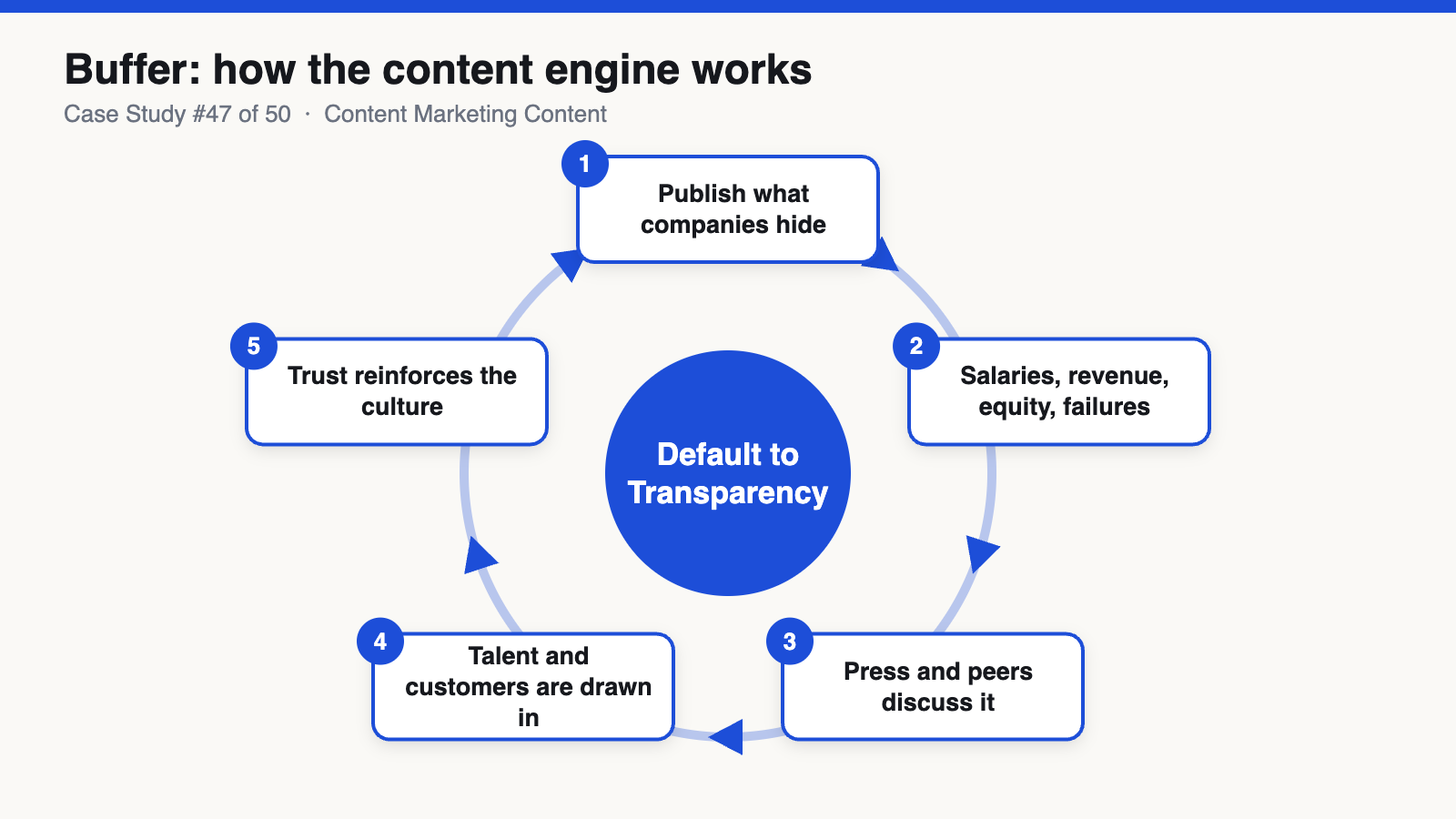
Buffer made its internal spreadsheets its marketing. Salaries, revenue, equity, and the reasoning behind layoffs were published not as stunts but because openness was a stated company value, and that is why people believed them.
The Strategic Context & Bottleneck
- A commodity product. Scheduling posts to social networks is a simple function offered by many tools, including the networks themselves.
- Larger, better-funded rivals. Competitors had bigger sales and marketing budgets.
- A remote company hiring globally. Buffer has been a distributed team since its early days. It needed to attract skilled people who would never visit an office and to build trust among employees who rarely met.
- A founder with strong views about how to run a company. Joel Gascoigne, who started Buffer in 2010, set out a list of values early. One of them was to default to transparency.
The bottleneck was distinctiveness, for customers and for recruits, in a category where features could not provide it. Buffer’s answer was to be a different kind of company, visibly.
Anatomy of the Content Engine
1. Guest Posting to the First Hundred Thousand Users
Before the transparency that made it famous, Buffer grew through a plainer method. Its co-founder Leo Widrich wrote guest articles for other blogs at an extraordinary rate, by his account around 150 in the first nine months. Each brought a small number of readers back to Buffer. The company credited this effort with its first hundred thousand users.
That established two habits: content as the main growth channel, and a willingness to do unglamorous work consistently.
2. A Blog Worth Reading for Its Own Sake
Buffer’s main blog published long, well-researched articles on social media, and for a period on productivity, psychology, and work habits. Posts on the best times to publish or the ideal length of a headline were widely shared and ranked well in search. This was conventional content marketing done unusually well.
3. The Open Blog
The second publication, called Open, was where Buffer wrote about itself. It is the heart of this case. Among the things published there:
- Salaries and the formula behind them, updated over the years as the approach changed.
- Equity, including how grants are calculated.
- Revenue, through a public dashboard showing live monthly recurring revenue, customer numbers, and churn.
- Pricing, with a breakdown of how each dollar of a subscription is spent.
- Diversity data on the composition of the team and applicants.
- Experiments in how to work, such as self-management without managers, which it abandoned and explained why, and later a four-day working week.
- Failures. In 2016 the chief executive wrote that the company had grown its team too quickly, run short of cash, and was laying off ten people. He set out the financial figures, took responsibility, and described the pay cut he and his co-founder were taking.
4. Transparency as a Value, Not a Tactic
What made this credible is that it was applied internally first. Employees could see one another’s pay and the company’s finances before the public could. Email within the company was open to all staff. The public disclosures were an extension of how Buffer already operated.
That distinction is the reason the content was believed. A company that reveals its numbers only when they flatter it is doing publicity. One that also publishes its layoffs is doing something else.
5. Research That Serves the Community
Buffer publishes an annual survey on the state of remote work, drawing responses from thousands of people. It is cited widely by journalists and other companies, positions Buffer as an authority on distributed teams, and earns links and coverage each year, in the manner described in SEMrush (#20).
6. The Conversion Bridge
Buffer’s audience is social media managers, marketers, and small business owners. The marketing blog brings them in through search. The Open blog gives them a reason to prefer Buffer over an equivalent tool: they like and trust the company. In a market of similar products, that preference is the deciding factor. For recruitment, the bridge is direct. Candidates know the salary before they apply and the culture before they interview.
Quantifiable Impact & Business Results
- Early growth (co-founder’s account): About 150 guest posts in nine months, credited with the first 100,000 users.
- After the salary post (company-stated): Job applications rose from roughly 1,260 in the previous thirty days to roughly 2,880 in the thirty days after.
- Revenue (public dashboard): Buffer’s revenue has been visible in real time for years, running at around twenty million dollars annually in recent periods.
- Ownership: In 2018 the company bought out most of its venture investors using its own profits, which it also wrote about.
Uniquely among the cases in this series, Buffer’s financial figures can be checked by anyone, because the company publishes them. It does not publish an attribution of revenue to its transparency content, and it has been open that growth has been modest for stretches.
First-Principles Breakdown: Why Competitors Couldn’t Easily Copy It
It has to be true inside before it can be published outside. Most companies could not release their salaries without exposing inequities they could not defend. Buffer could because it had built a formula first. The content is a by-product of an operating system.
The cost is real, which makes the signal credible. Publishing pay invites comparison, poaching, and criticism. Publishing layoffs is uncomfortable. Few leaders will accept that, and their unwillingness is what makes the disclosure meaningful.
Founder conviction. These decisions were made by a founder acting on principle, without a board to overrule him. A professional management team would rarely take the risk.
The material is exclusive. Nobody else can publish Buffer’s numbers. In an industry where everyone writes the same advice, this content had no substitute.
It attracted the right employees. People who applied after seeing the salaries had already accepted the culture. Transparency filtered candidates as well as drawing them.
Size suited it. With tens of employees, the data is simple and the relationships personal. The same practice at a company of thousands raises harder legal and privacy issues.
Groove (#46) used disclosure as a narrative device toward a goal. River Pools (#41) used candor to answer customers. Buffer made openness part of its identity, and continued when the news was bad.
The Replicable Playbook (For Mid-Sized Teams)
- Decide what you can honestly open up, starting inside. Share more with your own team first: financial performance, how pay is decided, why decisions were made. Fix what you would be embarrassed to reveal.
- Publish your reasoning, not just your results. Write up how you arrived at a pricing change, a policy, or a reorganization, including alternatives you rejected. The thinking is more useful to readers than the outcome.
- Write about one failure candidly. Choose a real mistake, give the facts and figures, take responsibility, and explain what changed. Do it before anyone asks.
- Run an annual survey on a subject you live. If your company has an unusual way of working or serves a distinct community, survey that community each year and publish the findings openly.
Risks, Limitations & What Doesn’t Transfer Today
- Transparency does not guarantee growth. Buffer is admired far beyond its size. It has also grown slowly at times, lost ground to competitors, and reported flat or declining revenue in some periods, all of which it has shared. Goodwill and market share are different things.
- Privacy and consent. Publishing salaries by name affects employees’ lives outside work. Buffer later adjusted how it presents the data. Any company attempting this needs real consent and legal advice, and in some jurisdictions the rules differ.
- Formulas create their own disputes. A published pay formula invites argument about every input, such as location adjustments, which Buffer revised more than once.
- Hard to maintain at scale. As headcount and complexity grow, full openness becomes harder to manage and to defend.
- Much of the novelty has passed. Pay transparency is now required by law in a growing number of places, and many companies publish salary bands. The practice no longer makes headlines.
- Audience mismatch. Content about company culture attracts founders, HR professionals, and job seekers more than it attracts social media managers. The link to product sales is indirect.
- Bad news is public too. A commitment to openness means your struggles are visible to customers, recruits, and competitors.
Related case studies in this series: Groove HQ (#46) for a start-up’s public journey; River Pools (#41) for honesty with customers; Patagonia (#22) for values proved by costly action; SEMrush (#20) for annual research; Intercom (#10) for founder-led writing.
Sources & Further Reading
- Buffer Open blog
- Joel Gascoigne, “Introducing Open Salaries at Buffer” (Buffer, December 2013)
- Joel Gascoigne, “Tough News: We’ve Made 10 Layoffs” (Buffer, June 2016)
- Buffer, State of Remote Work annual reports
Build Your Own Content Engine: The Tools We Recommend
Google Workspace: editorial calendars in Sheets, drafts and briefs in Docs, shared drives for assets, and professional email on your own domain.
Gusto: payroll, benefits, and contractor payments in one place, so growing a content team does not mean growing your admin work.
Disclosure: these are referral links. We may earn a commission if you sign up, at no extra cost to you.