
Pet food is heavy, repetitive, and available everywhere, including from the largest retailer on earth. Chewy competes by treating customers’ animals as family: hand-painted portraits sent as a surprise, handwritten cards, and flowers when a pet dies. Each gesture reaches one household, and then, very often, hundreds of thousands of strangers.
| Series Metadata | Details |
|---|---|
| Pillar | Pillar 5: Hyper-Niche, B2B Niche & Viral Stunt Content (Case Study #50 of 50) |
| Primary Channels | Customer Service Interactions, Physical Mail (Cards, Portraits, Flowers), Customer Social Posts, Press |
| Core Growth Lever | Personal, Unscalable-Looking Gestures at Scale That Customers Voluntarily Publicize |
| Best For | Subscription and repeat-purchase businesses in emotional categories; companies with large service teams |
Recommended Tools for Content Teams
Every content engine in this series runs on two unglamorous things: a shared workspace and a team that gets paid on time. Google Workspace covers the docs, sheets, shared drives, and email your editorial process lives in. Gusto handles payroll, benefits, and contractor payments for the writers, editors, and freelancers who produce the work.
Disclosure: these are referral links. We may earn a commission if you sign up, at no extra cost to you.
Executive Hook
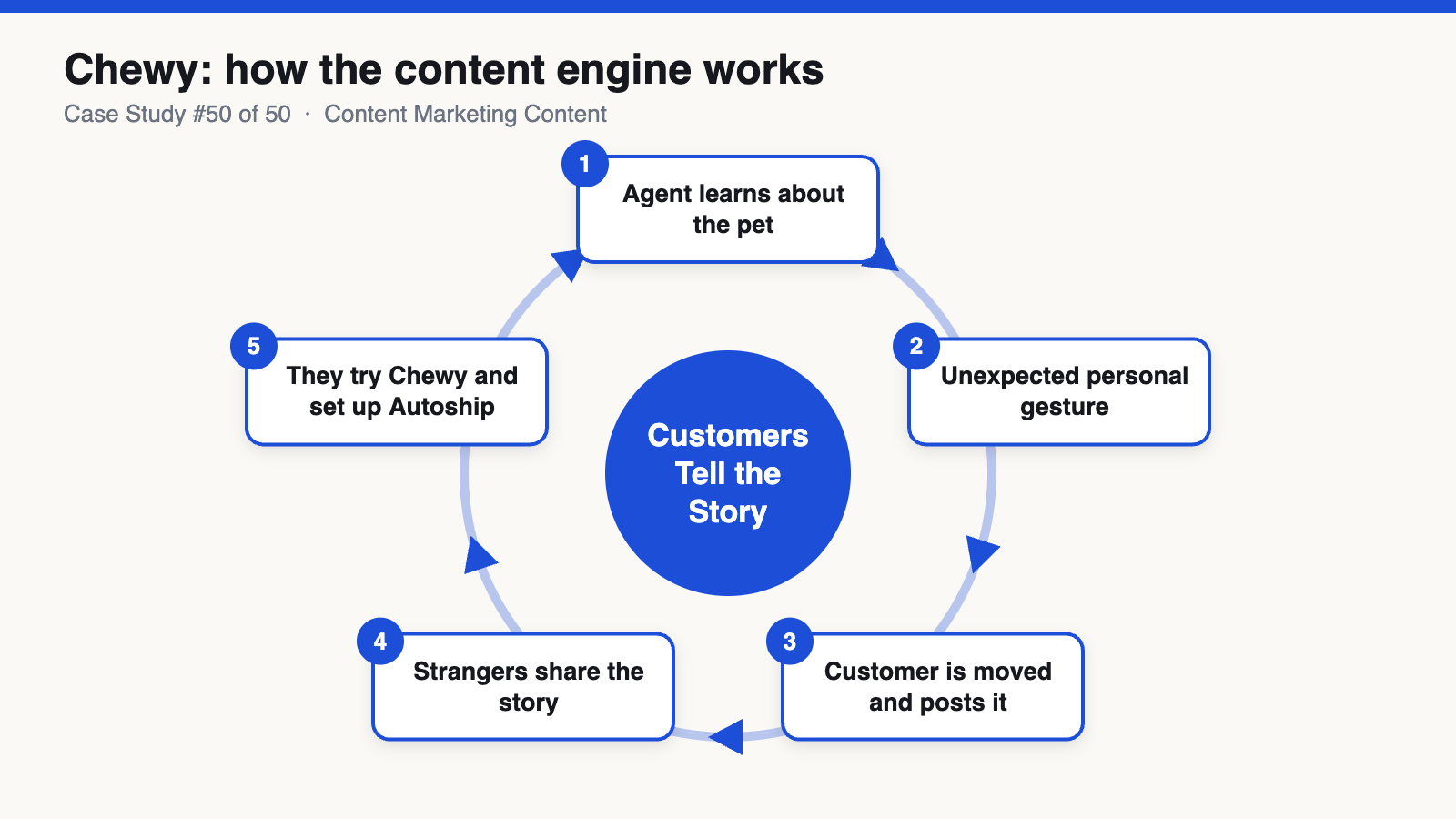
Every so often a post goes around social media that follows a familiar pattern. Someone’s dog or cat has died. They contacted the online pet retailer Chewy to cancel a recurring order or return an unopened bag of food. The agent refunded the money, told them not to send the food back but to donate it to a shelter, and expressed sympathy. A few days later a bouquet of flowers arrived with a handwritten card, signed by the person they had spoken to.
The posts draw hundreds of thousands of reactions. The comments fill with other people telling the same story about their own pet. Many end by saying they will never shop anywhere else.
Chewy did not write those posts, pay for them, or ask for them. It also did not get them by accident. The company, founded in 2011 by Ryan Cohen and Michael Day, built its service operation to produce exactly this kind of moment, thousands of times a week. This final case in the series is about content a company causes but does not create.
THE MECHANISM IN ONE LINE
Chewy does not make content about how much it cares. It does things that make customers cry in their kitchens, and the customers write the content themselves.
The Strategic Context & Bottleneck
- A commodity sold by a giant. The same brands of pet food are available from the dominant online retailer, often at similar prices with fast delivery.
- Low loyalty in e-commerce. Online shoppers compare prices and switch easily. A retailer of other companies’ products has little to hold them.
- An emotional customer. People regard their pets as members of the family. They talk about them, photograph them, and grieve for them. Few retail categories carry so much feeling.
- A recurring need. Pets eat the same food every month. A customer who stays is worth a great deal over the animal’s life.
The bottleneck was a reason to choose and stay with Chewy that the largest competitor could not match. Price and speed would not do it. Chewy’s founders decided to compete on how the customer was treated.
Anatomy of the Content Engine
1. A Service Team Hired and Trained for Empathy
Chewy staffs its customer service around the clock with its own employees. Agents are encouraged to talk about pets, ask their names, and take their time. They are not measured on how quickly they end a call. Details about a customer’s animals are recorded on the account.
This is the collection mechanism. Every later gesture depends on someone having listened.
2. Handwritten Cards
Chewy sends handwritten notes to customers: a welcome after a first order, cards for holidays, and messages for pets’ birthdays. The company has said it posts millions each year. A card with real handwriting, mentioning a pet by name, is rare enough from any business to be noticed and kept.
3. Surprise Pet Portraits
The best known program is the pet portrait. Customers often upload photographs of their animals to their accounts or share them with agents. Without warning, some receive in the post a hand-painted portrait of their pet on canvas. Chewy works with a large number of artists and sends out, by its own account, more than a thousand portraits a week.
There is no promotion attached and no way to request one. The absence of any sales purpose is what makes it affecting. Recipients photograph the painting, usually alongside the animal, and post it.
4. Sympathy Flowers and Refunds
When a customer mentions that a pet has died, agents are empowered to refund recent orders, suggest that unopened food be given to a shelter, and send flowers with a personal note. They do not need a manager’s approval.
This is the gesture that travels furthest, because it arrives at a moment of real grief, when the customer expected a transaction. People describe being reduced to tears by a pet food company.
5. Customers as Publishers
Chewy’s own social media and advertising are fairly conventional. The distinctive content is produced by customers. A single account of the flowers, posted in 2022, drew several hundred thousand likes and was reported by national news outlets. Stories of this kind recur continually, and each prompts a flood of similar testimonies in reply.
The company’s part is to make sure there is always something worth telling. It occasionally responds to or reshares customers’ posts, and its executives discuss the programs in interviews, but it does not need to do more.
6. The Conversion Bridge
A reader moved by one of these stories has a pet of their own and a monthly need for food. Chewy offers the same products at competitive prices, so trying it costs nothing. The company’s subscription program, which delivers on a schedule at a discount, then makes staying effortless. Once a customer has received a card or a portrait, leaving for a slightly cheaper competitor feels like a betrayal.
Quantifiable Impact & Business Results
- Acquisition (public record): Bought by a large pet store chain in 2017 for about $3.35 billion, at the time described as the largest acquisition of an e-commerce company.
- Public listing: Chewy listed on the stock market in 2019.
- Scale (public filings): Annual net sales of more than $11 billion and around 20 million active customers.
- Subscription share (public filings): Recurring scheduled orders account for roughly four-fifths of net sales, an indication of exceptional retention.
- Programs (company-stated): Millions of handwritten cards a year and more than a thousand hand-painted portraits a week.
Chewy does not disclose the cost of these programs or attribute sales to them. The best evidence of their effect is the subscription share and the rate of repeat purchase in a category where customers could easily shop elsewhere.
First-Principles Breakdown: Why Competitors Couldn’t Easily Copy It
It is an operating model, not a campaign. The gestures depend on in-house agents with time, authority, and training, on systems that record what customers say about their pets, and on a logistics operation for cards, paintings, and flowers. A marketing department cannot switch that on. It has to be built into the company.
The economics justify it. A customer who subscribes for the life of a pet is worth thousands. Spending a small amount on a portrait or a bouquet is a sound investment in retention and referral, though it looks extravagant on a per-order basis.
The largest competitor’s model points the other way. A retailer built on automation and minimal human contact is poorly placed to offer personal attention. Chewy chose the one dimension its rival was structurally unsuited to.
The category is emotional. A portrait of a pet matters to its owner in a way a gesture from an office-supplies retailer never could. Much of the power comes from the subject.
Surprise is the mechanism. Nothing is advertised or promised. Customers cannot expect or demand the gesture. That is why it delights, and why they feel compelled to tell someone.
Generosity at the moment of loss. Sending flowers to a customer whose pet has died, when there is nothing left to sell them, signals that the kindness is sincere. That sincerity is what gets shared.
Airbnb (#24) and Sephora (#37) rely on customers’ words to build trust. Share a Coke (#48) gave customers an object to post about their friends. Chewy gives them an experience to post about their grief or joy. In each, the customer is the author.
The Replicable Playbook (For Mid-Sized Teams)
- Give front-line staff time, information, and a budget. Let service people have real conversations, record personal details, and spend a modest sum per customer on their own judgment, without approval.
- Send something handwritten. A short, specific note from a named person, after a first order or a meaningful event in the customer’s life, costs little and is remembered.
- Design one signature surprise. Choose a gesture that is personal, physical, unannounced, and has no sales message. Do it for a small share of customers consistently. Do not promote it.
- Be generous when there is nothing to gain. Decide in advance how your company responds when a customer cancels because of a loss, a hardship, or a life change. Make the response kind and unconditional.
Risks, Limitations & What Doesn’t Transfer Today
- The cost is real and continuous. Staffing for unhurried conversations, plus artists, cards, and flowers, is a substantial expense. Chewy operated at a loss for years and remains a low-margin business. The model needs high customer lifetime value to make sense.
- It cannot be faked or automated. A printed card in a handwriting font, or a gesture triggered mechanically, is recognized and resented. The effect depends on a real person having paid attention.
- Expectation erodes surprise. As the stories have spread, some customers have come to expect a portrait or flowers and are disappointed when they receive nothing. Fame makes delight harder.
- Limited to emotional categories. A personal gesture lands when the customer cares deeply about the subject. For most routine purchases it would seem odd.
- Dependent on culture and continuity. The practice was established by founders who have since left, and the company has had layoffs and cost pressures. Sustaining generosity through leadership changes and tight budgets is difficult.
- Privacy. Noting personal details and acting on them can feel intrusive if handled clumsily. Customers must feel cared for, not tracked.
- Uncontrolled narrative. Because customers tell the story, the company cannot script it. Bad service experiences are shared just as freely.
Related case studies in this series: Airbnb (#24) and Sephora (#37) for customer-authored trust; Share a Coke (#48) for personal objects worth posting; REI (#49) and Patagonia (#22) for actions that speak for a brand; Dollar Shave Club (#43) for what arrives in the box; River Pools (#41) for winning by being the most trusted.
Sources & Further Reading
- Chewy, Inc. annual reports and public filings (2019 onward)
- Press coverage of Chewy’s customer service programs (The Washington Post; Forbes; People; CNBC)
- Ryan Cohen interviews on the company’s founding philosophy
Build Your Own Content Engine: The Tools We Recommend
Google Workspace: editorial calendars in Sheets, drafts and briefs in Docs, shared drives for assets, and professional email on your own domain.
Gusto: payroll, benefits, and contractor payments in one place, so growing a content team does not mean growing your admin work.
Disclosure: these are referral links. We may earn a commission if you sign up, at no extra cost to you.