
A nineteen-year-old with a sewing machine could not afford advertising or athletes. He could afford to post parcels to the fitness YouTubers he and his friends actually watched. That decision, made years before influencer marketing had a name, built a billion-pound company.
| Series Metadata | Details |
|---|---|
| Pillar | Pillar 4: Community-Driven, Social-First & Creator-Led (Case Study #34 of 50) |
| Primary Channels | Creator Partnerships (YouTube, Instagram, TikTok), Live Events and Meet-Ups, Community Challenges |
| Core Growth Lever | Early, Long-Term Partnerships With Niche Creators + In-Person Community |
| Best For | Challenger consumer brands in passion categories with identifiable micro-celebrities |
Recommended Tools for Content Teams
Every content engine in this series runs on two unglamorous things: a shared workspace and a team that gets paid on time. Google Workspace covers the docs, sheets, shared drives, and email your editorial process lives in. Gusto handles payroll, benefits, and contractor payments for the writers, editors, and freelancers who produce the work.
Disclosure: these are referral links. We may earn a commission if you sign up, at no extra cost to you.
Executive Hook
Ben Francis started Gymshark in 2012 in Birmingham, England. He was nineteen, studying at university, and delivering pizzas in the evenings. With a friend he first sold supplements through a website, then bought a sewing machine and a screen printer and began making gym clothing in his parents’ garage, because he could not find clothes that fitted the way he wanted.
He had no money for advertising and no access to the athletes that Nike or Adidas sponsored. What he had was his own habits as a customer. He and his friends did not take their training advice from professional sportspeople. They took it from a small number of bodybuilders and fitness enthusiasts who posted videos on YouTube.
Francis sent those YouTubers free clothing. They wore it in their videos because they liked it. Their viewers asked where to buy it. In 2013 Gymshark took a stand at a fitness trade show in Birmingham and brought some of those creators along. The stand was mobbed, and when a tracksuit worn there spread online afterward, the website took more in half an hour than it had in many previous months.
THE MECHANISM IN ONE LINE
In 2013 the people with the most influence over what young gym-goers wore were not athletes or magazines. They were a handful of YouTubers nobody in sportswear had heard of. Gymshark sent them clothes.
The Strategic Context & Bottleneck
- No budget. A student-run startup could not buy media or sponsor recognized athletes.
- A market owned by giants. Global sportswear companies had the retail distribution, the technology, and the stars.
- A neglected customer. Young people training in gyms for physique were not the focus of brands built around team sports and running. The fit and style they wanted was not on offer.
- A new kind of authority. Fitness YouTubers had loyal audiences who trusted them more than any advertisement, and almost no commercial relationships.
The bottleneck was credibility and reach among a specific subculture, at close to no cost. The solution was that the subculture had already chosen its own heroes, and those heroes were available.
Anatomy of the Content Engine
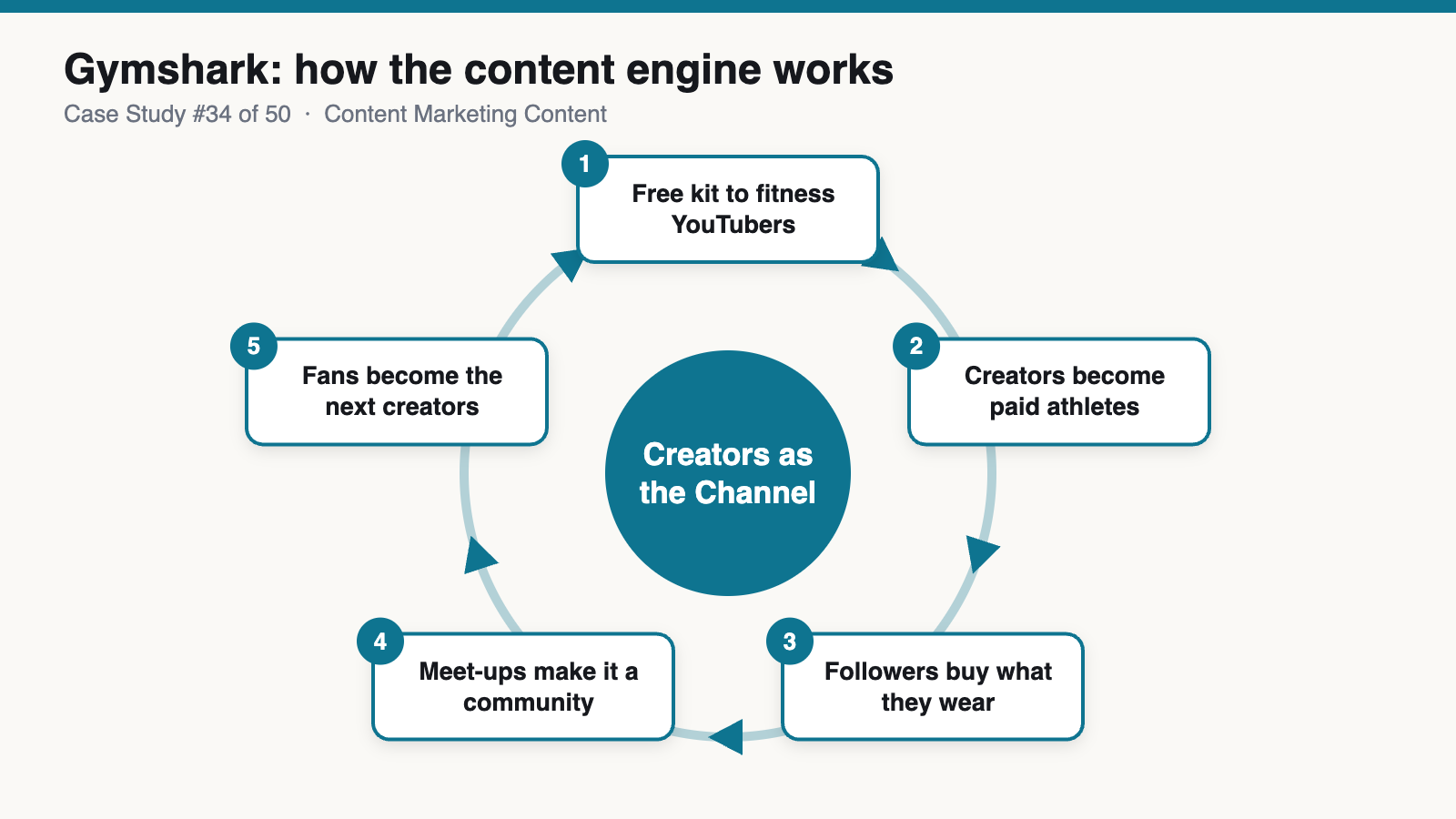
1. Seeding the Right Few
The first partners were chosen because Francis was a fan. They were people with tens or hundreds of thousands of subscribers, not millions. The product was sent with no contract. When creators kept wearing it and their audiences responded, Gymshark formalized the relationships, paying them and calling them Gymshark athletes.
The term matters. It placed online fitness personalities in the role that professional sportspeople hold at larger brands, and it gave them status in return.
2. Long Relationships, Not Posts
Gymshark kept its early creators for years. They traveled together, appeared at events together, and featured in one another’s videos. Viewers watching a creator’s channel saw the brand as part of that person’s life, not as a sponsored segment. Some partners were given input into products. The depth of the association made it believable.
3. Content Made by the Creators
Gymshark did not produce most of the content that built it. The creators did: training videos, physique updates, day-in-the-life vlogs, clothing hauls. The brand’s product appeared naturally because it was what they wore to train. Gymshark’s own channels amplified that material and added behind-the-scenes footage of the company itself, with Francis as a visible, relatable founder.
4. Offline Gatherings
The trade show taught the company that its online audience would turn up in person. Gymshark ran meet-ups and pop-up shops in cities around the world where fans queued for hours to meet the creators and buy limited stock. These events were filmed and became content in turn. They converted viewers of separate channels into members of one community with the brand at its center.
5. Community Challenges
The brand runs an annual challenge asking people to commit to a positive habit for sixty-six days and document it. Participants post their progress under a shared tag. It gives ordinary customers a reason to create content and a sense of taking part in something collective.
6. Scarcity and Events in Commerce
Product launches and major sales are treated as scheduled events, announced in advance and promoted by all creators at once. Limited runs sell out. The sale itself becomes something the community anticipates and talks about.
7. The Conversion Bridge
Gymshark sold directly through its own website from the beginning, with no wholesale partners for most of its history. A viewer saw a creator wearing an item, followed a link, and bought from the brand. That gave the company the margin, the customer data, and the ability to see which creators and which products drove sales.
Quantifiable Impact & Business Results
Gymshark is privately held. Figures are from company statements and press reports.
- Founding: 2012, by a nineteen-year-old student.
- The 2013 trade show (founder accounts): After the event, the site took around £30,000 in about half an hour.
- Valuation (press-reported): In 2020 a private equity firm bought a 21% stake at a valuation above £1 billion. The company had taken no prior outside investment.
- Revenue (company filings): Annual sales have been reported at over £500 million in recent years.
- Social audience (company channels): Many millions of followers across platforms.
Gymshark does not disclose how much of its revenue is attributable to creator partnerships. Since the company sold almost entirely direct and its early marketing consisted almost entirely of creators and events, the inference is strong, but it is an inference.
First-Principles Breakdown: Why Competitors Couldn’t Easily Copy It
It was early, and early was cheap. In 2012 and 2013 fitness creators had large, trusting audiences and few brand deals. Access cost a parcel of clothing. Within a few years the same reach cost many thousands per post. The arbitrage was time-limited.
The founder was the customer. Francis chose partners by being a fan. He knew who mattered in the subculture in a way a marketing department reading follower counts could not. Authentic selection produced authentic endorsement.
Incumbents were looking elsewhere. Major brands measured influence by sporting achievement and television exposure. A YouTuber filming in a bedroom did not register. By the time they adjusted, the creators were committed.
Relationships, not transactions. Long-term partnerships gave Gymshark a consistent presence in creators’ lives. One-off sponsored posts from competitors read as advertisements by comparison.
Community took the brand beyond any single creator. Events and challenges bound followers to Gymshark itself. If one partner left, the community remained.
Direct sales captured the value. Because purchases happened on the company’s own site, Gymshark kept the margin and learned what worked. A brand selling through retailers would have seen the demand benefit the store.
Nike (#30) built its brand on elite athletes and mass media. Gymshark built an alternative on niche creators and the internet, and the contrast marks a generational change in where credibility comes from. CeraVe (#39) benefited from creators in a comparable way, though less by design.
The Replicable Playbook (For Mid-Sized Teams)
- Identify who your customers actually listen to. Ask them, and look at what they watch and follow. The names are often small accounts specific to the niche, not well-known figures.
- Send product with no strings to people who would plausibly use it. Choose a dozen. See who uses it unprompted and how their audience reacts. Formalize only the relationships that are already working.
- Commit for years and give them status. Offer a title, involvement in product decisions, and inclusion in events. Treat creators as partners in the brand, not as media placements.
- Bring the audience together in person. Host a meet-up, pop-up, or challenge where followers of different creators meet each other and the company. Film it.
Risks, Limitations & What Doesn’t Transfer Today
- The timing advantage has gone. Creator marketing is now a mature, expensive industry with agents, rate cards, and disclosure rules. The cheap access Gymshark enjoyed no longer exists in established niches. The opportunity is only in communities that brands have not yet discovered.
- Creators carry reputational risk. A partner’s behavior or statements reflect on the brand. Gymshark has had to end relationships and has faced criticism over choices of ambassadors.
- Dependence on personalities. When prominent creators leave or launch competing labels, as several fitness personalities have, they take followers with them.
- Regulation. Advertising authorities require clear disclosure of paid relationships. Casual, undisclosed product placement is no longer permissible in most markets.
- Scaling strains the community feel. A brand that began as a group of friends becomes a large company with stores and a private equity investor. Maintaining the sense of belonging gets harder with size.
- Operational readiness. Viral demand has repeatedly overwhelmed systems. An extended website failure during a major sale in the company’s early years cost significant revenue and prompted a rebuild.
- Product must stand up. Creator endorsement gets the first purchase. Fit and quality determine the second.
Related case studies in this series: CeraVe (#39) for expert creators; Nike (#30) for the incumbent model; Glossier (#32) for a brand built with its audience; Peloton (#38) for personalities as the product; Notion (#5) for ambassador programs in software.
Sources & Further Reading
- Ben Francis interviews on the founding and first trade show (The Diary of a CEO; BBC; Forbes)
- Gymshark Central (company blog)
- Press coverage of the 2020 investment by General Atlantic (Financial Times; BBC News)
Build Your Own Content Engine: The Tools We Recommend
Google Workspace: editorial calendars in Sheets, drafts and briefs in Docs, shared drives for assets, and professional email on your own domain.
Gusto: payroll, benefits, and contractor payments in one place, so growing a content team does not mean growing your admin work.
Disclosure: these are referral links. We may earn a commission if you sign up, at no extra cost to you.