
Duolingo’s users had been joking for years that its green owl would hunt them down for missing a lesson. A new graduate asked to run the company’s dormant TikTok account and leaned all the way in. The result was a brand account that behaves like a creator, with an audience measured in the tens of millions.
| Series Metadata | Details |
|---|---|
| Pillar | Pillar 4: Community-Driven, Social-First & Creator-Led (Case Study #31 of 50) |
| Primary Channels | TikTok, Instagram, YouTube Shorts, In-App Notifications, Stunts |
| Core Growth Lever | A Mascot Operated as a Platform-Native Creator, Steered by Audience Comments |
| Best For | Consumer apps with a habit loop, a recognizable character, and tolerance for creative risk |
Recommended Tools for Content Teams
Every content engine in this series runs on two unglamorous things: a shared workspace and a team that gets paid on time. Google Workspace covers the docs, sheets, shared drives, and email your editorial process lives in. Gusto handles payroll, benefits, and contractor payments for the writers, editors, and freelancers who produce the work.
Disclosure: these are referral links. We may earn a commission if you sign up, at no extra cost to you.
Executive Hook
Language learning has a retention problem that no amount of acquisition spending fixes. People download an app in a burst of resolve and stop opening it within weeks. Duolingo’s product response was a system of streaks and reminders, including push notifications from its owl mascot, Duo, that grew plaintive and then guilt-inducing as days went by.
Users noticed. Long before the company did anything about it, the internet had turned those reminders into a meme: the owl as a menacing figure who would show up at your door if you skipped Spanish. It was affectionate mockery, and it was entirely user-made.
In 2020 Duolingo hired Zaria Parvez, then 23 and just out of university. The company had a TikTok account it was barely using. She asked if she could make videos for it. Her pitch, by her own account, was to stop treating the account as a brand channel and have Duo be a creator himself. The team had an owl costume and an office to film in.
THE MECHANISM IN ONE LINE
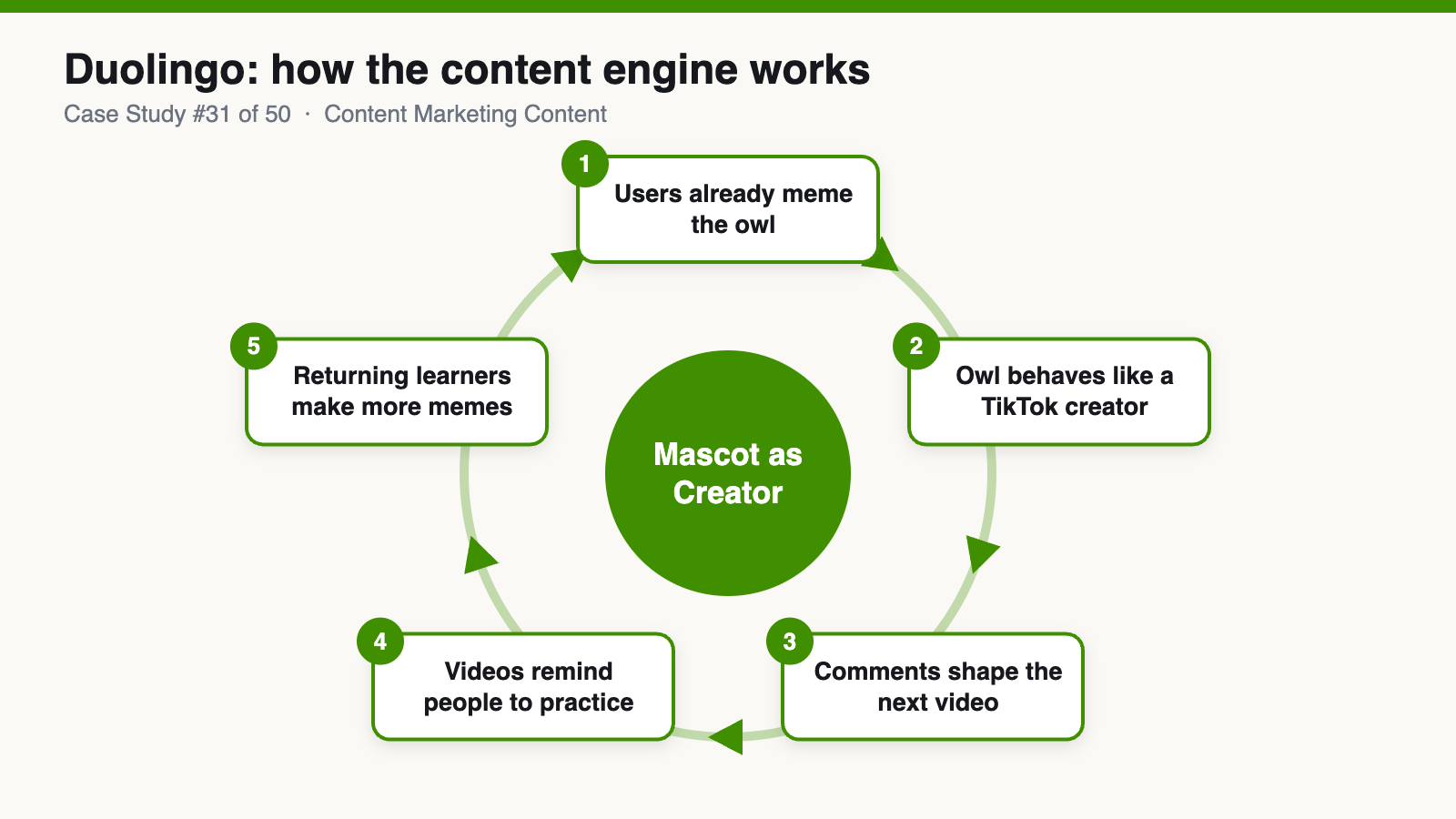
Duolingo did not invent the joke about its owl stalking you to do your lesson. Its users did. The company’s move was to stop resisting it and let the mascot play the character the internet had already written.
The Strategic Context & Bottleneck
- A habit product competing with entertainment. Parvez has described the realization that if a billion people were spending their time on TikTok, they were not spending it in Duolingo’s app. The competition was not other language apps.
- Rising paid acquisition costs. Buying installs for a mostly free consumer app was becoming more expensive and less effective.
- A young audience immune to ads. The users most likely to adopt a new app were on short-video platforms and scrolled past anything that looked like marketing.
- An educational product that is hard to make exciting. Tips about verb conjugation do not travel on social media.
The bottleneck was attention and recall among people who were not thinking about language learning at all. The asset was a character the audience had already given a personality.
Anatomy of the Content Engine
1. The Mascot as a Creator
The account does not post about features. A person in a large owl suit takes part in whatever is happening on the platform that week: trending sounds, dance formats, jokes, celebrity gossip. Duo has an ongoing infatuation with a pop star, feuds with the legal department, twerks on conference tables, and makes veiled threats about unfinished lessons.
The company has described the mix as roughly 80% unhinged and 20% wholesome. The voice is that of a slightly deranged individual, not an institution. Videos are shot on phones in the office with minimal production.
2. The Comment Section Is the Brief
The team’s stated rule is that the comments are their creative brief. Viewers’ reactions and suggestions determine what gets made next. When a throwaway joke lands, it becomes a recurring storyline. The audience is, in effect, co-writing a serialized character.
This is a direct extension of how the meme began. The audience created the persona; the brand now performs it and takes direction.
3. Speed and Autonomy
Short-video trends last days. Duolingo gave a very small social team the authority to conceive, shoot, and publish quickly, with a light approval process and a leader in marketing who was willing to say yes. Parvez has described the approach as dreaming big and iterating small: pushing a little further each time and using results to earn more freedom.
4. Stunts as Tentpoles
The daily stream is punctuated by larger set pieces. In early 2025 the company announced that Duo had died, with mock-solemn statements, an investigation, tributes from other brands, and a challenge to users to earn enough points collectively to bring him back. The response, the team said, showed how attached people had become to the character. Earlier stunts included a five-second advertisement during the 2024 Super Bowl and elaborate April Fools’ productions.
5. Product and Content Share a Voice
The same personality appears in the app’s notifications, widgets, year-in-review, and email. A user who laughs at a video and then receives a guilt-trip notification experiences one coherent character. The content is not a layer on top of the product. It expresses the same joke the product started.
6. The Conversion Bridge
The chief marketing officer has called daily social posting a retention driver: entertaining content reminds existing users that the app exists and nudges them back to their streak. For non-users, constant exposure to a funny character builds familiarity, so that when the thought of learning a language arises, Duolingo is the name that comes to mind. Most videos contain no call to action. The download happens later, by search or directly in an app store.
Quantifiable Impact & Business Results
- Audience (third-party tallies and press reports): The TikTok account grew from roughly 50,000 followers when Parvez took it over to around 17 million. Combined followers across major platforms have been put at around 30 million.
- Paid support: Parvez has said early growth to several million followers was entirely organic.
- Users (company data compiled by third parties): Monthly active users rose from about 37 million in late 2020 to 116.7 million by the end of 2024.
- Company: Duolingo listed publicly in 2021.
The growth in users cannot be assigned to social media alone. Over the same period Duolingo overhauled its product, extended its gamification, expanded internationally, and benefited from a pandemic-era surge in online learning. Management credits social content with brand awareness and retention, and the user figures are consistent with that, but there is no public attribution.
First-Principles Breakdown: Why Competitors Couldn’t Easily Copy It
The joke already existed. Duolingo did not have to convince anyone its owl was funny or threatening. Users had done that. A brand cannot manufacture an organic meme about itself. It can only recognize one and decide whether to embrace it.
The product creates the premise. The owl’s persona grows directly out of the app’s reminders. Every user has received those notifications, so everyone is in on the joke. A competitor with a mascot but no shared experience behind it has a costume and no material.
Leadership tolerated real risk. The account regularly posts things a legal or brand team would normally block. That required executives who accepted that some posts would misfire. Most companies’ approval processes would have removed everything that made it work.
One person’s native fluency. The strategy was conceived by someone who used the platform as a consumer, not as a marketer. Her instincts about tone and timing could not be written into guidelines.
A character scales across formats. Because the content is a personality and not a campaign, it adapts to any trend, platform, or stunt without a new idea each time.
Liquid Death (#33) uses entertainment to sell a commodity, and Wendy’s famously pioneered a sharp-tongued brand voice on an earlier platform. Duolingo’s contribution was to treat a brand account as a recurring character performed in person, with the audience directing.
The Replicable Playbook (For Mid-Sized Teams)
- Find out what people already joke about. Search social platforms for unprompted humor about your product or category. An existing running joke, even a slightly unflattering one, is a far better starting point than anything invented in a workshop.
- Give one fluent person the account and real authority. Choose someone who spends their own time on the platform. Define a small set of hard limits, then let them publish without a chain of approvals.
- Take your direction from the comments. Read every reply. Turn the most-liked suggestions and reactions into the next piece of content. Let recurring bits develop.
- Match the product’s voice to the account’s. Carry the same personality into notifications, emails, and interface copy, so the humor people see publicly is the humor they meet in use.
Risks, Limitations & What Doesn’t Transfer Today
- Reach is plateauing, by the company’s own account. Duolingo’s chief marketing officer has said the existing approach was no longer expanding its audience much and that the company intended to tone it down. The format has a ceiling, and a brand can reach it.
- Key-person dependence. The strategy was closely identified with one employee, who has since left for another company. A voice that lives in a person leaves with them.
- Edgy humor misfires. The account has had to apologize for jokes that crossed a line, including one about a celebrity court case. An unhinged persona and a public company’s obligations are in constant tension.
- Affection is conditional. In 2025 the company’s announcement that it would become AI-first and reduce its use of contractors drew a sharp backlash from the same online audience that loved the owl. A playful brand voice does not protect a company from anger over its business decisions, and the contrast can make that anger worse.
- Awareness is not learning. Critics note that being entertained by an owl is not the same as acquiring a language. If the product’s effectiveness is doubted, the humor starts to look like a distraction.
- Widely imitated. Brand accounts acting chaotic on short-video platforms are now common. The approach no longer stands out as it did in 2021.
- Platform risk. A strategy built on one platform’s algorithm is exposed to changes in that platform’s rules, popularity, or legal status.
Related case studies in this series: Liquid Death (#33) for entertainment-first branding; Spotify Wrapped (#11) for shareable in-app moments; CeraVe (#39) for creator-led reach; BuzzFeed (#17) for the hazards of platform dependence.
Sources & Further Reading
- How Duolingo’s social media team built a viral marketing strategy (Technical.ly)
- How Duolingo grew its TikTok to 6.6M followers (Digital Native)
- Duolingo’s Duo owl marketing strategy (Adweek)
- Duolingo social media strategy report (Brand24)
Build Your Own Content Engine: The Tools We Recommend
Google Workspace: editorial calendars in Sheets, drafts and briefs in Docs, shared drives for assets, and professional email on your own domain.
Gusto: payroll, benefits, and contractor payments in one place, so growing a content team does not mean growing your admin work.
Disclosure: these are referral links. We may earn a commission if you sign up, at no extra cost to you.