
In 1900 France had a few thousand cars and almost no reason to drive them far. The Michelin brothers printed a free guide to make motoring easier and more appealing. A century later, chefs build careers around its stars, and it still carries a tire maker’s name.
| Series Metadata | Details |
|---|---|
| Pillar | Pillar 3: Brand Media Houses & Documentary Storytelling (Case Study #27 of 50) |
| Primary Channels | Annual Printed Guide, Star Ratings, Anonymous Inspections, Later Digital Guides and Award Ceremonies |
| Core Growth Lever | Useful Content That Increases Demand for the Whole Category, Then Becomes an Independent Authority |
| Best For | Market leaders in young categories; brands able to commit to editorial independence over decades |
Recommended Tools for Content Teams
Every content engine in this series runs on two unglamorous things: a shared workspace and a team that gets paid on time. Google Workspace covers the docs, sheets, shared drives, and email your editorial process lives in. Gusto handles payroll, benefits, and contractor payments for the writers, editors, and freelancers who produce the work.
Disclosure: these are referral links. We may earn a commission if you sign up, at no extra cost to you.
Executive Hook
When André and Édouard Michelin published the first Michelin Guide in 1900, there were fewer than three thousand automobiles in the whole of France. The brothers ran a tire company in Clermont-Ferrand, and their problem was arithmetic. Tires wear out with distance. Hardly anyone was driving any distance. Roads were poor, fuel was sold in pharmacies, breakdowns were frequent, and there was little sense that a car was for going anywhere in particular.
They printed about 35,000 copies of a small red book and gave it away. It contained maps, instructions for changing a tire, lists of mechanics and fuel sellers, and places to eat and stay the night. Its purpose was to make it practical, and then tempting, to drive somewhere far away.
It is the most cited origin story in content marketing, and usually told as a charming trick. It deserves a closer reading. The Michelin Guide illustrates three distinct ideas: content that expands a market, the moment content gains value by being charged for, and the transformation of a marketing vehicle into an institution whose authority depends on being separate from marketing.
THE MECHANISM IN ONE LINE
Michelin could not sell more tires to people who had nowhere to go. So it published the places worth going, and has been the authority on them for longer than most of its competitors have existed.
The Strategic Context & Bottleneck
- A tiny installed base. The market for car tires was limited by the number of cars and the distance they traveled.
- Driving was difficult. Infrastructure for motorists barely existed. Information about where to find fuel, repairs, or a bed was scattered or absent.
- Michelin was already the leader. As the leading French tire maker, the company would capture much of any growth in driving. That made growing the whole market a rational strategy.
- No established reasons to travel by car. Motoring was a hobby for the wealthy. The idea of touring had to be encouraged.
The bottleneck was usage. The category needed to grow, and the barrier was practical confidence and a destination.
Anatomy of the Content Engine
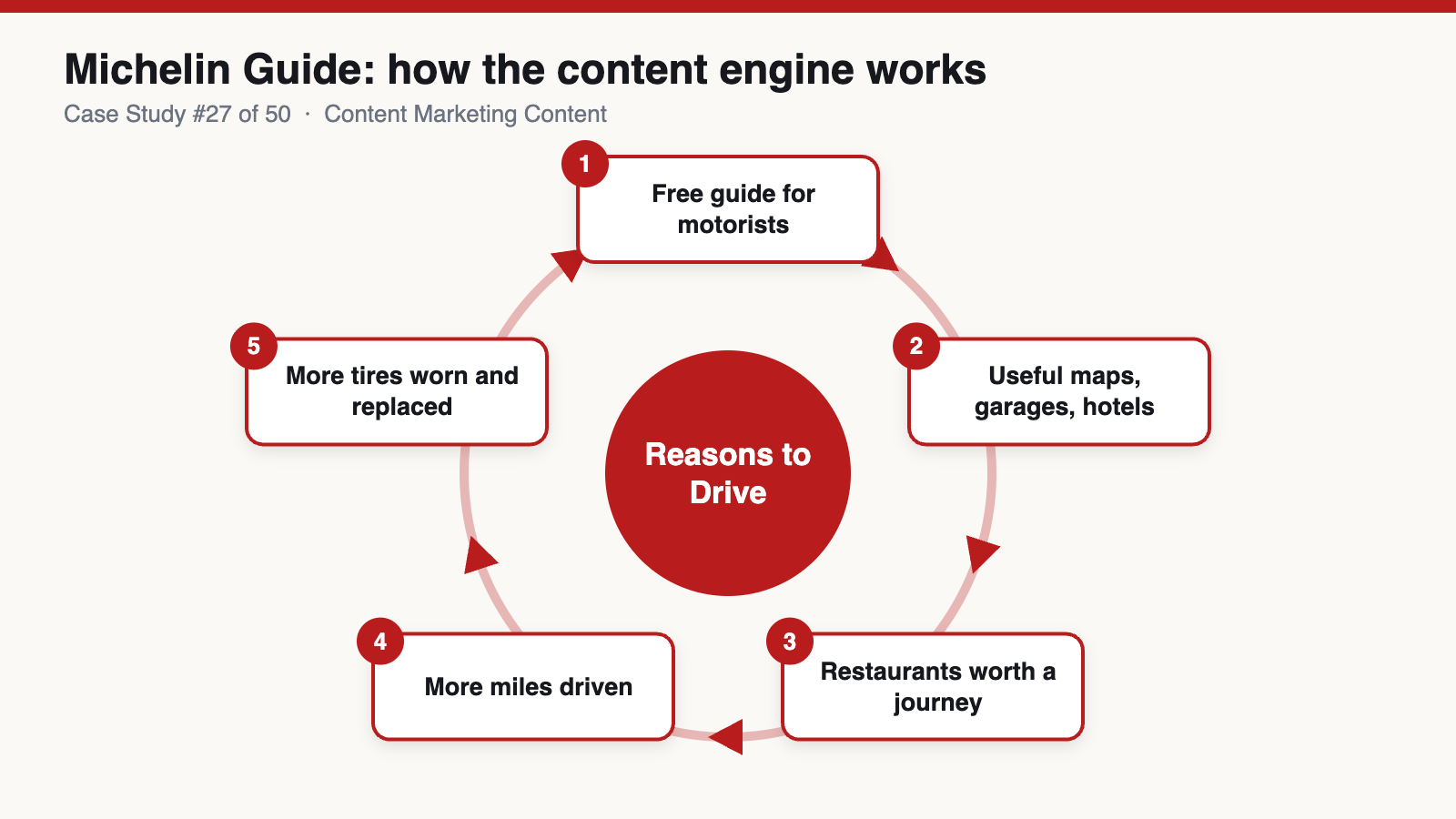
1. Pure Utility First
The early guide was a handbook. Its value lay in solving the motorist’s immediate problems: how to repair a puncture, where the nearest garage was, which hotels had somewhere to keep a car. It was a reference a driver would keep in the vehicle and consult repeatedly. Every use reinforced the association between Michelin and the experience of driving.
2. From Free to Paid
For two decades the guide was free. The company’s own account of what changed is that André Michelin visited a tire dealer and found copies being used to prop up a workbench. Concluding that people only respect what they pay for, Michelin began charging for the guide in 1920. At the same time it dropped paid advertising from the book.
Both moves raised the guide’s standing. A price signaled worth. Removing advertisements signaled independence. A promotional booklet began to become a publication.
3. Restaurants and the Stars
As the restaurant section grew in popularity, Michelin recruited a team of anonymous inspectors to visit and assess establishments. In 1926 it began awarding a star to fine dining restaurants. In the early 1930s it introduced the hierarchy of one, two, and three stars, and later published the definitions that are still used. One star marks a very good restaurant in its category. Two stars mean excellent cooking worth a detour. Three mean exceptional cuisine worth a special journey.
Those definitions are the strategy stated in plain words. The rating is expressed in terms of how far you should drive.
4. A Methodology Built for Credibility
The guide’s authority rests on process. Inspectors are employed by Michelin, trained, anonymous, and pay their own bills. Restaurants cannot buy a rating. Decisions are collective. The company has kept the criteria consistent across countries and decades.
This rigor is expensive and has no direct commercial return. It is also the entire source of the guide’s power.
5. Scarcity and Ceremony
Stars are few, and they can be taken away. The annual announcement of who has gained and lost them is covered as news around the world. Chefs describe the pressure in interviews and documentaries. The guide generates a yearly cycle of coverage without a media budget, because the stakes for the people rated are real.
6. Expansion
The guide spread across Europe and, from the 2000s, to the United States and Asia. It added an award for good-value restaurants, a distinction for sustainable practices, and more recently a rating for hotels. It now exists mainly as a website and app. In a number of regions, the guide’s arrival has been supported financially by local tourism authorities, according to press reports, which reflects how valuable a rated restaurant scene is to a destination.
7. The Conversion Bridge
In 1900 the bridge was direct: more driving meant more tire wear, and the market leader would sell most of the replacements. Today almost nobody chooses tires because of a restaurant rating. The bridge has become one of association. The Michelin name stands for exacting standards and quality, attached to a product, tires, that is otherwise hard to feel anything about.
Quantifiable Impact & Business Results
- First edition: Roughly 35,000 copies distributed free in 1900, when France had fewer than 3,000 cars.
- Pricing change: The guide became a paid publication in 1920.
- Rating system: A single star from 1926; the three-level hierarchy from the early 1930s.
- Reach today (company-stated): Guides covering dozens of countries and many thousands of restaurants.
- Parent company (public filings): Michelin is one of the world’s largest tire manufacturers, with annual sales in the tens of billions of euros.
There is no reliable measurement of how many tires the guide has sold, in 1900 or since. Press reports over the years have suggested the guide business itself runs at a loss or near break-even and is maintained for its brand value. That should be treated as reported, not confirmed.
First-Principles Breakdown: Why Competitors Couldn’t Easily Copy It
It grew the category, and the leader captured the growth. Content that increases total demand benefits everyone in a market in proportion to share. Only a dominant player gains enough to justify paying for it. A small competitor publishing the same guide would have been subsidizing Michelin.
Independence was chosen over promotion. The decision to remove advertising, charge a price, and employ anonymous inspectors meant giving up short-term marketing value. That sacrifice created an authority that no promotional publication could match. Most companies will not give their content that much distance from their product.
Time is the moat. The guide has operated continuously, apart from wartime interruptions, for well over a century, with stable criteria. Its ratings carry the accumulated weight of generations of chefs who organized their careers around them. A new rating system starts with none of that.
It rates something people care about deeply. Food is a subject of universal interest and personal pride. Chefs, diners, journalists, and cities all have a stake in the outcome. The guide’s subject generates its own attention.
The scale is intuitive and scarce. One, two, or three stars can be understood by anyone in any language. Very few are awarded. Simplicity and scarcity made the rating a currency.
Guinness World Records (#28) followed a similar arc from a promotional giveaway to an independent authority. The modern equivalents inside this series are HubSpot (#1), which taught a discipline in order to sell its software, and Shopify (#6), which creates entrepreneurs who then need a store. Each increases the activity that drives demand for the core product.
The Replicable Playbook (For Mid-Sized Teams)
- Ask what would make people use your category more. If you lead your market, the most valuable content may be whatever increases the underlying activity: travel, cooking, running, building, investing. Write down the practical obstacles and the missing reasons, and publish against those.
- Start with a reference people keep. A handbook, a directory, a map, or a calculator that solves recurring problems earns repeated use. Repeated use builds the association.
- Create a rating or selection, and protect its integrity. Choose something in your field worth judging. Publish clear criteria, apply them consistently, and never sell a place. Its value to you depends entirely on being trusted.
- Give it distance from sales. Let the content stand on its own merits, with its own name and standards. Resist adding product promotion. The less it looks like marketing, the more it will do for the brand.
Risks, Limitations & What Doesn’t Transfer Today
- The timescale is extreme. This strategy paid out over decades. No modern marketing organization is planning on that horizon, and the origin story should not be read as a quick tactic.
- The link to the product has dissolved. The guide today does little to sell tires directly. A company following the path may end up owning a respected media property with a faint connection to its business.
- Market-growth content rewards the leader. If you are not the largest player, expanding the category helps your competitors more than you.
- Authority attracts criticism. The guide has been accused of favoring certain cuisines and styles, of imposing damaging pressure on chefs, and of compromising its independence through paid arrangements with tourism bodies. Some chefs have asked to hand back their stars. Any rating system inherits these disputes.
- Free information is now abundant. In 1900 a list of mechanics was scarce and valuable. Today user reviews and maps supply most practical information. Only the judgment, the curation, remains hard to replace.
- Independence is costly to maintain. Inspectors, travel, and meals are a permanent expense with no direct revenue to match.
Related case studies in this series: Guinness World Records (#28) for the parallel story in brewing; HubSpot (#1) and Shopify (#6) for modern market-creating content; LinkedIn (#14) for rankings as authority; McKinsey (#15) for a century-scale publishing commitment.
Sources & Further Reading
- About the Michelin Guide: history (Michelin Guide)
- Michelin Group corporate history and annual reports (michelin.com)
Build Your Own Content Engine: The Tools We Recommend
Google Workspace: editorial calendars in Sheets, drafts and briefs in Docs, shared drives for assets, and professional email on your own domain.
Gusto: payroll, benefits, and contractor payments in one place, so growing a content team does not mean growing your admin work.
Disclosure: these are referral links. We may earn a commission if you sign up, at no extra cost to you.