
Razor blades were controlled by one company, priced high, and locked behind glass in shops. Dollar Shave Club’s founder made a single comic video for a few thousand dollars that explained the alternative. The quieter part of the story is what the company sent its members afterward.
| Series Metadata | Details |
|---|---|
| Pillar | Pillar 5: Hyper-Niche, B2B Niche & Viral Stunt Content (Case Study #43 of 50) |
| Primary Channels | Launch Video, Subscription Box Inserts, Printed Newsletter, Later a Digital Men’s Magazine |
| Core Growth Lever | A Comic Explainer That Names a Shared Grievance + Editorial Content That Sustains the Relationship |
| Best For | Challenger brands against a complacent incumbent; subscription and direct-to-consumer businesses |
Recommended Tools for Content Teams
Every content engine in this series runs on two unglamorous things: a shared workspace and a team that gets paid on time. Google Workspace covers the docs, sheets, shared drives, and email your editorial process lives in. Gusto handles payroll, benefits, and contractor payments for the writers, editors, and freelancers who produce the work.
Disclosure: these are referral links. We may earn a commission if you sign up, at no extra cost to you.
Executive Hook
On March 6, 2012, a start-up selling razors by post uploaded a video of a minute and a half. In it the founder, Michael Dubin, walks through a warehouse addressing the camera. He explains that the company’s blades are great, in rather stronger language, that they cost a dollar a month, and that buyers of branded razors are paying for a tennis player’s endorsement and for technology they do not need. A toddler shaves a man’s head. A bear appears. It ends with a dance.
The film cost a reported $4,500 and was shot in a day. Dubin had trained in improvisational comedy and wrote and performed it himself. Within hours the company’s website had crashed under the traffic. Within two days it had taken around twelve thousand orders.
Four years later Unilever bought Dollar Shave Club for a reported one billion dollars. The video is the famous part. It was also only the first ninety seconds of a content strategy.
THE MECHANISM IN ONE LINE
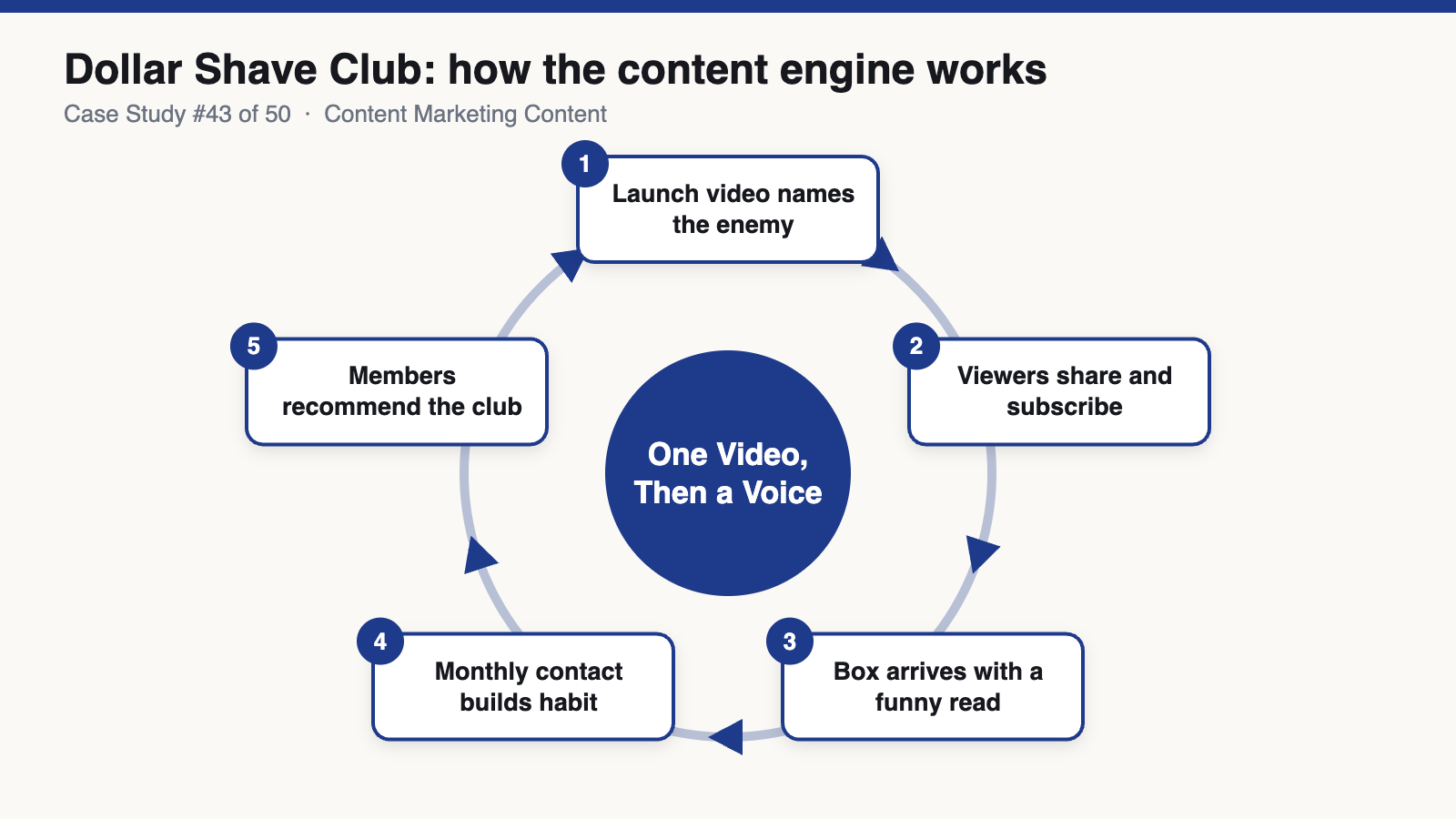
The video won the attention. What kept the customers was that the same voice turned up in the box every month, in a little newspaper to read in the bathroom.
The Strategic Context & Bottleneck
- A dominant incumbent. One company held around 70% of the American market for men’s razors and had spent decades adding blades and raising prices.
- An irritating purchase. Cartridges were expensive and, because they were often stolen, kept in locked cases. Buying them meant finding a shop assistant.
- A resentful customer. Men disliked the price and the hassle and felt they were paying for marketing. Nobody had voiced it for them.
- A product with little to say. A razor blade supplied by a contract manufacturer is not a story. And a start-up could not match the incumbent’s advertising.
The bottleneck was getting a mass audience to understand a new way of buying, by subscription and post, and to trust an unknown name with something they put against their face. All for a few thousand dollars.
Anatomy of the Content Engine
1. The Launch Video as an Explainer
Under the jokes, the film is a tightly constructed sales pitch. In ninety seconds it states the offer and the price, describes the product, identifies what is wrong with the alternative, answers the obvious objection about quality, explains how the service works, and asks for the order. Every laugh is attached to a selling point.
It also identifies an enemy without naming it. The viewer is invited to feel smart for no longer overpaying. A shared grievance, expressed with humor, gave people a reason to pass the video on: sending it to a friend said something about both of them.
2. The Founder on Camera
Dubin was the writer, the performer, and the chief executive. His delivery was dry and confident. A founder speaking plainly to camera made a tiny company feel like a person, in contrast to the athletes and slow-motion graphics of the incumbent’s advertising.
3. Consistent Voice at Every Touchpoint
The tone of the video carried through everything the customer saw afterward: the website, the emails, the wording on the packaging, the names of products. The brand talked like a funny friend who did not take grooming too seriously.
4. The Newspaper in the Box
Each monthly delivery included a small printed newsletter designed to be read in the bathroom. It contained short humorous articles, odd facts, answers to members’ questions, cartoons, and profiles of members. Very little of it was about razors.
This is the less celebrated half of the strategy and arguably the more important. A subscription is cancelled when the customer stops noticing it, or notices only the charge. A box that brings something to read each month makes its arrival a small pleasure. The insert cost very little, gave the company a regular editorial channel directly into homes, and provided a place to introduce other products without a hard sell.
5. A Men’s Magazine
In 2015 the company started an online magazine covering men’s lives, culture, health, and relationships, with a staff of journalists and its own name. It was editorially independent and rarely mentioned the parent. The intent was to earn the attention of the same audience through writing they would choose to read, and it published a good deal of well-regarded journalism before being spun off and later closed.
6. More Films
The company followed the launch video with further comic films introducing new products, the best known of which announced a line of wipes with similar bluntness. They did well, though none matched the first.
7. The Conversion Bridge
The video ended with the website address and a one-dollar starting price. Signing up took a minute. After that, the subscription itself did the selling: blades arrived, the newsletter arrived, and other products such as shave butter and hair gel were offered to an existing customer who was already amused.
Quantifiable Impact & Business Results
- Launch video (company-stated and press-reported): A production cost of about $4,500; roughly 12,000 orders in the first 48 hours; tens of millions of views in the years since.
- Membership (company-stated at acquisition): More than three million members by 2016.
- Acquisition (press-reported): Bought by Unilever in 2016 for a reported $1 billion.
- Market effect (industry data and press): The incumbent’s share of the American razor market fell significantly over the following years as subscription rivals grew, and it cut prices in response.
- Afterward (press-reported): Unilever sold a majority stake in the business to a private equity firm in 2023, reportedly at a much lower valuation.
The order figures are the company’s own. The larger claim, that a start-up took meaningful share from one of the most entrenched consumer monopolies, is supported by market data.
First-Principles Breakdown: Why Competitors Couldn’t Easily Copy It
The incumbent could not make the joke. A company charging premium prices cannot run an advertisement mocking premium prices. The positioning was unavailable to the market leader by definition.
A real grievance did the distribution. Men already felt overcharged. The video said aloud what they thought. Content that articulates a resentment people already hold is shared willingly.
The founder was the talent. Dubin’s comic training meant the company’s key creative asset was in-house and free. Most founders could not perform that script, and most agencies would not have written it.
The business model fit the message. A low starting price, no need to visit a shop, and a subscription meant the action the video requested was easy and cheap. Humor created the impulse and the model removed the friction.
Timing. In early 2012 online video advertising of this kind was fresh, social sharing reached far for free, and direct-to-consumer subscription was a novelty. The same video released today would meet a wall of imitators.
Retention content was cheap and physical. A printed sheet in a box is seen by every subscriber every month. No algorithm filters it. Competitors copying the video seldom copied the newsletter.
Liquid Death (#33) extended the comic launch into a permanent method. Blendtec (#42) made a product demonstration funny. Morning Brew (#35) shows what a consistent editorial voice does for retention. Dollar Shave Club joined a launch stunt to an ongoing read.
The Replicable Playbook (For Mid-Sized Teams)
- Find the grievance your customers share. What do buyers in your category resent and seldom say? State it plainly and make your offer the remedy.
- Write the explainer first and the jokes second. Draft a ninety-second script that covers offer, price, proof, how it works, and the call to action. Then make each point entertaining. If a joke does not carry a selling point, cut it.
- Put a real person from the company on camera. A founder or employee with natural presence is more convincing than hired talent, and costs nothing.
- Give customers something to read every time you deliver. Add a short, well-written, mostly non-promotional piece to each shipment, invoice, or monthly email. Feature customers. Make the arrival of your product or bill slightly enjoyable.
Risks, Limitations & What Doesn’t Transfer Today
- A viral launch cannot be planned. For each video that spreads, thousands do not. The company had a fallback in paid acquisition and needed it, since customer acquisition costs later rose sharply.
- The channel economics changed. Cheap reach through social sharing and inexpensive online ads was a feature of the early 2010s. Direct-to-consumer brands since have found acquisition far costlier.
- A voice is not a moat. Rivals with similar models and tones appeared quickly, and the incumbent launched its own subscription and lowered prices. The eventual resale at a lower value shows that the advantage eroded.
- Humor ages and narrows. A blokeish comic tone that worked in 2012 can feel dated and can limit who feels addressed.
- Editorial ventures are hard to sustain inside a brand. The men’s magazine produced good work and no clear commercial return, and did not survive a change of ownership priorities.
- Subscription fatigue. Consumers have become wary of recurring charges. A model that felt convenient in 2012 now meets more resistance, and regulators have tightened rules on cancellation.
Related case studies in this series: Liquid Death (#33) for comedy as an operating model; Blendtec (#42) for a low-budget video series; Morning Brew (#35) for voice-led retention; Chewy (#50) for surprise and delight in what arrives at the door; Mailchimp (#7) for brand-funded editorial.
Sources & Further Reading
- Dollar Shave Club, “Our Blades Are F***ing Great” (launch video, March 2012)
- Michael Dubin interviews on the launch (Inc.; How I Built This; Fortune)
- Press coverage of Unilever’s 2016 acquisition and 2023 sale (The Wall Street Journal; Financial Times)
Build Your Own Content Engine: The Tools We Recommend
Google Workspace: editorial calendars in Sheets, drafts and briefs in Docs, shared drives for assets, and professional email on your own domain.
Gusto: payroll, benefits, and contractor payments in one place, so growing a content team does not mean growing your admin work.
Disclosure: these are referral links. We may earn a commission if you sign up, at no extra cost to you.