
A cooler is a plastic box. YETI’s costs many times what a serviceable one does. The company justified that price with word of mouth among hunting and fishing guides, and then with a library of quiet, beautifully shot films about people who live outdoors, in which the product is close to invisible.
| Series Metadata | Details |
|---|---|
| Pillar | Pillar 3: Brand Media Houses & Documentary Storytelling (Case Study #26 of 50) |
| Primary Channels | YETI Presents Short Films, Ambassador Network, Film Tours, Print Journal, Specialty Retail |
| Core Growth Lever | Documentary Portraits of Credible Practitioners, With No Product Pitch |
| Best For | Premium physical products with an authentic core user and a much larger aspirational market |
Recommended Tools for Content Teams
Every content engine in this series runs on two unglamorous things: a shared workspace and a team that gets paid on time. Google Workspace covers the docs, sheets, shared drives, and email your editorial process lives in. Gusto handles payroll, benefits, and contractor payments for the writers, editors, and freelancers who produce the work.
Disclosure: these are referral links. We may earn a commission if you sign up, at no extra cost to you.
Executive Hook
Brothers Roy and Ryan Seiders founded YETI in Austin, Texas, in 2006 because the coolers they used for fishing kept breaking. Lids caved in when stood on, latches snapped, ice melted by midday. They designed one that was nearly indestructible and held ice for days. It cost several hundred dollars, in a category where the standard product cost thirty.
They did not sell it through big-box stores. They sold it through tackle shops, hunting outfitters, and hardware stores, to people who spent their working lives outdoors and could justify the price: fishing guides, ranchers, hunters, outfitters.
A decade later YETI was a household name selling drinkware to suburban commuters and had become a status object well beyond anyone who had ever needed ice to last five days. The route from one to the other ran through a series of short documentary films in which nobody explains what a YETI cooler does.
THE MECHANISM IN ONE LINE
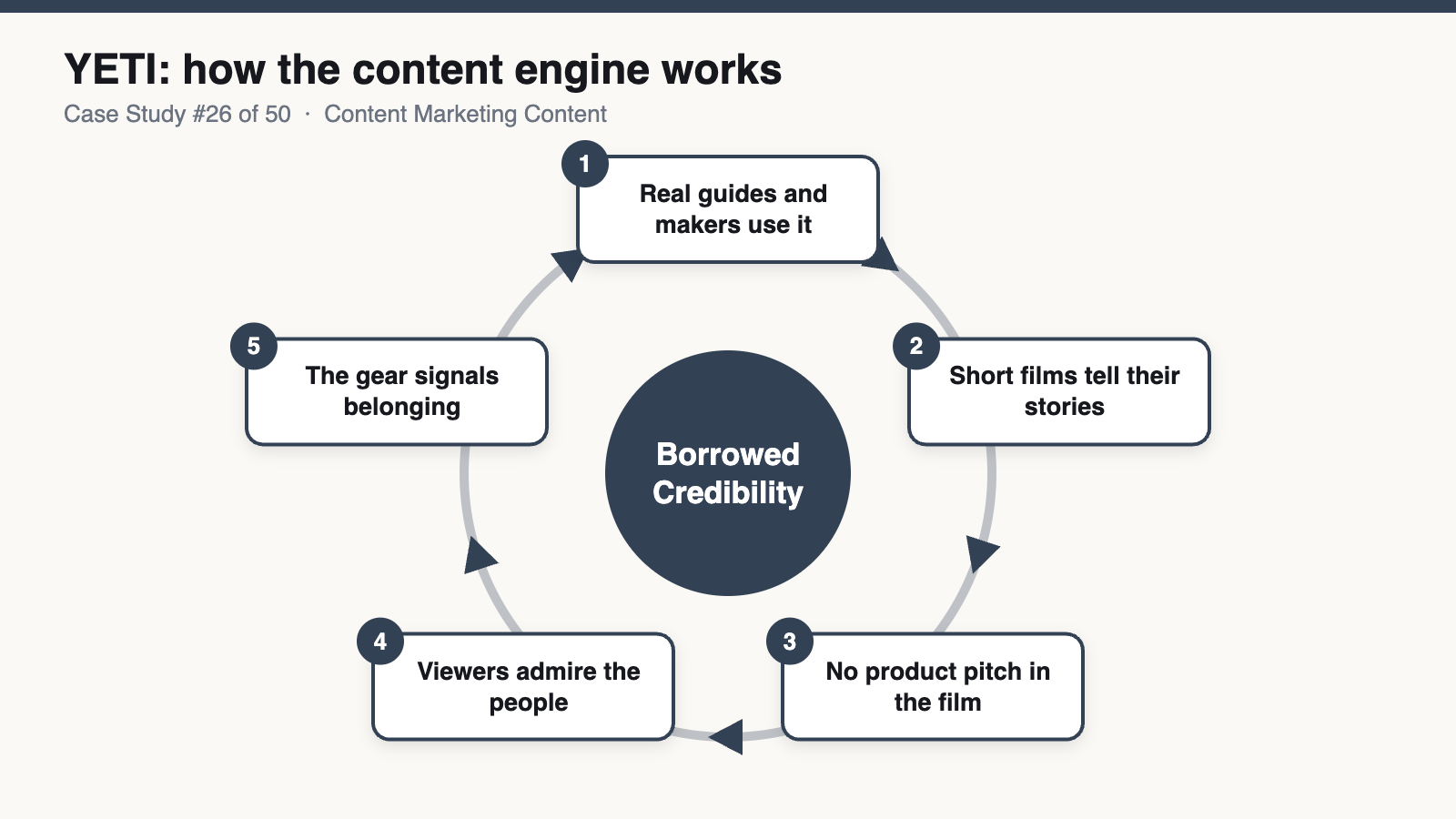
YETI does not film its coolers. It films the kind of person who needs one, with enough respect that the audience wants to belong to the same tribe, and the logo on the lid becomes the membership card.
The Strategic Context & Bottleneck
- An extreme price premium for a mundane object. The functional advantage was real but relevant to few buyers. Most people do not need a cooler a bear cannot open.
- A small authentic market. Professional guides and serious outdoorspeople are a limited population. Growth required reaching people who admired that life more than they lived it.
- A premium that depends on credibility. If the brand came to be seen as an expensive toy for people who do not go outdoors, its core users would abandon it, and the aspiration would collapse with them.
- An audience that distrusts advertising. Hunters, anglers, and ranchers respond to peers and to demonstrated competence, not to slogans.
The bottleneck was expanding to a mass aspirational market without losing the hard-won respect of the core. That is a problem of meaning, not of awareness.
Anatomy of the Content Engine
1. Seeding With People Who Mattered
Before any films, YETI built a network of ambassadors: respected fishing and hunting guides, rodeo competitors, pitmasters, surfers, climbers, and ranchers. These were people known and admired within their own communities. They used the products because the products held up, and their use was the endorsement. Hats and stickers spread through the same circles.
2. YETI Presents
From the mid-2010s YETI began releasing short documentaries under the banner YETI Presents. Each runs from a few minutes to around half an hour and profiles a person or a small group: a legendary fly-fishing guide looking back on his career, a family of ranchers, a female big-wave surfer, a barbecue cook, a veteran finding peace on a river.
The films share a set of choices.
- The subject is the person, not the activity or the product. They are character studies about dedication, craft, loss, and place.
- Production values are cinematic. Careful photography, original music, patient editing, and unhurried pacing. They are made by filmmakers and look like independent documentaries.
- The product is incidental. A cooler may be visible in the back of a truck. Often it is not. Nobody talks about it. The brand appears as a title card.
- The tone is respectful. The films admire their subjects without sentimentalizing them. Core users recognize the portrayal as true.
3. A Catalog, Not a Campaign
YETI has released films steadily for years and now has a deep library. Individual pieces are evergreen. A film about a guide made eight years ago is as watchable today. This is the opposite of a campaign that runs for a quarter and is retired. The library accumulates.
4. Distribution Where the Audience Gathers
Films are published on YETI’s own site and video platforms, and also taken on the road: screened at film tours, in specialty retailers, and at outdoor festivals, where a room full of the core audience watches together. A print journal extends the same storytelling in photographs and essays. Ambassadors share films about themselves and their friends.
5. Product Expansion Rides the Brand
In 2014 YETI introduced insulated cups and bottles at a price far more people could afford. Drinkware carried the logo into offices, cars, and gyms. This is where the content strategy paid out commercially. The films had established what the brand stood for. A thirty-dollar tumbler let anyone buy a piece of it.
6. The Conversion Bridge
The films carry no offer. The bridge is identity. A viewer who admires the people in the films wants to be associated with their world. Buying the product, and displaying the logo, is the available way to do that. The purchase happens later, in a shop or online, and often begins with drinkware.
Quantifiable Impact & Business Results
- Growth (public filings): YETI’s sales rose from tens of millions of dollars early in the 2010s to well over a billion by the end of the decade. The company listed on the New York Stock Exchange in 2018 and has reported annual revenue above $1.8 billion.
- Product mix (public filings): Drinkware now accounts for more than half of sales, exceeding coolers.
- Film library: A large and growing library of films released under the YETI Presents banner, several selected for film festivals.
YETI does not publish viewing figures across its library or attribute revenue to films. As with other cases in this pillar, the evidence for effect is indirect: sustained premium pricing in a category full of cheaper imitations, and the transfer of that premium to a new product line.
First-Principles Breakdown: Why Competitors Couldn’t Easily Copy It
The credibility was earned before it was filmed. The films work because the people in them had already chosen the product. The storytelling documents a real relationship with a real community. A competitor commissioning similar films without that history would be making fiction.
Restraint is the signal. Leaving the product out communicates confidence. It tells the viewer that the brand does not need to sell, and it respects their intelligence. Most marketing organizations cannot resist inserting a product shot and a call to action, which is exactly what would make the films ordinary.
The core protects the periphery. By continuing to make content for guides and ranchers long after most customers were suburban, YETI kept the people who give the brand its meaning. The mass market buys what the core validates.
The product delivers. The premium rests on durability that owners can confirm. Brand films would not survive a product that failed.
Cheaper copies reinforce the original. As imitators appeared with similar-looking coolers and cups at lower prices, the YETI logo became more clearly a statement. The content gave that statement its content.
This is Red Bull (#21) at a scale a mid-sized company can study. Where Red Bull stages spectacles, YETI makes portraits. The principle is the same: show the life, not the product. Patagonia (#22) adds a cause, which YETI largely avoids.
The Replicable Playbook (For Mid-Sized Teams)
- Identify your most credible users. Find the practitioners in your field whom others respect, and who already use your product because it works. Get to know them before asking for anything.
- Make one short film about a person, not a product. Hire a documentary filmmaker, not an advertising agency. Five to ten minutes. Tell the subject’s story honestly. Keep your product out of the script and limit branding to the opening and closing cards.
- Screen it for the core audience first. Show it at an industry event, in a partner’s shop, or to a customer community. Watch whether they recognize it as true. Their reaction is the test.
- Build a library, one film at a time. Release two to four a year. Keep each one available indefinitely. After three years you will have an asset no competitor can produce quickly.
Risks, Limitations & What Doesn’t Transfer Today
- No direct return. A film with no product and no call to action cannot be justified by attribution. It needs leaders who understand brand and will fund it through weak quarters.
- Needs a real core. If no respected group already uses your product for good reasons, there is no one to film. Paying admired people to appear is not the same thing, and audiences can tell.
- Mass adoption threatens the meaning. When a symbol of rugged competence is carried by everyone, it risks becoming a fashion item and losing the people who made it mean something. YETI manages this tension continuously.
- Premium demand is cyclical. Discretionary purchases of expensive coolers and cups are sensitive to the economy, and the company’s growth has slowed at times.
- Cultural reading of the audience can go wrong. A brand rooted in hunting and ranching culture occupies politically sensitive ground. YETI has experienced backlash from within its own base over a corporate decision. Close identification with a community brings exposure to its disputes.
- Attention for long-form brand film is scarce. Quiet, slow documentaries reach a self-selected audience. They need distribution through events and community, not just an upload.
Related case studies in this series: Red Bull (#21) for the large-scale version; Patagonia (#22) for film with a cause; Mailchimp (#7) for no-pitch brand entertainment in software; Liquid Death (#33) for the opposite tonal approach to a commodity.
Sources & Further Reading
- YETI Presents film library
- YETI Holdings, Inc. annual reports and public filings (2018 onward)
- Press profiles of YETI’s founders and content team (Inc., Texas Monthly, Outside)
Build Your Own Content Engine: The Tools We Recommend
Google Workspace: editorial calendars in Sheets, drafts and briefs in Docs, shared drives for assets, and professional email on your own domain.
Gusto: payroll, benefits, and contractor payments in one place, so growing a content team does not mean growing your admin work.
Disclosure: these are referral links. We may earn a commission if you sign up, at no extra cost to you.