
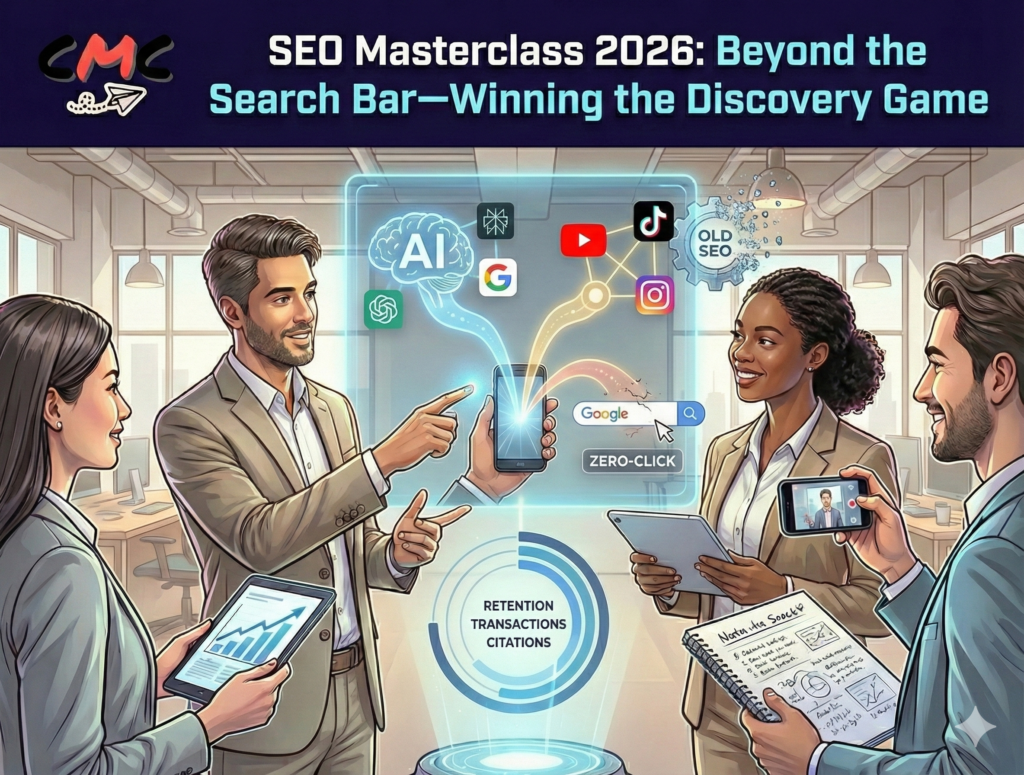
SEO Masterclass 2026: Beyond the Search Bar—Winning the Discovery Game
The search landscape has fundamentally transformed. While marketers once obsessed over Google rankings and keyword density, today’s consumers discover brands through an entirely different paradigm. The question is no longer “How do I rank on Google?” but rather “How do I become the answer that algorithms recommend before users even know they’re searching?”
This shift from intent-based search to feed-first discovery represents the most significant evolution in digital marketing since the birth of SEO itself. Let’s explore how to win in this new ecosystem.
Part 1: The New Front Door of Discovery
Search no longer begins with a white box and a blinking cursor. Instagram processes 6.5 billion searches daily, while YouTube handles 3.5 billion queries. For Gen Z and younger millennials, TikTok has already become the default platform for how-to tutorials, product research, and local business discovery—eclipsing Google for these use cases.
The fundamental difference lies in user behavior. Traditional search operates on intent: you have a question, you type it in, you get results. But in 2026, discovery happens differently. Algorithms surface solutions before you realize you have a problem. You’re scrolling through your feed, and suddenly a video appears demonstrating a solution to dry winter skin—a problem you hadn’t consciously acknowledged until that moment.
This creates what I call “the decision flip.” By the time a consumer opens a browser in 2026, their purchase decision has often already been made. They watched the tutorial on TikTok, saw the unboxing on YouTube, read the review thread on Reddit. The browser becomes a checkout tool, not a discovery tool.
Part 2: From Keywords to “Situational Sentences”
The language of search has evolved from fragmented keywords to complete, conversational queries. Users no longer type “dry skin winter fix”—they ask full questions like “How do I fix my dry skin in winter when moisturizer isn’t working?”
This shift requires a complete rethinking of how we create searchable content. Social platforms now index content the way Google once indexed websites. Algorithms “read” your videos by analyzing on-screen text, transcribing spoken words, and parsing caption structures. Your TikTok video isn’t just entertainment—it’s a searchable asset that needs optimization.
The practical implication is clear: every piece of social content should answer a specific, long-tail question that your audience is asking. Tools like AnswerThePublic and Ubersuggest reveal these questions across platforms. The brands that win are those that systematically address these queries in their content calendars, treating each post as both entertainment and an indexed answer.
Think of your captions as meta descriptions, your spoken content as body copy, and your on-screen text as headlines. Structure matters again, but in a visual medium.
Part 3: Mastering the Closed-Loop Ecosystem
Platform algorithms have become increasingly sophisticated in identifying value, and their definition of value has shifted dramatically. Retention—how long users stay engaged with your content and remain on the platform afterward—has become a primary ranking signal across Instagram, TikTok, and YouTube.
But there’s an even more powerful signal: transactions. When you use native commerce features like Instagram Checkout, TikTok Shop, or YouTube product tagging, you’re sending the platform a clear message: “This content doesn’t just engage users; it generates revenue for the ecosystem.” Platforms reward this behavior with dramatically increased organic reach because brands driving on-platform commerce directly contribute to the platform’s bottom line.
Here’s the critical warning: consistently directing users to external links creates what platforms interpret as an “exit signal.” You’re essentially telling the algorithm that your content’s purpose is to remove users from the platform. Over time, this pattern can suppress your organic reach in favor of competitors who keep the user journey contained.
This doesn’t mean abandoning your website. It means being strategic about when and how you use external links, and maximizing on-platform conversion opportunities wherever possible. Start conversations in DMs, collect emails through native lead forms, and save the website redirect for users who are already deep in your funnel.
Part 4: Winning the AI Citation Game
The rise of AI-powered search through ChatGPT, Perplexity, Google’s AI Overviews, and similar tools has created a new discovery layer that few marketers fully understand. These systems don’t create knowledge—they synthesize and cite existing sources. The question is: which sources do they trust?
Analysis of AI citations reveals a striking pattern: a majority come from social platforms, particularly Reddit, YouTube, Quora, and increasingly TikTok. These platforms offer real human experiences, detailed explanations, and community validation—exactly what AI systems need to provide confident recommendations.
This creates a counterintuitive reality. Your YouTube tutorial might generate fewer direct clicks than a blog post ranked on Google, but when an AI system cites it as the authoritative source for thousands of users, the trust and brand awareness generated far exceeds what traditional metrics capture.
The strategic shift required is significant. Instead of obsessing over click-through rates, start monitoring brand mentions in AI conversations. Track “reach through search” in your social analytics. Understand that visibility in these systems creates purchase intent that may convert days or weeks later, often through entirely different channels.
Part 5: The 2026 SEO Tech Stack
The tools and tactics that defined SEO success five years ago are insufficient for today’s landscape. Modern brand tracking requires platforms that understand multi-channel discovery. Tools like Ahrefs Brand Radar now track mentions and rankings across YouTube, Reddit, and traditional search engines, giving marketers a holistic view of where and how their brand is being discovered.
Native conversion tools have become essential. On-platform lead forms eliminate friction by capturing interest without forcing users to leave their feed. DM automation platforms like ManyChat enable brands to start meaningful conversations exactly where audiences already are, rather than requiring multiple platform jumps that increase abandonment.
The measurement framework itself must evolve. Attribution becomes more complex when discovery happens on TikTok, research happens in AI overviews, and purchases happen days later through direct website visits. Multi-touch attribution models and brand lift studies become more valuable than last-click metrics.
The Concierge Service Paradigm
Think of 2026 SEO as the evolution from a library to a concierge service. In a library—traditional Google search—you must know what you’re looking for, navigate to the right section, and find the specific book yourself. It requires intent, effort, and existing awareness.
In a concierge service—modern social and AI-powered discovery—the expert observes your needs, anticipates your questions, and hands you the perfect solution before you articulate the problem. But here’s the crucial detail: the concierge only recommends resources they trust and that provide value to their ecosystem.
Your job as a marketer isn’t to force your way into the recommendation. It’s to position your brand as the obvious choice—through consistent, valuable content that answers real questions, through participation in the platforms that feed AI systems, and through strategic use of native features that signal value to algorithms.
The brands that thrive in 2026 aren’t those with the highest Google rankings. They’re the ones that appear in feeds, AI citations, and platform search results at the exact moment consumers are open to discovery—before they’ve even formulated their question.
The Bottom Line: SEO in 2026 isn’t dead; it’s distributed. Your optimization efforts must span social platforms, AI citation networks, and traditional search engines simultaneously. The winners will be those who understand that discovery now happens everywhere—and who build strategies sophisticated enough to win across all these fronts at once.