
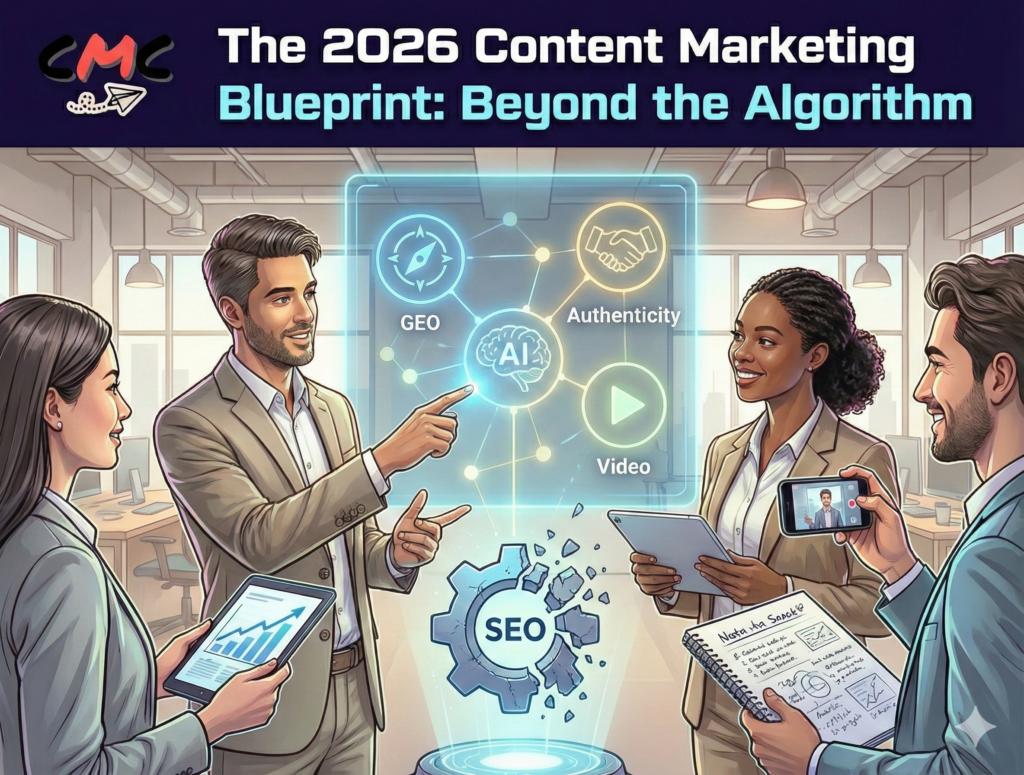
The 2026 Content Marketing Blueprint: Beyond the Algorithm
5 Game-Changing Strategies to Dominate Content Marketing in 2026
If you’re a business owner or marketer who feels like you’re shouting into the void, you’re not alone. The content marketing landscape has fundamentally shifted beneath our feet. Organic reach is declining. AI-generated “slop” floods every platform. And perhaps most frustratingly, your potential customers are getting their answers without ever clicking through to your carefully crafted website.
Welcome to the zero-click era—where the platforms themselves have become the destination, not the doorway.
But here’s the truth that separates thriving businesses from struggling ones in 2026: this isn’t a crisis. It’s a filtering mechanism. The old tactics that relied on gaming algorithms and keyword stuffing are dying. What’s emerging is something more authentic, more strategic, and ultimately more rewarding for those willing to adapt.
This blueprint will show you exactly how to win in this new landscape. No theory. No fluff. Just five battle-tested strategies that will position your expertise-based or service business as the trusted guide in a sea of algorithmic noise.
Strategy #1: The Zero-Click Reality & The Rise of GEO
Why Traditional SEO Is No Longer Enough
Let’s address the elephant in the room: Google Search is no longer the kingmaker it once was. In 2026, nearly 60% of searches end without a click. Users are getting their answers directly from AI Overviews, ChatGPT, Perplexity, and social media feeds. Your beautifully optimized blog post might rank on page one, but if the AI has already extracted and summarized your key points, why would anyone visit your site?
This is the zero-click reality. The game hasn’t disappeared—it’s just moved to a new arena.
Enter Generative Engine Optimization (GEO)
Traditional SEO optimized for search engines. GEO optimizes for AI recommendation engines. The goal isn’t just to rank—it’s to be cited, quoted, and recommended by the AI systems that are increasingly intermediating between your expertise and your audience.
Here’s how to implement GEO in your content strategy:
Tactic #1: Secure Industry Roundup Mentions
Large language models are trained on authoritative content aggregations. When reputable industry sites publish roundups like “Top 15 Marketing Strategies for 2026” or “Expert Opinions on Remote Work,” they become training data. Getting featured in these roundups positions you as a source of record.
Action Steps:
- Identify the top 10-15 industry publications in your niche
- Monitor their editorial calendars (most share these publicly or via newsletters)
- Pitch yourself as a contributor for expert roundups 60 days in advance
- Provide quotable, data-backed insights rather than generic advice
- Build relationships with editors through consistent value, not just self-promotion
Tactic #2: Implement Advanced Schema Markup
Schema markup is the structured data that helps AI systems understand the context and authority of your content. In 2026, this isn’t optional—it’s table stakes.
Critical Schema Types to Implement:
- HowTo Schema: For instructional content, this helps AI extract step-by-step processes
- FAQ Schema: Positions your answers for direct AI citation
- Review Schema: Builds trust signals that AI systems weight heavily
- Person/Organization Schema: Establishes entity authority in knowledge graphs
- Speakable Schema: Optimizes content for voice-based AI interactions
Pro Tip: Use Google’s Rich Results Test and Schema.org validators to ensure your markup is error-free. AI systems penalize malformed structured data by ignoring it entirely.
Tactic #3: Create “Comparison Content” That Feeds the LLMs
When users ask AI systems “What’s the best project management tool?” or “Should I hire Agency X or Agency Y?”, the AI needs comparative data to generate useful responses. By creating honest, detailed comparison content, you position yourself in these AI-mediated conversations.
Comparison Content Framework:
- Your Brand vs. Competitor A: Be objective. Highlight where competitors excel. This builds trust.
- Your Brand vs. Competitor B: Focus on differentiation, not superiority.
- Your Brand vs. DIY Approach: Help prospects understand when they need professional help versus when self-service works.
- Traditional Method vs. Modern Approach: Position yourself as the innovation leader.
The key is radical honesty. AI systems are trained to detect and penalize overtly promotional content. When you’re genuinely helpful, the AI rewards you with citations and recommendations.
Content Funnel Application (GEO):
- Awareness Stage: Industry roundups and comparison content that introduce your brand
- Consideration Stage: Deep-dive schema-optimized guides that position you as the expert
- Decision Stage: Case studies and reviews with proper markup that validate your approach
Strategy #2: The “YouTube Podcast Collab” Growth Hack
Bypassing the Algorithm by Borrowing Trust
Building a YouTube channel from zero subscribers in 2026 feels like pushing a boulder uphill. The algorithm favors established channels. New creators struggle to gain traction. But there’s a strategic workaround that leverages collaborative leverage: the Strategic YouTube Podcast Collab.
Here’s how it works.
The Strategic YouTube Podcast Collab Model
Instead of grinding away on your own channel hoping for algorithmic favor, you strategically partner with established creators to co-post long-form interview content. This isn’t guest posting—it’s a mutual growth strategy that bypasses the slow burn entirely.
The Mechanics:
- Identify Complementary Creators: Find YouTube channels in adjacent (not competing) niches with 10K-100K subscribers. These creators have established authority but are still accessible and actively growing.
- Propose the Strategic Collab: Pitch a co-posted interview where both parties publish the same video on their channels simultaneously. Frame it as “we both interview each other” or “collaborative conversation” rather than guest appearance.
- The Distribution Magic: When both channels post the video:
- The established channel’s audience discovers you as a peer authority (not a guest seeking attention)
- YouTube’s algorithm sees engagement signals on both channels, amplifying reach
- Each creator’s community cross-pollinates, creating compound growth
- The content lives in two search ecosystems, doubling discoverability
- Create a Series Format: Don’t make it a one-off. Build a “Founder to Founder” or “Expert Exchange” series where you alternate hosting duties monthly.
Why This Works in 2026:
The algorithm has gotten smarter about collaborative content. When two channels post the same video and both see strong engagement, YouTube interprets this as high-quality content worth promoting. You’re not gaming the system—you’re demonstrating social proof at scale.
Pro Tip: In the video description and pinned comment, each creator should explain the collaborative format and direct viewers to the other channel for additional perspective. This transparency builds trust and converts curious viewers into subscribers.
Implementation Timeline:
- Month 1: Identify 5-7 potential collab partners and craft personalized outreach
- Month 2: Conduct 2-3 collaborative interviews (batch production)
- Month 3: Post videos, cross-promote in newsletters and social feeds
- Month 4: Analyze metrics and double down on the partnerships showing strongest engagement
Content Funnel Application (YouTube Collab):
- Awareness Stage: The collaborative interviews introduce your expertise to new audiences
- Consideration Stage: Your channel’s backlog of content (guides, case studies) converts curious viewers into qualified leads
- Decision Stage: Strategic CTAs in video descriptions funnel interested viewers to booking calls or product pages
Strategy #3: From PDF Lead Magnets to AI-Powered Tools
The Death of the “Free PDF Checklist”
Let’s be honest: PDF lead magnets are dead. When was the last time you actually read one? Your prospects are drowning in unread PDFs, gathering digital dust in forgotten Downloads folders. In 2026, a static PDF is about as compelling as a fax machine.
The problem isn’t lead magnets themselves—it’s the format. Modern buyers expect immediate, interactive value. They want solutions now, not homework.
The AI-Powered Tool as Lead Magnet
Here’s the game-changer: AI has democratized software development. You no longer need a six-figure development budget or a technical co-founder to build genuinely useful tools. With AI assistants like ChatGPT and Claude, you can build interactive, problem-solving tools that serve as high-converting lead magnets.
Examples of AI-Powered Lead Magnet Tools:
- Real-Time Speech Coach: For communication consultants—a tool that analyzes uploaded video and provides feedback on pacing, filler words, and body language
- ROI Calculator: For marketing agencies—a dynamic calculator that shows potential returns based on industry benchmarks and user inputs
- Content Strategy Generator: For content marketers—input your business model and get a customized 90-day content calendar
- Pricing Optimizer: For coaches—answer questions about your market and get data-driven pricing recommendations
- Burnout Risk Assessment: For HR consultants—an interactive quiz that scores burnout risk and generates a personalized mitigation plan
How to Build These Tools (Even If You’re Not Technical)
Step 1: Identify the Micro-Problem
Don’t try to build a comprehensive solution. Focus on one painful micro-problem your audience faces that typically requires professional help. Your tool should provide 70-80% of the value instantly, positioning your full service as the path to 100%.
Step 2: Use AI as Your Developer
Here’s a prompt framework to get started with Claude or ChatGPT:
“I want to create an interactive web-based tool for [target audience] that solves [specific problem]. The tool should collect [input A, input B, input C], process this through [logic/calculation/framework], and output [specific result]. The design should be clean, mobile-friendly, and professional. Can you build this as a single HTML file I can host or embed?”
The AI will generate functional code you can customize. You’ll iterate through 3-5 rounds of refinement, but you’ll have a working prototype in hours, not months.
Step 3: Host and Gate Strategically
- Host the tool on your website using a subdomain (tools.yoursite.com)
- Gate the results, not the tool itself—let users interact freely but require an email to see their personalized output
- Follow up with automated email sequences that position your paid services as the logical next step
Step 4: Distribution Strategy
- Create YouTube videos demonstrating the tool in action
- Share results screenshots on LinkedIn and Twitter
- Embed the tool in blog posts that rank for relevant keywords
- Offer the tool as a bonus during podcast interviews and webinars
Pro Tip: Build a suite of 3-5 micro-tools rather than one comprehensive solution. This creates multiple entry points into your ecosystem and positions you as the go-to resource who provides value before asking for anything in return.
The Conversion Advantage:
These interactive tools convert at 2-3x the rate of traditional lead magnets because they provide immediate gratification. The user gets value in real-time, experiences your expertise firsthand, and can immediately see the gap between the free tool and your full offering.
Content Funnel Application (AI Tools):
- Awareness Stage: Share tool demos and user testimonials on social media
- Consideration Stage: The tool itself educates users while collecting qualified leads
- Decision Stage: Automated email sequences nurture tool users toward paid offerings
Strategy #4: The Ethics of AI User-Generated Content (UGC)
The Controversial Rise of “Synthetic Respondents”
We need to talk about the elephant in the digital marketing room: AI-generated UGC. Some marketers are using AI to create entirely fictional customer testimonials, complete with AI-generated faces and voices. This isn’t just ethically dubious—it’s a trust apocalypse waiting to happen.
But here’s the nuance: there is an ethical middle ground that leverages AI’s capabilities while maintaining complete transparency and trust.
The Ethical Framework: AI Actors Bringing Real Testimonials to Life
The problem with traditional text testimonials isn’t the testimonials themselves—it’s the format. Written testimonials lack the emotional resonance and credibility of video. But not every happy customer wants to appear on camera, or has the time, equipment, or confidence to record professional-quality video.
The Ethical AI UGC Approach:
- Start with Real, Verified Customer Testimonials: Only use written testimonials you’ve collected from actual customers who’ve given permission for you to use their words.
- Transform Text to Video Using AI Actors: Use AI video generation tools (like Synthesia, HeyGen, or D-ID) to create video versions where an AI actor reads the customer’s words verbatim.
- Use Clear, Prominent Disclaimers: Every AI-generated video must include clear disclosure:
- Text overlay: “This video features an AI actor reading a real customer testimonial”
- Verbal disclosure at the beginning
- Written disclaimer in the video description
- Attribute Properly: Include the real customer’s name, company, and role (with permission), making it clear that the words are authentic even if the presenter is AI-generated.
Why This Works:
- You maintain ethical integrity by using real customer feedback
- You overcome the barrier of customers who don’t want to appear on camera
- You create consistent, high-quality video content at scale
- You’re transparent about the use of AI, which builds trust rather than eroding it
When to Use This Approach:
- Product launches that need social proof but don’t yet have video testimonials
- Case studies where customers prefer anonymity but have powerful stories
- Multilingual markets where you need testimonials in languages your customers don’t speak
- High-volume content where recording individual videos with each customer isn’t scalable
The Trust Paradox:
Here’s what’s surprising: when you’re radically transparent about using AI actors, trust actually increases. Modern consumers understand AI is a tool. What they won’t tolerate is deception. By clearly disclosing your process, you demonstrate integrity while still leveraging technology’s advantages.
Pro Tip: Consider creating a “How We Create Our Testimonials” page that explains your process, shows examples of the written testimonial alongside the AI video version, and reinforces your commitment to authentic customer voices.
What to Avoid (The Line You Must Not Cross):
- Never create fictional customers or testimonials
- Never use AI to generate fake reviews for public platforms like Google or Trustpilot
- Never hide or obscure the fact that an AI actor is being used
- Never manipulate real customer words to say something they didn’t actually express
Content Funnel Application (Ethical AI UGC):
- Awareness Stage: Social media posts featuring AI-narrated testimonials with clear disclaimers spark curiosity
- Consideration Stage: Landing pages with multiple AI UGC videos demonstrate breadth of satisfied customers
- Decision Stage: Case study pages combine AI testimonials with real data and measurable results
Strategy #5: Humanity as the Ultimate Differentiator
The AI Content Flood and the Human Response
Here’s the uncomfortable truth about 2026: AI can now produce competent content faster and cheaper than any human. Blog posts, social media captions, video scripts, email sequences—AI handles all of it with increasing sophistication.
So where does that leave you?
Right where you’ve always had the advantage: in your irreplaceable humanity.
In a world flooded with AI-generated content that’s technically proficient but soullessly identical, personal brands and founder brands have become the only truly trendproof assets. People don’t just buy products or services—they buy from people they know, trust, and feel connected to.
The Rise of “Founder Brands”
A founder brand is exactly what it sounds like: a business where the founder’s personal story, values, and personality are inseparable from the brand identity. Think Gary Vaynerchuk, Marie Forleo, or Alex Hormozi. Their businesses succeed because of them, not in spite of them.
In 2026, this isn’t just for celebrity entrepreneurs. Every service-based and expertise-based business should be cultivating a founder brand as their primary competitive moat.
Why Founder Brands Win:
- AI can’t replicate your specific life experiences and lessons learned
- Your audience develops parasocial relationships that competitors can’t poach
- You become a category of one rather than competing on features or price
- Your content has built-in differentiation because it’s filtered through your unique perspective
Implementing “Connectioneering” in Your Content
“Connectioneering” is the strategic engineering of relatable, shared human experiences in your content. It’s about finding the universal truths in your specific journey and articulating them in ways that make your audience feel seen and understood.
Connectioneering Tactics:
1. Behind-the-Scenes Vulnerability: Share the messy middle—the failures, pivots, and moments of doubt. AI content is polished and perfect. Human content is real and relatable.
Example: Instead of “5 Strategies That Grew My Business,” try “The Strategy That Almost Bankrupted Me (And What I Learned)”
2. The “Me Too” Moment: Create content that articulates what your audience is feeling but hasn’t yet put into words.
Example: “That moment when you realize you’re working 60-hour weeks in a business you built to create freedom…”
3. Shared Cultural Touchstones: Reference experiences your audience has in common—not generic references, but specific, generational, or industry-specific moments.
Example: For marketing professionals: “Remember when we thought QR codes were dead? 2020 wants a word…”
4. The Founder’s Framework: Take your personal methodology and brand it. This creates intellectual property that’s uniquely yours and can’t be replicated by AI or competitors.
Example: Instead of “time management tips,” create “The 3-Portal Day” or “The Focus-Flex-Flow System”
“All the Feels”: Sensory-Rich, Tactical Visuals
In a sea of AI-generated stock photos and generic graphics, sensory-rich content cuts through the noise. This is content that engages multiple senses and creates emotional resonance.
Tactical Implementation:
1. Show, Don’t Tell:
- Film your actual workspace, not a staged set
- Share screen recordings with your voice narrating your thought process
- Post photos of your notebook with handwritten strategies and sketches
2. The Sensory Hook: Lead with sensory language that creates embodied experience.
Bad: “I was stressed about the client call” Good: “I could feel my heart hammering as I hovered over the Zoom link, coffee going cold on my desk”
3. Micro-Moments Over Polished Production: Raw iPhone footage of you solving a problem in real-time beats a professionally produced video where everything is scripted. Authenticity trumps production value.
4. User-Generated Content That’s Actually Generated by Users: Feature your actual customers and their actual results. No AI. No actors. Just real people telling real stories in their own words and on their own devices.
The Founder Content Production System
Here’s the reality: creating personal, human-centric content consistently is hard. It requires vulnerability and time. This is where strategic systems prevent burnout.
The Weekly “Founder Content Hour”:
Block one hour every week where you:
- Share one lesson learned from the past week
- Answer one common customer question in depth
- Tell one story from your business journey
- Record one unscripted video about a challenge you’re currently facing
This single hour generates:
- 4-5 LinkedIn/Twitter posts
- 1 email newsletter
- 1-2 YouTube videos or podcast episodes
- Multiple story-format content pieces for Instagram/TikTok
Content Funnel Application (Humanity & Founder Brands):
- Awareness Stage: Personal stories and vulnerable shares attract aligned audience members
- Consideration Stage: Behind-the-scenes content and founder frameworks demonstrate your unique methodology
- Decision Stage: Direct founder-to-prospect conversations in video or audio format close deals because trust is pre-established
The Workhorse Production Schedule: Avoiding Burnout While Maintaining Consistency
Strategy without execution is hallucination. You can have the best content plans in the world, but if you can’t sustain production, none of it matters. Here’s the battle-tested system for producing a month’s worth of content in a single focused week.
The Content Batching Framework
Week 1: The Production Week
Monday: The Planning & Batch Recording Day
- 9:00-10:00 AM: Review the monthly content calendar and themes
- 10:00-12:00 PM: Record 4-6 long-form videos (8-15 minutes each) on primary topics
- 1:00-3:00 PM: Record 10-12 short-form videos (60-90 seconds each) for social
- 3:00-4:00 PM: Record audio versions for podcast feed
- 4:00-5:00 PM: Collect B-roll footage and behind-the-scenes content
Tuesday: The Writing Day
- 9:00-12:00 PM: Write 2 long-form blog posts (1,500-2,500 words)
- 1:00-3:00 PM: Write 4 email newsletters
- 3:00-5:00 PM: Draft 20-25 social media captions for posts throughout the month
Wednesday: The Editing & Asset Creation Day
- 9:00-12:00 PM: Edit long-form videos (or hand off to editor)
- 1:00-3:00 PM: Create thumbnails, graphics, and visual assets
- 3:00-5:00 PM: Edit short-form videos for Reels/TikTok/Shorts
Thursday: The AI Enhancement Day
- 9:00-11:00 AM: Use AI to generate alternative headlines, meta descriptions, and SEO optimization
- 11:00-1:00 PM: Create AI-powered tools or lead magnets
- 2:00-4:00 PM: Generate transcripts, show notes, and blog post repurposing
- 4:00-5:00 PM: Quality check all AI-generated content for accuracy and brand voice
Friday: The Scheduling & Optimization Day
- 9:00-11:00 AM: Schedule all content across platforms using scheduling tools
- 11:00-12:00 PM: Set up email automation sequences
- 1:00-3:00 PM: Create engagement prompts and community management guidelines
- 3:00-5:00 PM: Review analytics from previous month and adjust strategy
Weeks 2-4: The Engagement Weeks
With content pre-scheduled, your focus shifts to:
- Engaging with your audience’s comments and questions
- Monitoring performance and making real-time adjustments
- Conducting the live elements (webinars, Q&As, collaborative interviews)
- Capturing spontaneous content opportunities as they arise
- Nurturing leads generated from the content machine
The Pillar-to-Micro Content Pyramid
Each long-form video or blog post (pillar content) generates:
- 5-7 social media posts pulling key insights
- 3-4 quote graphics
- 1 email newsletter
- 1 blog post (if video) or video (if blog post)
- 10-12 short-form video clips
- 1 podcast episode
- Multiple story/reel opportunities
Pro Tip: Use AI (ChatGPT, Claude, Descript) to help with this repurposing. Feed it your long-form transcript and ask it to extract the most shareable moments, generate headlines, and create promotional copy. This amplifies your effort without sacrificing quality.
The Content Types by Funnel Stage
Awareness Content (Weeks 1-2 of Publication Schedule):
- Broad, educational content that attracts cold audiences
- Provocative takes on industry trends
- Story-based content that demonstrates expertise without selling
Consideration Content (Weeks 2-3):
- How-to guides and tactical frameworks
- Case studies and results showcases
- Comparison content and decision-making frameworks
Decision Content (Weeks 3-4):
- Behind-the-scenes of your process
- Client testimonials and success stories
- Direct calls-to-action for bookings/purchases
By staggering content types throughout the month, you guide new audience members through a natural journey from discovery to decision.
Becoming the GPS, Not the Billboard
Remember the analogy: In 2026, content marketing is no longer about buying a billboard on a highway. It’s about becoming the GPS itself.
You don’t want people to stumble across you by accident. You want to be the trusted voice that guides them directly to their destination within the platform they’re already using.
This requires a fundamental mindset shift:
Old Approach: Create content and hope it gets found New Approach: Position yourself where decisions are already being made
When someone asks ChatGPT for marketing advice, your frameworks should be cited.
When they search on YouTube for solutions to their problems, your collaborative interviews should appear.
When they need a tool to solve an immediate pain point, your AI-powered lead magnet should provide instant value.
When they’re evaluating whether to trust you, your authentic founder content should create connection.
When they need social proof, your ethically produced testimonials should demonstrate results.
The businesses that will thrive in 2026 and beyond are those that stop chasing algorithms and start building genuine authority, leveraging strategic partnerships, creating remarkable utility, maintaining ethical standards, and leading with irreplaceable humanity.
This isn’t about working harder. It’s about working differently.
The tools, strategies, and tactics in this blueprint give you the roadmap. The production schedule gives you the sustainability model. The ethical framework gives you the guardrails.
What’s left is execution.
The zero-click era hasn’t made content marketing harder—it’s made it more honest. You can’t fake your way to the top anymore. You have to actually be valuable, actually be trustworthy, and actually be human.
And if you can do those three things consistently, you won’t just survive the algorithmic chaos of 2026.
You’ll become the signal in the noise that everyone is searching for.