
GoPro never had to imagine what its camera could do. Its customers showed it, from surfboards, helmets, and eagles’ backs. The company’s job was to find the best of that footage, pay for it, and put it in front of everyone else.
| Series Metadata | Details |
|---|---|
| Pillar | Pillar 3: Brand Media Houses & Documentary Storytelling (Case Study #23 of 50) |
| Primary Channels | YouTube and Social Channels, Customer Submissions, GoPro Awards, Athlete Partnerships |
| Core Growth Lever | User-Generated Footage as the Primary Advertising Asset |
| Best For | Products whose output is visible, shareable, and demonstrates the product’s value by itself |
Recommended Tools for Content Teams
Every content engine in this series runs on two unglamorous things: a shared workspace and a team that gets paid on time. Google Workspace covers the docs, sheets, shared drives, and email your editorial process lives in. Gusto handles payroll, benefits, and contractor payments for the writers, editors, and freelancers who produce the work.
Disclosure: these are referral links. We may earn a commission if you sign up, at no extra cost to you.
Executive Hook
Nick Woodman started GoPro in 2002 because he wanted a way to photograph himself surfing. The first product was a wrist strap for a film camera. Over the following decade it became a small, rugged, wide-angle digital video camera that could be mounted on almost anything.
That design had a consequence no advertising agency could have engineered. Because the camera went where no camera had gone, attached to the person doing the thing, it produced images nobody had seen before: the inside of a wave, the view from a wingsuit, a mountain bike descent from the rider’s eyes. And because the owner was the subject, every owner was motivated to shoot, edit, and post.
GoPro’s marketing team recognized early that their customers were making better advertisements than they could. The company built its entire brand on collecting, polishing, and redistributing that footage. It listed on the stock market in 2014 at a valuation that reflected a belief it was becoming a media company. What happened next is the other half of the lesson.
THE MECHANISM IN ONE LINE
GoPro’s product makes its own advertising. Every camera sold is a potential film crew, and the best footage is proof of what the next buyer could capture.
The Strategic Context & Bottleneck
- A new category that had to be shown. The idea of a wearable action camera was hard to explain in words. Seeing the footage made the case instantly.
- A small company against consumer electronics giants. Sony, Panasonic, and others had vastly larger marketing budgets and distribution.
- A product used where no film crew could go. Professional production of authentic action footage is slow, dangerous, and expensive.
- A purchase driven by aspiration. People bought a GoPro for what they imagined capturing. The marketing had to feed that imagination continuously.
The bottleneck was producing a constant supply of extraordinary, authentic footage on a startup’s budget. The customers were already producing it.
Anatomy of the Content Engine
1. The Camera as Content Generator
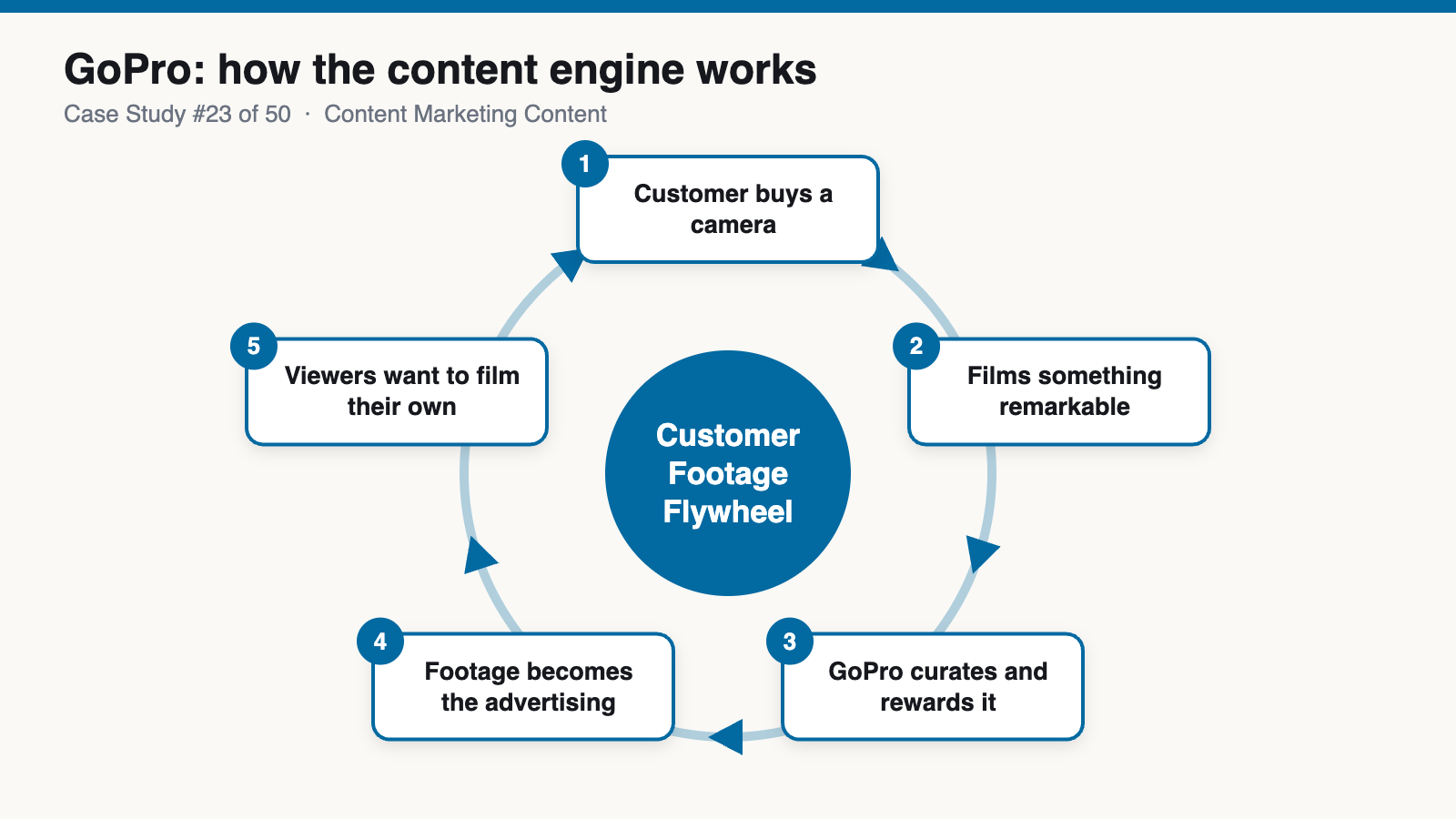
The product’s core attributes were also content attributes. A distinctive wide-angle look made GoPro footage recognizable without a logo. Mounts for helmets, chests, boards, and vehicles produced immersive first-person perspectives. Durability and waterproofing meant the camera survived the moments worth filming. Users did not need to be told to make content. Making content was the product’s purpose.
2. Curation and Polish
GoPro’s in-house team searched for the best customer videos, licensed them, and re-edited them to a consistent standard with music and the company’s end card. The brand’s channels became a showcase where a surfer’s barrel and a firefighter reviving a kitten sat alongside professional athletes’ runs. The firefighter clip, shot on a helmet camera in 2013, drew tens of millions of views and showed that the format reached well beyond extreme sports.
A video of the day or photo of the day feature gave the audience a reason to return and gave creators a goal.
3. Paying for Submissions
In 2015 GoPro formalized the pipeline with an awards program that paid cash for the best photos, raw clips, and edited videos submitted by users, committing millions of dollars a year. It later added an annual challenge in which customers submit footage shot on the newest camera, with the best clips assembled into the launch highlight reel and a million-dollar prize pool divided among those selected.
Payment does three things: it gives GoPro clear rights to the footage, it rewards creators in a way that keeps them shooting on GoPro, and it turns each product launch into a crowdsourced production.
4. Athletes as the Top of the Pyramid
GoPro sponsored surfers, skiers, snowboarders, motorsport riders, and other athletes and equipped them with cameras. Their footage set the aspirational ceiling. The customer submissions showed that ordinary owners could get close to it.
5. Distribution Through the Brand and the Creator
Each video was posted twice: by GoPro on channels with many millions of subscribers, and by the creator to their own friends and followers, usually tagged or titled with the brand. The second kind of distribution was free, trusted, and unlimited. GoPro’s YouTube channel became one of the largest brand channels on the platform.
6. The Conversion Bridge
Every clip implied a sentence: shot on GoPro. A viewer who wanted to capture their own ski trip or dive saw the proof of quality and the proof that someone like them had done it. The path to purchase ran through retailers and GoPro’s site, and the highlight reel accompanying each new model was the main sales tool.
Quantifiable Impact & Business Results
- Growth phase (public filings): GoPro’s revenue rose rapidly through its 2014 public listing and peaked at about $1.6 billion in 2015.
- Audience (company-stated): Its YouTube channel has more than ten million subscribers, and its social following across platforms runs to tens of millions.
- Creator payments (company-stated): The awards program launched with a commitment of several million dollars a year, and the annual challenge distributes a million dollars among selected customers.
- Decline (public filings): Revenue fell after 2015 and was roughly half its peak by 2024. The company has been through several rounds of layoffs, and its share price is a small fraction of its high.
The content flywheel was real and it built a globally recognized brand at low media cost. It did not protect the company from what followed. Both facts belong in any honest account.
First-Principles Breakdown: Why It Worked, and Why It Was Not Enough
The output is the demonstration. For most products, user-generated content is a testimonial: a customer saying the thing is good. GoPro’s is the product’s actual output. A stunning clip is direct evidence of image quality, durability, and perspective. No claim is needed.
Customer motives align with the brand’s. People film their adventures to share them and earn recognition. GoPro offered the largest possible stage. The customer wanted the same thing the marketing department wanted.
Supply scales with sales. Each camera sold increased the pool of potential footage. The content library grew as a by-product of the business.
Authenticity competitors could not stage. A rival camera maker could commission professional shoots, but could not manufacture years of real moments captured by real owners.
Then the limits appeared.
Content is not a product moat. Smartphones acquired excellent stabilized, waterproof cameras. For most people, the device already in their pocket became good enough. Brand affection did not create a reason to buy a second camera.
Infrequent replacement. A GoPro lasts for years. Enthusiasm for the content did not translate into repeat purchases at the rate a hardware business needs.
The media-company thesis did not hold. GoPro invested in an entertainment division to monetize content directly and wound it down within a few years. Audiences enjoyed the clips for free; that did not make GoPro a studio.
The creators could leave. Footage is not tied to a platform GoPro owned. Creators publish on YouTube, Instagram, and TikTok, and can shoot on any camera.
Set beside Red Bull (#21), the contrast is clear. Red Bull’s content supports a consumable bought weekly at high margin. GoPro’s supported a durable good bought once every several years in a category being absorbed by phones.
The Replicable Playbook (For Mid-Sized Teams)
- Ask whether your product’s output is worth looking at. If customers produce something visible with your product (designs, meals, rooms, results, footage), that output is your best advertising. If the output is invisible, this playbook does not apply.
- Build a submission pipeline with clear rights. Create a simple way for customers to send you their best work, with terms that let you reuse it. Review submissions weekly.
- Reward creators with money and a stage. Pay for what you use, credit the creator prominently, and feature a regular “best of” slot. Recognition from the brand is a strong motive on its own, and payment secures goodwill and rights.
- Crowdsource your launch. Give early access to a group of capable customers before a release and build the launch material from what they make.
Risks, Limitations & What Doesn’t Transfer Today
- A brand flywheel cannot outrun category decline. If a general-purpose device absorbs your product’s function, loved content will slow the erosion, not stop it.
- Low purchase frequency caps the return. Awareness and affection are worth less when the customer needs only one unit per decade. Recurring revenue has to come from somewhere; GoPro’s later subscription service was an attempt to supply it.
- Do not mistake an audience for a media business. People watching your content for free does not mean they or advertisers will pay for it.
- Rights and safety. User footage raises questions of music licensing, bystander privacy, and liability for dangerous behavior encouraged by prizes. Clear terms and moderation are essential.
- Platform-native creators have more options now. In 2012 being featured by GoPro was a creator’s best route to an audience. Today creators build their own channels, and brands must offer more to earn their footage.
- Curation takes staff. Finding, licensing, and editing the best submissions is ongoing skilled work, not a free resource.
Related case studies in this series: Red Bull (#21) for owned action-sports media; Notion (#5) and Canva (#3) for user-created assets as distribution; Coca-Cola (#48) for a consumer UGC loop; Peloton (#38) for hardware plus content.
Sources & Further Reading
- GoPro, Inc. annual reports and public filings (2014 onward)
- GoPro Awards and Million Dollar Challenge program pages (gopro.com)
- GoPro YouTube channel
Build Your Own Content Engine: The Tools We Recommend
Google Workspace: editorial calendars in Sheets, drafts and briefs in Docs, shared drives for assets, and professional email on your own domain.
Gusto: payroll, benefits, and contractor payments in one place, so growing a content team does not mean growing your admin work.
Disclosure: these are referral links. We may earn a commission if you sign up, at no extra cost to you.