
Any brand can say it cares about the environment. Patagonia publishes investigative films against dams, tells customers not to buy its jackets, and repairs old gear for free. Its content is believed because the company’s actions make it expensive to fake.
| Series Metadata | Details |
|---|---|
| Pillar | Pillar 3: Brand Media Houses & Documentary Storytelling (Case Study #22 of 50) |
| Primary Channels | Documentary Films, The Cleanest Line Blog, Catalog Essays, Books, Activism Platform, Repair Program |
| Core Growth Lever | Mission-Led Storytelling Backed by Costly, Verifiable Action |
| Best For | Founder-led or mission-driven brands whose operations can withstand scrutiny |
Recommended Tools for Content Teams
Every content engine in this series runs on two unglamorous things: a shared workspace and a team that gets paid on time. Google Workspace covers the docs, sheets, shared drives, and email your editorial process lives in. Gusto handles payroll, benefits, and contractor payments for the writers, editors, and freelancers who produce the work.
Disclosure: these are referral links. We may earn a commission if you sign up, at no extra cost to you.
Executive Hook
On Black Friday 2011, the busiest shopping day of the American year, Patagonia bought a full-page advertisement in The New York Times. It showed one of the company’s best-selling fleece jackets under a headline in capital letters: Don’t Buy This Jacket.
The copy below explained the environmental cost of making that jacket, in water, carbon, and waste, and asked readers to think before buying anything they did not need, including from Patagonia. It asked them to repair what they owned and to buy used.
Sales rose in the period that followed. Critics called the ad a clever paradox, a way of selling by pretending not to. That reading is too simple. The ad worked because Patagonia had spent the previous four decades behaving in ways consistent with it, and has continued to since. The company’s content is best understood as documentation of conduct. That is a much harder thing to copy than a campaign.
THE MECHANISM IN ONE LINE
Patagonia’s content persuades because the company keeps doing things that cost it money. The storytelling is the receipt, not the claim.
The Strategic Context & Bottleneck
- A premium product in a crowded category. Outdoor apparel is technically similar across the leading brands. Patagonia charges at the top of the range.
- A business whose activity harms what its customers love. Making clothing consumes resources and pollutes. Patagonia’s customers are climbers, surfers, anglers, and hikers who care about wild places. That tension could not be advertised away.
- Rising cynicism about green claims. As environmental marketing spread, consumers learned to distrust it. An assertion of virtue became close to worthless.
- A founder reluctant to be in business at all. Yvon Chouinard, who started the company in 1973 after making climbing hardware, has described himself as a reluctant businessman who wanted the company to serve a purpose beyond growth.
The bottleneck was credibility. In a market full of unverifiable environmental claims, Patagonia needed its commitment to be believed. Belief of that kind cannot be bought with media. It has to be earned with evidence.
Anatomy of the Content Engine
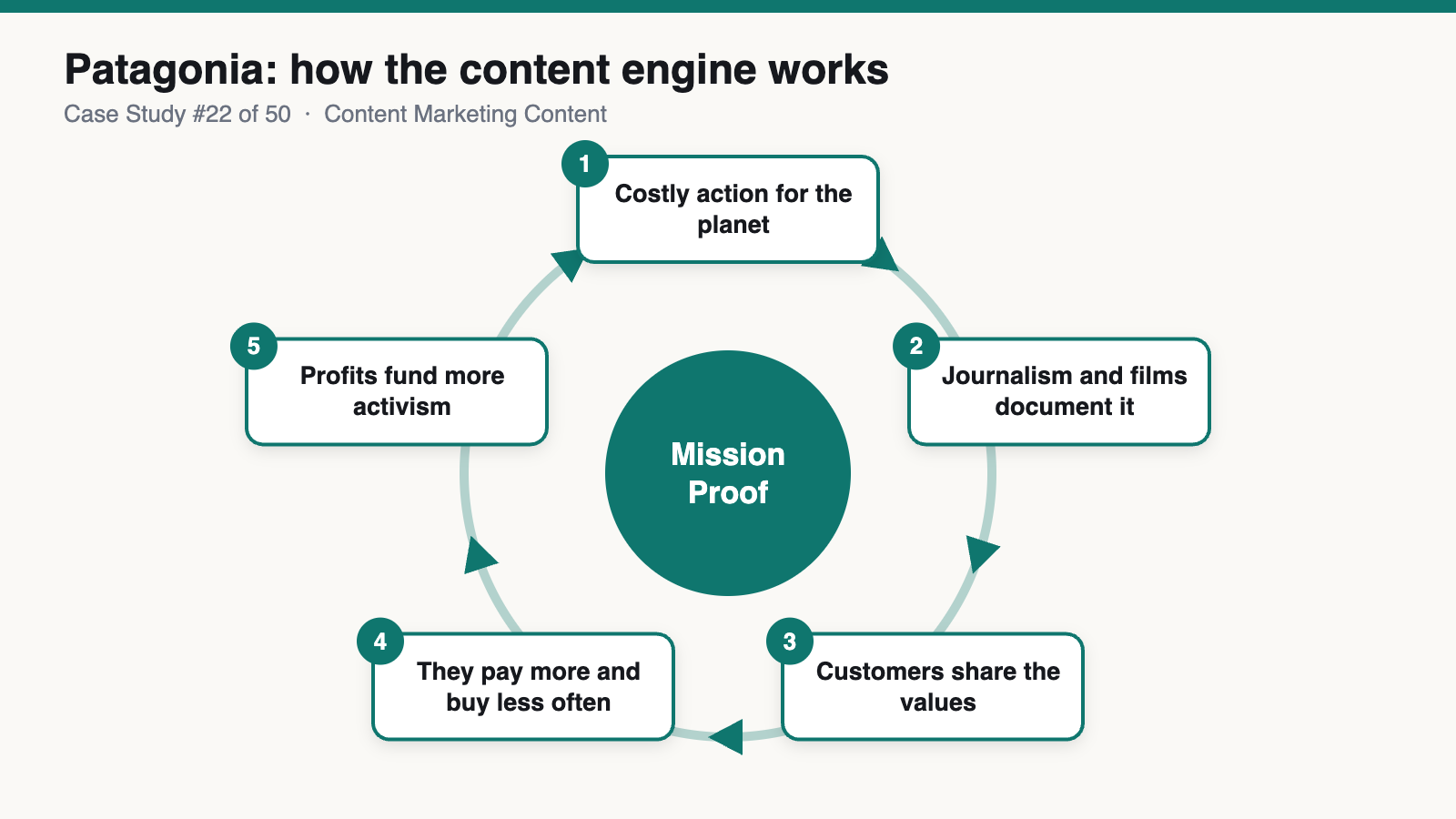
1. Catalogs as Magazines
Long before content marketing had a name, Patagonia’s printed catalogs carried essays by climbers, surfers, and environmental writers alongside the product pages, and used photographs of real people in real places instead of models. As early as the 1970s the company used its catalog to argue that climbers should switch to equipment that did not damage rock, a change that hurt its own core product at the time. The pattern was set: use the company’s media to make an argument about how to behave, even at a cost.
2. The Cleanest Line
The company’s blog, named for a principle of climbing, publishes field reports, environmental reporting, and essays from employees, ambassadors, and outside writers. Its subjects are rivers, public lands, fisheries, activism, and the craft of outdoor sports. Product is incidental.
3. Documentary Films With an Agenda
Patagonia has produced and funded feature documentaries on specific environmental fights: the case for removing obsolete dams, the effect of fish hatcheries and farms on wild salmon, the threat to the last wild rivers in the Balkans, and the defense of public lands in the United States. These are campaigning films. They end with a petition or a call to contact officials. They are screened at festivals and in stores and released free online.
The films are journalism with a point of view. They name opponents, they take sides, and several have been associated with real policy outcomes, including dam removals.
4. Programs That Are Themselves Content
Some of Patagonia’s most effective storytelling is operational. Its repair and resale program takes back used garments, fixes them, and sells them again, and for years a repair truck toured the country mending clothing of any brand for free. The program produces a steady supply of stories about decades-old jackets and the people who wore them. It also makes the Don’t Buy This Jacket message concrete.
Similarly, the company built a platform connecting customers with local environmental groups, turning its audience into volunteers and donors.
5. Corporate Actions as Editorial Events
Patagonia treats major business decisions as public statements. It has pledged one percent of sales to environmental groups since the 1980s. It gave away the entirety of one Black Friday’s sales. It sued the federal government over the reduction of national monuments and changed its homepage to a stark accusation. In 2022 Chouinard and his family transferred ownership of the company to a trust and a nonprofit so that profits not reinvested would fund environmental work, announcing it with the line that Earth is now the company’s only shareholder.
Each of these generated enormous news coverage without a media budget. More importantly, each is expensive, public, and hard to reverse.
6. The Conversion Bridge
The content does not sell. It builds a conviction among a specific kind of customer that buying from Patagonia is consistent with their values, and that the higher price pays for durability and for the company’s conduct. That customer buys less often, keeps products longer, and is extremely loyal. The repair program brings them back into stores and onto the site between purchases.
Quantifiable Impact & Business Results
Patagonia is privately held and discloses little.
- Revenue (press-reported): Annual sales have been widely reported at around a billion dollars or more in recent years.
- Giving (company-stated): One percent of sales to environmental groups since 1985, and a reported $10 million from a single Black Friday in 2016, several times what the company had expected.
- After the 2011 ad (press-reported): Sales grew strongly the following year. Estimates of the increase vary by source and should be treated as reported, not audited.
- Ownership change (company-stated): In 2022 all voting stock was placed in a purpose trust and all non-voting stock in a nonprofit collective.
- Film reach: Individual documentaries have drawn millions of online views and festival awards; Patagonia does not publish consolidated figures.
There is no public attribution of sales to content. The business result that can be stated with confidence is that Patagonia has sustained premium pricing and high loyalty for fifty years in a category where both are rare.
First-Principles Breakdown: Why Competitors Couldn’t Easily Copy It
The claims are backed by costly actions. Giving away revenue, suing the government, discouraging purchases, and surrendering ownership are things a company would not do merely for publicity, because they cost too much. That cost is what makes the message believable. A competitor can copy the films but not the sacrifices behind them without becoming a different company.
Ownership permitted it. For five decades Patagonia was controlled by one family with no outside investors to object. Decisions that reduced short-term profit could be made on principle.
Consistency over half a century. The stance in 2022 is recognizably the stance of the 1970s catalogs. A brand that discovers its values in a recent campaign is measured against that record and found wanting.
Operations had to match. Patagonia changed how it makes things: organic cotton, recycled materials, supply-chain audits, repairable design. Content that outruns operations is greenwashing, and environmental journalists check.
Taking sides creates loyalty. By accepting that some people would be alienated, Patagonia won deep allegiance from others. Brands trying to offend no one cannot generate the same attachment.
Red Bull (#21) owns the events it covers. Patagonia owns a cause. Both are media operations inside product companies, and both depend on private control and long horizons. REI (#49) later made a similar move with a single symbolic act.
The Replicable Playbook (For Mid-Sized Teams)
- Start with the action, not the story. Identify one thing your company could do that costs you something and serves a purpose your customers care about. Do it first. If there is nothing, you do not have a mission-led content strategy yet.
- Document it as a journalist would. Report on the problem, the people affected, what you did, and what did not work. Include the trade-offs and the failures. Candor is the differentiator.
- Turn an operation into a recurring story. A repair service, a take-back scheme, a grant program, or an apprenticeship produces fresh human stories indefinitely. Build the capture of those stories into the program.
- Pick one issue and stay on it for years. Depth on a single cause, tied closely to your product, builds more standing than statements on many.
Risks, Limitations & What Doesn’t Transfer Today
- Hypocrisy is fatal. A company that campaigns on values invites investigation of its own conduct. Patagonia has faced critical reporting on labor conditions in its supply chain and on materials such as synthetic microfibers. It has generally responded by publishing the problem itself. Few companies are prepared for that level of exposure.
- Polarization is a real cost. Taking political positions loses some customers and can make the brand a target. That is acceptable only if the core audience is large and committed enough.
- Impossible under most ownership. Public companies and venture-backed startups answer to investors who will not approve giving away revenue. Much of this playbook is unavailable to them.
- The growth paradox remains. Patagonia sells more products each year while urging restraint. The company acknowledges the contradiction. Critics do not consider acknowledgment a resolution.
- Purpose fatigue. Consumers have grown skeptical of brand activism after a decade of shallow imitations. The bar for being believed is higher now.
- Does not create a product advantage. Mission attracts customers to a product that already performs. It will not rescue a weak one.
Related case studies in this series: REI (#49) for a values-driven symbolic act; Red Bull (#21) and YETI (#26) for brand film; Dove (#29) for purpose marketing at a conglomerate; Stripe Press (#16) for publishing as an expression of values.
Sources & Further Reading
- The Cleanest Line (Patagonia)
- Yvon Chouinard, Let My People Go Surfing: The Education of a Reluctant Businessman (Penguin, revised edition 2016)
- Patagonia, “Don’t Buy This Jacket” advertisement, The New York Times, November 25, 2011
- Yvon Chouinard, “Earth is now our only shareholder” (Patagonia, September 2022)
Build Your Own Content Engine: The Tools We Recommend
Google Workspace: editorial calendars in Sheets, drafts and briefs in Docs, shared drives for assets, and professional email on your own domain.
Gusto: payroll, benefits, and contractor payments in one place, so growing a content team does not mean growing your admin work.
Disclosure: these are referral links. We may earn a commission if you sign up, at no extra cost to you.