
A consulting engagement cannot be inspected before purchase and is hard to evaluate after. McKinsey solved that problem six decades ago by publishing its thinking at a standard closer to an academic journal than a brochure, and letting the ideas reach the boardroom before its partners did.
| Series Metadata | Details |
|---|---|
| Pillar | Pillar 2: Original Data, Research & Interactive Experiences (Case Study #15 of 50) |
| Primary Channels | McKinsey Quarterly, McKinsey Global Institute Reports, Insights Hub, Books, Partner Bylines |
| Core Growth Lever | Research-Grade Publishing That Sets the Executive Agenda and Signals Competence |
| Best For | Professional services, advisory firms, and any high-trust, high-ticket B2B offer |
Recommended Tools for Content Teams
Every content engine in this series runs on two unglamorous things: a shared workspace and a team that gets paid on time. Google Workspace covers the docs, sheets, shared drives, and email your editorial process lives in. Gusto handles payroll, benefits, and contractor payments for the writers, editors, and freelancers who produce the work.
Disclosure: these are referral links. We may earn a commission if you sign up, at no extra cost to you.
Executive Hook
For most of its history McKinsey & Company did not advertise. The firm held that a profession should not solicit, in the manner of law and medicine, and that its reputation should bring clients to it. That left an obvious question: how does a firm that will not promote itself become the default choice of chief executives around the world?
Part of the answer is a publication. In 1964 the firm launched the McKinsey Quarterly, a journal of management thinking written largely by its own consultants. In 1990 it added the McKinsey Global Institute, an internal think tank that produces long-horizon economic research and is funded by the partnership, not commissioned by clients.
Neither sells anything directly. Both exist to put McKinsey’s analysis of a problem in front of a senior executive months or years before that executive decides to seek help with it. By the time the call is made, the terms of the discussion have often been set by something McKinsey published.
THE MECHANISM IN ONE LINE
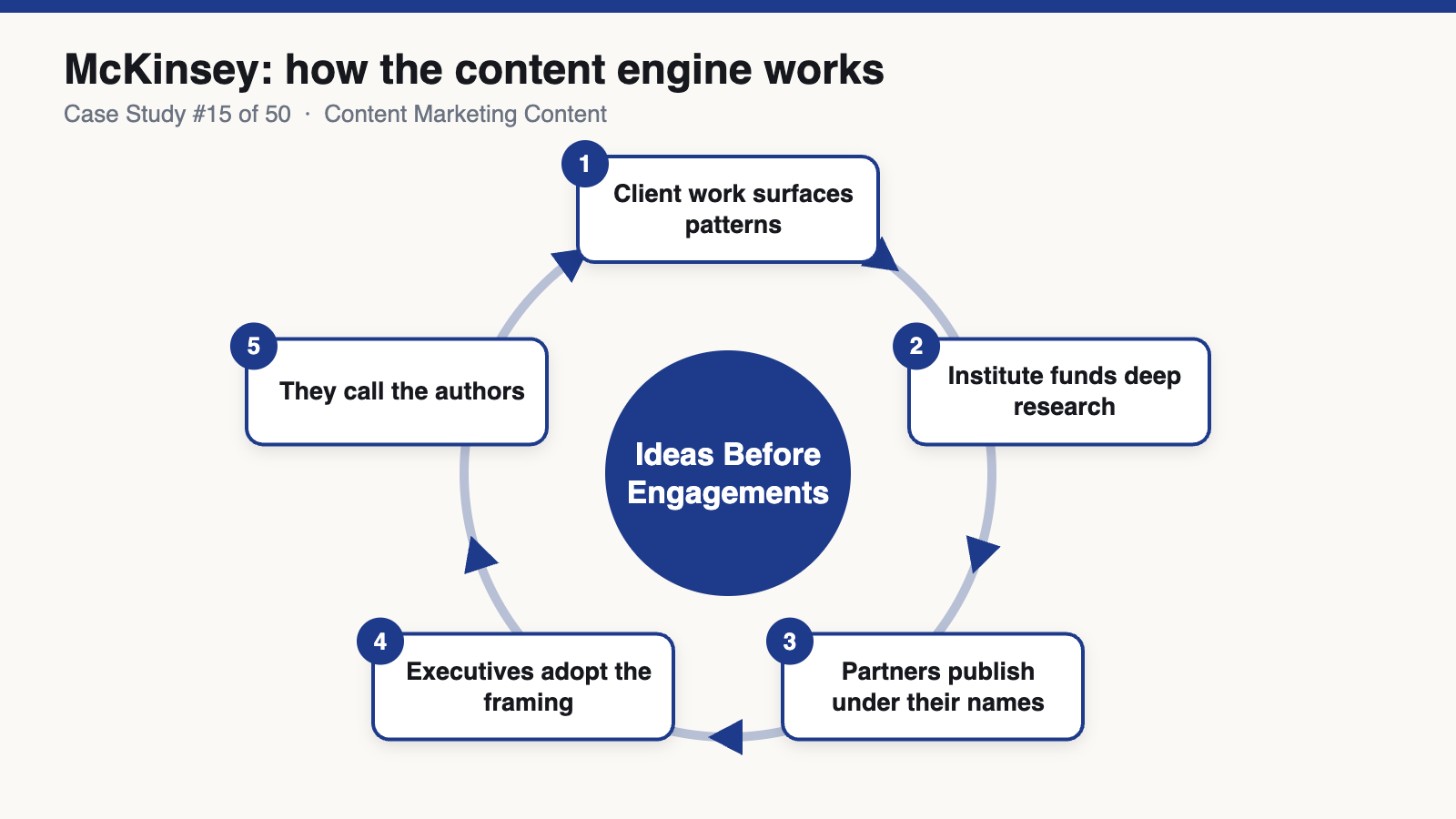
McKinsey gives away the diagnosis so that the executive arrives already using its vocabulary, already convinced the problem is real, and already knowing whose name is on the report.
The Strategic Context & Bottleneck
- A credence good. Advice is a service whose quality the buyer cannot easily judge, even afterward. Results depend on execution, markets, and luck. Buyers therefore rely on signals of competence.
- Career risk for the buyer. An executive who hires an adviser and sees the project fail must justify the choice. The safest decision is the one no board will question.
- Self-imposed limits on promotion. A culture averse to advertising and bound by client confidentiality cannot run case studies naming clients or publish results in the usual way.
- A product that is the people. What the firm sells is the judgment of its partners. That judgment has to be visible somehow before it is bought.
The bottleneck was demonstrating intellectual quality to a small, senior, skeptical audience without advertising and without revealing client work. Publishing ideas, detached from any specific engagement, satisfied every constraint.
Anatomy of the Content Engine
1. A Journal, Not a Newsletter
The Quarterly adopted the conventions of a serious periodical: long articles, named authors, charts, an editorial board, and professional editors, many with backgrounds in business journalism. The firm built an internal publishing function to hold partners’ drafts to a consistent standard of argument and prose. The format itself communicates rigor before a word is read.
2. A Think Tank With Its Own Agenda
The McKinsey Global Institute studies subjects such as productivity, urbanization, automation, and capital flows, often over a year or more, and publishes reports running to a hundred pages or longer. Because the research is funded by the firm and not by any client, it can be presented as independent. Its estimates, for example of the share of work activities that could be automated or the economic value at stake in a technology, are quoted widely by journalists, governments, and other consultancies.
Large, specific numbers are a deliberate feature. A headline figure for the size of an opportunity is easy to cite, gives executives a reason to act, and travels with the firm’s name attached.
3. Frameworks That Become Common Language
McKinsey’s most durable content takes the form of named models: the 7-S framework for organizational alignment, the three horizons of growth, and the phrase “war for talent,” which originated in the firm’s research in the late 1990s. Two consultants’ 7-S work led to In Search of Excellence in 1982, one of the best-selling business books ever published.
A framework is content that lodges in the buyer’s working vocabulary. Once a management team is discussing its portfolio in terms of three horizons, it is already thinking inside McKinsey’s structure.
4. Proprietary Evidence
The publishing draws on things only the firm has: patterns observed across many engagements, anonymized and aggregated; a long-running global survey panel of executives; and benchmarking databases built from client work. This gives the articles a factual basis that outside commentators cannot match, while preserving confidentiality.
5. Partners as Authors
Articles carry the names of the partners who lead the relevant practice. Publication is tied to professional standing inside the firm. The byline converts institutional research into a personal credential, and gives the reader a specific person to contact.
6. Distribution to a Small, Important Audience
The firm distributes through its insights website, email newsletters segmented by industry and function, a mobile app, podcasts, and conference appearances. Reports are sent directly to executives and summarized by the business press. A vast alumni network, many of whom now sit in senior corporate roles, receives and circulates the material.
7. The Conversion Bridge
There is no “request a demo.” The bridge is a relationship: an executive reads an analysis of a problem they recognize, forwards it to their team, and at some point asks the authoring partner to come in and discuss it. The article has done the work of the first meeting. It has also armed the internal champion with a document to justify the conversation.
Quantifiable Impact & Business Results
McKinsey is a private partnership and discloses very little.
- Longevity: The Quarterly has been published continuously since 1964, and the Global Institute since 1990.
- Firm scale (press-reported): Annual revenue has been reported in the business press at roughly $16 billion in recent years.
- Citation: MGI estimates are routinely quoted in major newspapers, government documents, and other firms’ reports. No reliable total exists and none is offered here.
- Cultural footprint: Several of the firm’s frameworks are standard material in business schools, and In Search of Excellence sold millions of copies.
The firm does not publish, and likely could not precisely measure, the revenue its publishing generates. The evidence for effectiveness is the scale and persistence of the investment by a partnership that scrutinizes how partner time is spent, and the fact that every major competitor has built a similar research arm.
First-Principles Breakdown: Why Competitors Couldn’t Easily Copy It
The raw material is client access. The insight in the articles comes from having worked inside a large share of the world’s biggest companies. A firm without that access can write about management, but not from the same evidence.
It spends the scarcest resource. Serious publishing consumes partner hours, which are the firm’s inventory. Committing them to unbilled research is an expensive signal that only a highly profitable firm can sustain, and the expense is itself part of what makes the signal credible.
Patience measured in decades. A research institute that takes a year to publish a report, on a topic that may produce client work several years later, requires an ownership structure that tolerates long payback. A partnership with no outside shareholders has that tolerance.
Authority compounds. Sixty years of publication means that when the firm issues a number, it is treated as a reference point. A newcomer producing an equally good report does not receive the same deference.
The buyer needs cover. For an executive, citing McKinsey research in support of a decision reduces personal risk. The content serves the reader’s political needs inside their own organization, which is a motive to read and share that has nothing to do with the firm.
Competitors have copied the form. BCG, Bain, Deloitte, and others run institutes and journals of their own. What they illustrate is that in advisory work this kind of publishing has become the cost of entry, not that it is easy.
The Replicable Playbook (For Mid-Sized Teams)
- Publish the diagnosis, sell the treatment. Write up, in full, how to recognize and size the problem you solve. Do not hold back the analysis out of fear of giving away the work. Clients pay for application to their situation.
- Aggregate what you see across clients. Turn anonymized patterns from your engagements into benchmarks: typical ranges, common failure points, what the best performers do. Even a small firm has data across clients that no single client can see.
- Name your framework. If you have a repeatable way of structuring a problem, give it a clear name and a simple diagram, and use it consistently in every article and presentation.
- Put senior names on it and hold an editorial standard. The author should be the person the reader would hire. Have a capable editor review every piece for clarity and evidence. Publish four strong pieces a year instead of forty thin ones.
Risks, Limitations & What Doesn’t Transfer Today
- Thought leadership has been devalued by volume. Every consultancy, agency, and software vendor now publishes “insights.” Much of it is generic. Only work with real evidence and a distinct argument is read by senior people.
- Requires something to say. A firm without proprietary experience or data will produce opinion. Opinion from an unknown firm carries little weight.
- Big numbers invite scrutiny. Headline estimates of market size or jobs affected are widely quoted and also widely criticized as speculative. Forecasts that prove wrong are remembered.
- Reputation is indivisible. Intellectual authority does not insulate a firm from the consequences of its client work. McKinsey has faced serious public criticism and legal settlements over certain engagements. Published rigor and actual conduct are judged together.
- Long payback. The return on research may arrive years later and cannot be tied to a specific report. Firms that need new business this quarter cannot rely on it.
- AI-generated synthesis is abundant. Summaries of existing knowledge are now free. The value has shifted decisively to original data and first-hand experience.
Related case studies in this series: Intercom (#10) for opinion publishing with editorial standards; Stripe Press (#16) for prestige publishing; LinkedIn (#14) for research built on platform data; SEMrush (#20) for annual industry studies.
Sources & Further Reading
- McKinsey Quarterly
- McKinsey Global Institute
- Thomas J. Peters and Robert H. Waterman Jr., In Search of Excellence (Harper & Row, 1982)
- Duff McDonald, The Firm: The Story of McKinsey and Its Secret Influence on American Business (Simon & Schuster, 2013)
Build Your Own Content Engine: The Tools We Recommend
Google Workspace: editorial calendars in Sheets, drafts and briefs in Docs, shared drives for assets, and professional email on your own domain.
Gusto: payroll, benefits, and contractor payments in one place, so growing a content team does not mean growing your admin work.
Disclosure: these are referral links. We may earn a commission if you sign up, at no extra cost to you.