
Webflow is hard to learn, and the company decided not to hide it. It built a free film-school-quality curriculum that teaches web design itself, staffed it with on-screen personalities, and produced a generation of professionals whose skills are native to its product.
| Series Metadata | Details |
|---|---|
| Pillar | Pillar 1: Product-Led & SEO Content Engines (Case Study #9 of 50) |
| Primary Channels | Webflow University (Video Courses & Lessons), YouTube, Certifications, Community Showcase |
| Core Growth Lever | High-Production Skill Education That Creates Professional Practitioners |
| Best For | Powerful products with real learning curves; tools sold through freelancers and agencies |
Recommended Tools for Content Teams
Every content engine in this series runs on two unglamorous things: a shared workspace and a team that gets paid on time. Google Workspace covers the docs, sheets, shared drives, and email your editorial process lives in. Gusto handles payroll, benefits, and contractor payments for the writers, editors, and freelancers who produce the work.
Disclosure: these are referral links. We may earn a commission if you sign up, at no extra cost to you.
Executive Hook
Every no-code website builder of the 2010s made the same promise: anyone can build a site in minutes. Wix and Squarespace delivered on it by hiding how the web works. Webflow, founded in 2013 by Vlad Magdalin, Sergie Magdalin, and Bryant Chou, went the other way. Its designer exposes the real building blocks of the web (the box model, flexbox, grid, classes, breakpoints) through a visual interface. It gives a designer the power of front-end code without writing it, and it asks them to understand what that code does.
That is a harder sell. A newcomer opening Webflow for the first time meets a dense panel of layout controls and no obvious first move. The product’s greatest strength, professional-grade control, is also the reason people give up in the first hour.
Webflow could have simplified the product or buried the complexity behind templates. Instead it chose to make the learning itself worth showing up for. Webflow University is a free library of courses and lessons with production values closer to a television show than a help center, hosted by recurring presenters with a dry sense of humor. It teaches people how websites work, and in doing so makes them fluent in Webflow.
THE MECHANISM IN ONE LINE
Webflow could not remove its learning curve without removing its advantage, so it made the learning good enough to be the marketing.
The Strategic Context & Bottleneck
- A learning curve that could not be designed away. Removing the complexity would have removed the differentiation. The product’s value depends on the user understanding layout and structure.
- A professional buyer who brings many customers. Webflow’s core users are freelance designers and agencies. One proficient freelancer builds and hosts sites for dozens of clients. Each trained professional is a channel, not a single account.
- Competition on two fronts. Simpler builders owned the beginner. WordPress, with its vast ecosystem of developers, themes, and tutorials, owned the professional. Webflow needed its own base of skilled practitioners to be a credible alternative.
- A category with no existing talent pool. In the early years there were no “Webflow developers” to hire and no courses to send employees to. Agencies will not adopt a platform nobody knows how to use.
The bottleneck was the supply of people competent in the product. Until that supply existed, growth was capped at the number of users willing to struggle through alone.
Anatomy of the Content Engine
1. Courses That Teach the Discipline
Webflow University is organized as a curriculum. Alongside product-specific lessons, it offers courses on the fundamentals: how HTML and CSS structure a page, layout systems, typography, responsive design, and accessibility. There are structured paths such as a comprehensive web design course and a multi-week portfolio course, plus material for freelancers on scoping projects and working with clients.
One reviewer who watched all 40 of the core tutorials in a day wrote that most of what he learned concerned the fundamentals of design more than Webflow specifically. That is the point. A learner who comes to understand flexbox through Webflow’s interface now thinks about flexbox in Webflow’s terms.
2. Production Quality as Strategy
The videos are scripted, tightly edited, professionally lit, and short. Lessons are shot on a consistent set that resembles a cozy library corner. Compared with the typical software tutorial (a screen recording with an unscripted voiceover) the gap is obvious within seconds.
The investment does specific work. Tight scripting respects the learner’s time, which keeps completion rates up. Visual polish signals that the company cares about craft, which matters when the audience is designers. And quality is a filter competitors cannot cheaply match: a rival can copy a topic list overnight, but not a studio, a writing team, and an editing standard.
3. Personality and Running Jokes
Webflow’s tutorials are funny. The presenters, including longtime education lead McGuire Brannon and a rotating cast of colleagues, deliver technical instruction with deadpan asides, absurd placeholder content, and recurring gags. A tutorial-video company that analyzed the series identified character as one of its defining features, noting that viewers came to know the presenters by name.
Humor converts a reference library into something people watch voluntarily and recommend. It also gives the brand a voice. For many users, the presenters are Webflow.
4. Lessons Mapped to Search and to the Product
Each lesson is a discrete, titled unit answering a specific question, such as how to build a sticky navigation bar or add customer testimonials to a page. That granularity serves three purposes: individual lessons rank in search and on YouTube for the exact task, they can be linked from inside the product at the moment a user needs them, and they double as documentation.
5. Credentials and a Professional Ladder
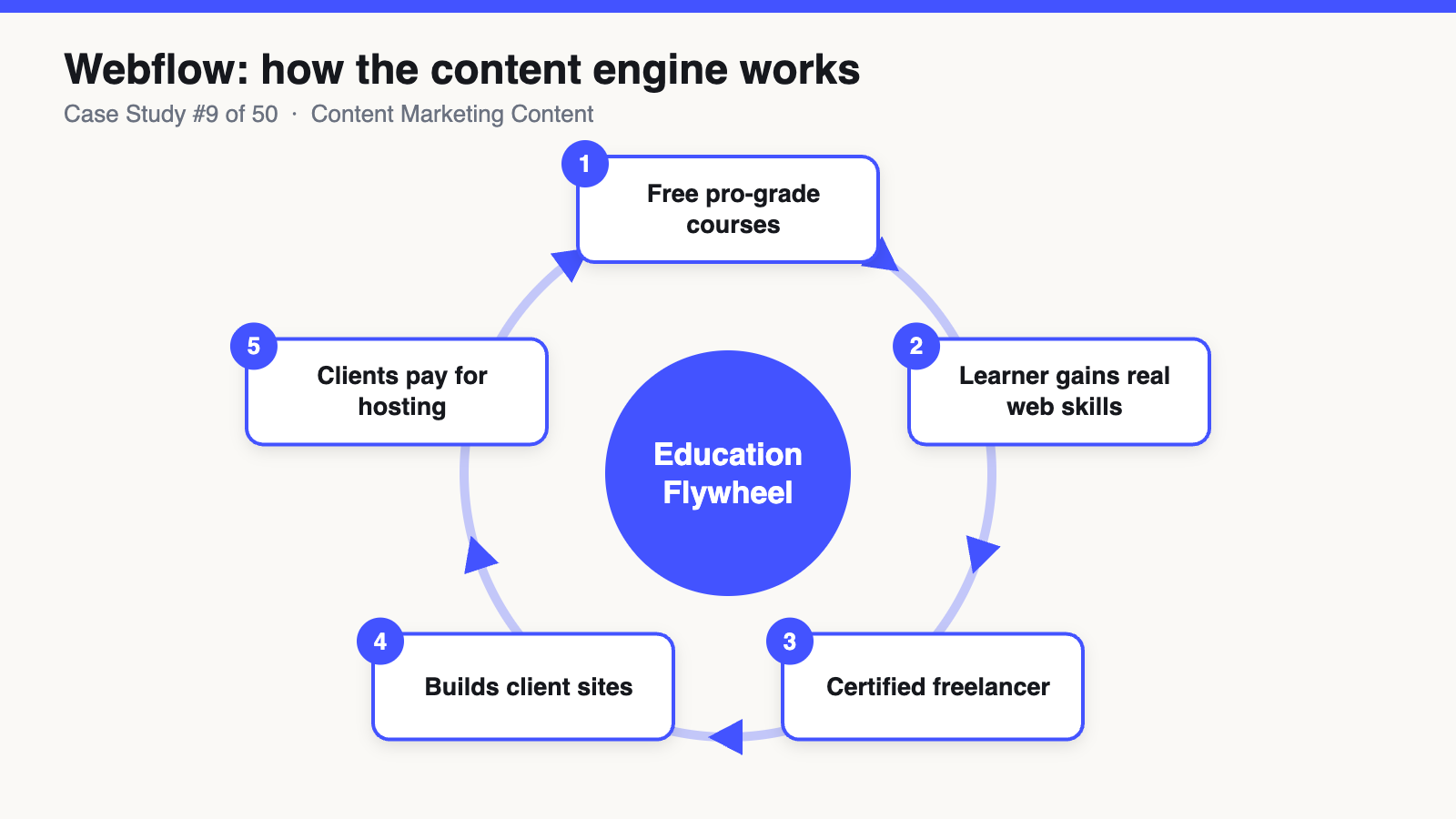
Webflow added certifications that designers can display, and a directory of vetted experts and agencies that sends client work to proficient practitioners. Education feeds certification, certification feeds the directory, and the directory produces income, which is the strongest reason to keep learning.
6. Showcase and Cloneables
The community showcase, known as Made in Webflow, displays real sites built on the platform, many of which can be cloned into a user’s own account and taken apart. This is the practical counterpart to the courses: learners study finished work and reverse-engineer it. The mechanism resembles the template loop described in Notion (#5).
7. The Conversion Bridge
Webflow is free to learn and build on; payment begins when a site is published on a custom domain or a team needs advanced features. A learner can complete a course, build a full portfolio site, and pay nothing until it goes live. The paid conversion often happens not with the learner but with the learner’s client, who pays for hosting on a site the freelancer built.
Quantifiable Impact & Business Results
Webflow is private and has published little about the performance of its education content.
- Company scale (company-stated and reported): Webflow raised a $120 million Series C in March 2022 at a reported $4 billion valuation, following a $140 million round at $2.1 billion in early 2021. Around the time of the 2022 round the company said it served more than 3.5 million designers and teams.
- Education leadership: The company created a vice-president-level role for education, an indication of how central the function is.
- Third-party assessments: Independent marketing analyses routinely cite Webflow University as a primary driver of the company’s growth, alongside its free plan and partner ecosystem. These are qualitative judgments, not measured attribution.
Figures for course enrollments, completion rates, or the share of paying customers who used the University have not been disclosed. The strongest evidence for impact is indirect: the existence of a large labor market of Webflow freelancers and agencies that did not exist a decade ago, and the company’s sustained and growing investment in the function.
First-Principles Breakdown: Why Competitors Couldn’t Easily Copy It
Simpler competitors have nothing to teach. A builder whose pitch is that no learning is required cannot build a university without contradicting itself. Webflow’s complexity gave it a curriculum; its rivals’ simplicity denied them one.
Skills learned in Webflow’s vocabulary are sticky. A designer who has invested weeks mastering the designer panel, the class system, and the CMS has acquired professional capital that only pays off on the platform. Switching means retraining. The more complete the education, the higher that cost.
Professionals multiply. Because the learner is frequently a freelancer or agency employee, each graduate brings multiple paying sites. The return on educating one person is several customers, which justifies a per-learner investment that would be irrational for a consumer product.
Craft is a hiring problem, not a spending problem. The quality of the videos reflects a team of writers, presenters, and editors with a specific sensibility, kept together for years. A competitor can allocate budget in a quarter. Assembling that team and voice takes far longer.
Authority on the subject, not just the product. By teaching web design fundamentals well, Webflow earned standing with design educators, bootcamps, and students. People are introduced to the product in the course of learning the craft, before they have compared any alternatives.
The parallel with HubSpot (#1) is close. HubSpot Academy trained marketers who then carried the software into their employers. Webflow University trains designers who carry it into their clients. Both built a talent pool that became a distribution channel. Webflow’s distinctive contribution is the proof that the quality and personality of the teaching can be a brand asset in its own right.
The Replicable Playbook (For Mid-Sized Teams)
- Teach the underlying skill, not just the clicks. Identify the professional discipline your product belongs to and create a short course on its fundamentals, demonstrated in your product. Learners should finish better at their job, with your tool as the natural place to apply it.
- Set a quality bar and cap the length. Script every video. Keep lessons under five minutes and focused on one task. Use decent audio, consistent framing, and a real edit. Ten excellent lessons outperform a hundred screen recordings.
- Put the same people on screen every time and let them be themselves. Choose one or two presenters with real product knowledge and a natural manner. Consistency builds familiarity; a point of view makes the material memorable. Do not force jokes, but do not sand off personality either.
- Close the loop with a credential and a referral path. Offer a simple certification for completing the core curriculum, and build a public directory of certified practitioners that prospects can hire from. Give learners an economic reason to finish.
Risks, Limitations & What Doesn’t Transfer Today
- Education does not fix a product that should be simpler. If your learning curve comes from poor design and not from real underlying power, a university is an expensive apology. Be honest about which kind of complexity you have.
- High fixed cost and constant upkeep. Polished video is expensive to make and more expensive to maintain. Every interface change dates the library. Webflow has had to reshoot and restructure its content repeatedly.
- Works best with a professional intermediary. The economics depend on each learner bringing multiple customers. For a product bought and used by a single end user, the return per learner is much lower.
- AI-assisted building changes what needs teaching. As tools generate layouts and components from a prompt, some hands-on skills become less necessary. The durable value shifts toward judgment, structure, and review, and curricula have to follow.
- Personality is a dependency. When a brand is strongly associated with particular presenters, their departure is felt by the audience. A bench of on-screen talent reduces the exposure.
- Humor has a narrow tolerance. What reads as charming to designers may read as unserious to enterprise buyers. As Webflow has moved upmarket, it has had to balance the voice that won freelancers with the expectations of larger customers.
Related case studies in this series: HubSpot (#1) for certification as distribution; Notion (#5) for community showcases and cloning; Ahrefs (#2) for product-led tutorials; Figma (#36) for design-community building.
Sources & Further Reading
- Webflow: the greatest tutorials on earth (Tella)
- What I learned watching all of Webflow’s video tutorials (Outseta)
- Teardown: Webflow content marketing strategy examples (StoryChief)
- Webflow marketing strategy (Lilach Bullock)
- Webflow University
Build Your Own Content Engine: The Tools We Recommend
Google Workspace: editorial calendars in Sheets, drafts and briefs in Docs, shared drives for assets, and professional email on your own domain.
Gusto: payroll, benefits, and contractor payments in one place, so growing a content team does not mean growing your admin work.
Disclosure: these are referral links. We may earn a commission if you sign up, at no extra cost to you.